How to Choose and Layer a Greek Cross Necklace Perfectly
Learn how to choose, layer, and style a Greek cross necklace. Step-by-step guide on lengths, metals, and neckline pairings for timeless elegance.


The Geometry of Faith and Fashion: Understanding the Greek Cross
Unlike the more common Latin cross, which features a longer descending arm, the Greek cross is defined by its perfect symmetry—all four arms are of equal length. Also known as the crux quadrata, this geometric design has roots in early Byzantine architecture and remains a powerful, balanced symbol in modern jewelry. Because of its symmetrical weight distribution, a Greek cross necklace sits differently on the chest than a traditional pendant, requiring specific considerations for chain weight, bail placement, and layering mechanics.
According to Britannica's guide to religious symbols, the equal-armed cross predates many modern denominational associations, making it a universally appreciated emblem of balance and antiquity. Whether you are styling a vintage 19th-century piece or a modern minimalist interpretation, mastering the styling of this unique silhouette requires a step-by-step approach.
Step 1: Selecting the Right Metal and Material Grade
The wide surface area of a Greek cross pendant catches the light differently than elongated pendants. The metal you choose will dictate not only the aesthetic but the longevity and maintenance requirements of the piece.
- 14k Gold (58.5% Pure): With a Vickers hardness of approximately 135 HV, 14k gold is the optimal choice for daily wear. It resists scratching and bending, which is crucial for the protruding arms of a Greek cross that might catch on clothing.
- 18k Gold (75% Pure): Softer (around 125 HV) but boasting a richer, deeper yellow hue. Best for occasional wear or pieces that sit securely under a layering stack where friction is minimized.
- 925 Sterling Silver: An alloy of 92.5% silver and 7.5% copper. Because the wide face of a Greek cross shows oxidation quickly, ensure your silver piece is plated with a protective rhodium layer of at least 0.75 to 1.0 microns to prevent tarnish.
- Platinum (95% Pure): Extremely dense and heavy. A solid platinum Greek cross will require a heavier, thicker chain (like a 2.5mm rope chain) to support the pendant's weight without the bail wearing through the chain links.
For a comprehensive breakdown of alloy compositions and durability, the Gemological Institute of America (GIA) provides essential metallurgical data that informs high-end jewelry purchasing.
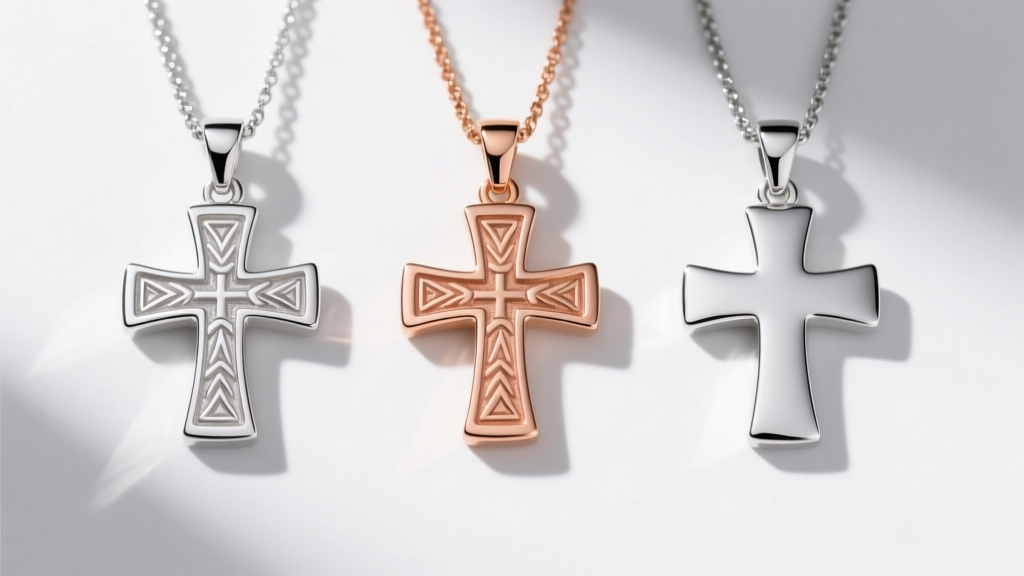
Step 2: Determining the Ideal Chain Length and Pendant Scale
The symmetry of the Greek cross means it acts as a visual anchor. If the pendant is too small for the chain, it gets lost; if it is too large, it overwhelms the neckline. Use the following matrix to match your chain length to the cross's width (measured horizontally from arm to arm).
| Chain Length | Cross Scale (Width) | Ideal Neckline | Visual Effect |
|---|---|---|---|
| 16 Inches (Choker) | 10mm - 14mm | Scoop, Sweetheart | Delicate, sits precisely on the collarbone hollow. |
| 18 Inches (Princess) | 15mm - 22mm | Crew, V-Neck | Classic placement, rests just below the clavicle. |
| 20-24 Inches (Matinee) | 25mm - 35mm | High-neck, Sweaters | Bold, bohemian, or streetwear-inspired statement. |
Step 3: The Art of Layering Your Greek Cross Necklace
Layering a symmetrical pendant requires strict adherence to spacing rules to avoid a cluttered look. The Greek cross demands negative space around its four arms to maintain its geometric integrity.
The 2-Inch Spacing Rule
When building a stack, never place another pendant within 2 inches of the Greek cross. If your Greek cross is on an 18-inch chain, your secondary chains should be exactly 16 inches and 20 inches. This creates a cascading effect that frames the cross rather than competing with it.
Weight Distribution and Chain Types
A common mistake in layering is using chains of identical thickness, which causes tangling. Instead, vary the chain profiles:
- The Anchor (18"): Your Greek cross should hang from a sturdy 1.5mm to 2.0mm box or wheat chain. These chains have high tensile strength and can support a 5-10 gram pendant without stretching.
- The Framer (16"): Use a delicate 1.0mm cable or snake chain with a small, non-distracting element like a 3mm bezel-set diamond or a simple gold bead.
- The Base (20"): Opt for a 3.0mm paperclip or rolo chain. The open links provide a textural contrast to the solid metal of the Greek cross.
Pro-Tip: To prevent the chains from twisting together throughout the day, invest in a 3-strand necklace spacer clasp. This small magnetic or lobster-clasp mechanism binds the chains together at the nape of the neck, ensuring the 2-inch spacing remains perfectly intact at the front.

Step 4: Matching the Cross to Your Neckline
Because the Greek cross is horizontally wider than a Latin cross, it interacts with shirt collars and necklines differently. Here is how to navigate common wardrobe staples:
- The V-Neck: The natural geometry of a V-neck mirrors the angles of the cross. An 18-inch chain with a 20mm cross is the ultimate pairing, allowing the bottom arm of the cross to point down the V-line, elongating the torso.
- The Button-Down Shirt: Wear the cross at 20 inches over the fabric for a relaxed, academic aesthetic, or at 16 inches with the top two buttons undone so the cross rests directly on the skin, framed by the open collar.
- The Crew Neck: Avoid thick, heavy crosses here, as they will sit awkwardly on the fabric rim. Choose a minimalist, flat-profile Greek cross (under 2mm thick) on a 16-inch chain to sit just above the collar line.
Step 5: Care, Maintenance, and Bail Inspection
The structural weak point of any pendant is the bail—the loop that connects the cross to the chain. Because the Greek cross has equal arms, it tends to swing and rotate more freely than bottom-heavy pendants, causing friction at the bail hole.
Routine Maintenance Checklist
- Monthly Bail Check: Inspect the hole where the chain passes through. If the metal is thinning, take it to a jeweler to have a hardening agent applied or the bail replaced.
- Cleaning: For solid gold or platinum crosses without porous gemstone inlays (like lapis lazuli or turquoise), an ultrasonic cleaner is safe and will remove sebum from the crevices where the arms meet the center.
- Polishing: Use a treated jeweler's rouge cloth. Wipe in a circular motion across the face of the cross, but use a soft-bristled toothbrush to clean the sharp inner corners of the four arms where polish cloths cannot reach.
By understanding the unique geometry, metallurgy, and spatial requirements of the Greek cross, you can transform this ancient symbol into a cornerstone of your modern jewelry wardrobe. Whether worn as a solitary talisman or the centerpiece of a meticulously layered stack, the equal-armed cross offers a timeless balance that few other pendants can achieve.