Sunburst Necklace Anatomy: Expert Guide to Metals & Settings
Discover the technical anatomy of a sunburst necklace. Expert insights on ray proportions, metal alloys, gemstone settings, and structural integrity.

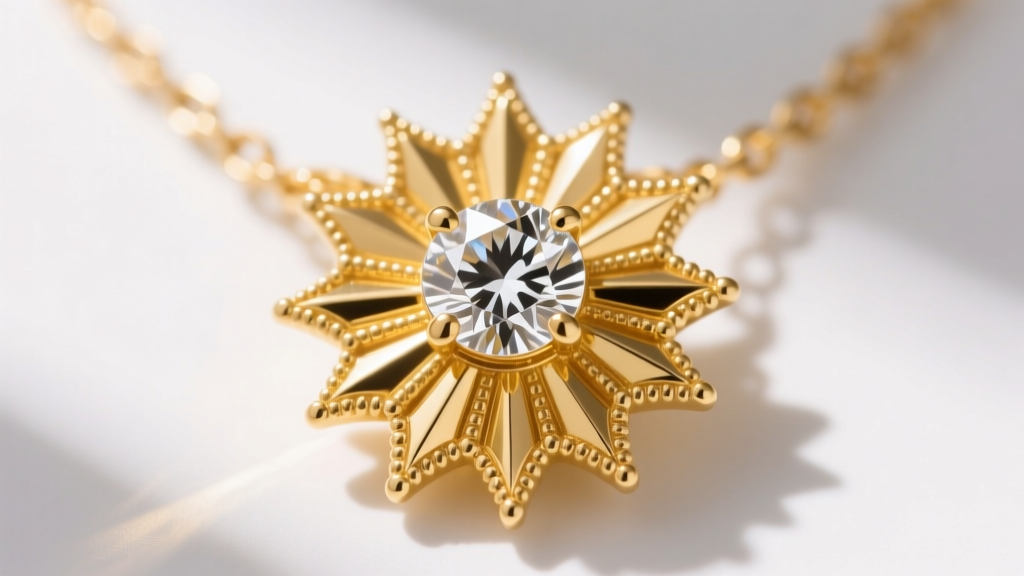
The sunburst necklace is a masterclass in radial symmetry and dynamic light reflection. While often appreciated purely for its vintage aesthetic and celestial motif, from a jewelry manufacturing perspective, a sunburst pendant presents a unique set of structural and metallurgical challenges. The transition from a heavy central hub to delicate, radiating spokes creates inherent stress points that demand precise engineering. In this expert deep dive, we dissect the technical anatomy of the sunburst necklace, exploring alloy selection, setting mechanics, bail engineering, and the manufacturing nuances that separate heirloom-quality pieces from fragile costume replicas.
The Structural Anatomy of a Sunburst Pendant
At its core, a sunburst pendant operates on a "hub and spoke" structural model. The central hub houses the primary gemstone and serves as the anchor for the radiating rays. The most critical engineering zone is the transition joint—the exact point where the base of the ray meets the central bezel or gallery.
In poorly constructed pieces, these joints are merely surface-soldered, leading to a high rate of shear failure when the necklace is subjected to lateral tension. High-end manufacturing utilizes laser welding or deep-penetration torch soldering using hard-grade solder (melting point around 1450°F for 14k gold) to ensure the joint's tensile strength matches the surrounding metal. Furthermore, the rays themselves must follow a precise tapering ratio. A standard technical specification for a 35mm diameter sunburst dictates a ray base thickness of 1.0mm, tapering smoothly to 0.4mm at the terminal point. This tapering not only mimics the natural dispersion of light but also reduces the distal weight, preventing the pendant from warping over time.
Metallurgy and Alloy Selection for Radiating Rays
The choice of metal alloy profoundly impacts the longevity and structural integrity of the sunburst rays. Because the rays are essentially thin cantilevered beams, they are highly susceptible to bending and work hardening. According to metallurgical data presented at the Santa Fe Symposium, the crystalline grain structure of the alloy dictates how well the rays will resist deformation.
| Alloy | Vickers Hardness (HV) | Yield Strength (MPa) | Min. Ray Thickness | Best Application |
|---|---|---|---|---|
| 14k Yellow Gold (Ni-free) | 135 HV | 350 MPa | 0.8mm | Everyday wear, durable antique reproductions |
| 18k Yellow Gold | 125 HV | 280 MPa | 1.0mm | High-end estate jewelry, rich color saturation |
| Platinum 950 (Ruthenium) | 130 HV | 450 MPa | 0.6mm | Micro-pavé rays, ultra-fine intricate designs |
| Sterling Silver (925) | 75 HV | 180 MPa | 1.2mm | Fashion jewelry, requires rhodium plating |
Platinum 950 alloyed with ruthenium is the superior choice for intricate sunburst designs featuring micro-pavé accent stones along the rays. Its high yield strength allows for thinner, more elegant spokes without risking catastrophic bending, and unlike gold, platinum displaces rather than chips when subjected to impact.
Gemstone Setting Techniques: Bezel vs. Multi-Prong
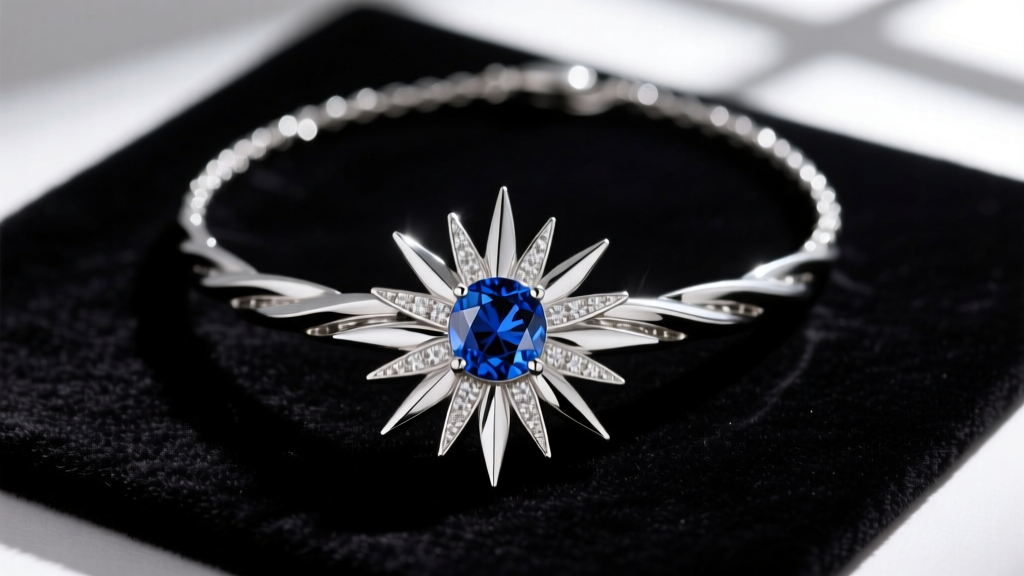
The central gemstone in a sunburst necklace acts as the visual and structural anchor. The setting technique chosen must account for the visual "noise" created by the radiating rays.
- Bezel Settings: A full bezel is the most technically sound choice for sunburst pendants. It provides a continuous metal wall that seamlessly blends into the base of the rays, distributing structural stress evenly. A Gemological Institute of America (GIA) technical review notes that bezel settings also protect the girdle of the central stone from the abrasive wear that can occur when adjacent ray tips flex inward.
- Multi-Prong Basket Settings: If a prong setting is required for maximum light return, a low-profile 6-prong or 8-prong basket is mandatory. Standard 4-prong settings leave too much of the stone's perimeter exposed, creating a visual disconnect with the dense metalwork of the rays. Furthermore, the prongs must be filed flush; any protrusion will catch on the delicate milgrain or pavé accents of the surrounding spokes.
- Ray Accent Stones: When rays feature accent diamonds, channel setting is vastly superior to pavé for structural reasons. Pavé requires removing small amounts of metal from the ray to form beads, which weakens the already narrow spoke. Channel setting, conversely, can be integrated into the CAD design as a structural groove that maintains the ray's overall rigidity.
Bail Engineering and Chain Pairing Dynamics
A frequently overlooked aspect of sunburst necklace design is bail engineering. Because the top rays extend upward and outward, the pendant is inherently top-heavy and prone to flipping forward, resting at an awkward angle against the wearer's sternum.
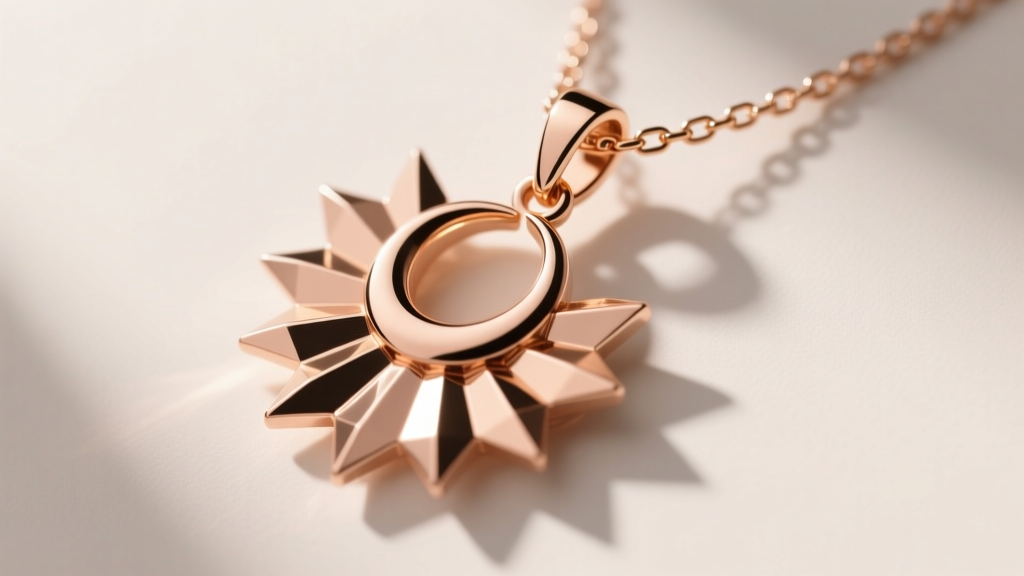
To counteract this, expert jewelers avoid standard soldered loop bails. Instead, they utilize an integrated hidden bail machined directly into the upper gallery of the central hub, or a tapered tube bail that sits flush against the back of the pendant. This lowers the center of gravity and forces the sunburst to lay flat.
For chain pairing, the bail's internal diameter dictates the maximum chain gauge. For a standard 25mm to 40mm sunburst pendant, a 1.2mm to 1.5mm box chain or rope chain is optimal. These chains possess the necessary tensile strength to support the pendant's weight (often 8 to 15 grams) without stretching, while remaining flexible enough to drape smoothly. Avoid delicate cable chains under 0.9mm, as the concentrated weight of the sunburst hub will rapidly cause link deformation at the clasp and bail contact points.
Authentication: Die-Struck vs. Cast Manufacturing
When evaluating vintage or high-end modern sunburst necklaces, understanding the manufacturing method is crucial for assessing durability and value.
Die-Striking: Antique sunburst pieces (particularly from the Art Deco and Retro periods) were often die-struck. This process involves stamping sheet metal under immense hydraulic pressure (up to 50 tons). The extreme compression aligns the metal's crystalline grain structure, resulting in a dense, springy material that is highly resistant to bending. Die-struck rays will flex and return to their original shape.
CAD/CAM Casting: Modern sunburst necklaces are predominantly cast using the lost-wax method. While casting allows for incredibly complex, three-dimensional ray geometries that die-striking cannot achieve, cast metal is inherently more porous and brittle. When examining a cast sunburst, inspect the ray joints under a 10x loupe for micro-porosity (tiny pinholes). According to Jewelers of America manufacturing standards, visible porosity at the ray joints is a critical failure point that will eventually lead to fracture under everyday stress.
Maintenance and Ultrasonic Cleaning Risks
The intricate geometry of a sunburst necklace makes maintenance a highly specific endeavor. The dense network of rays and micro-settings creates numerous traps for skin oils, lotions, and environmental dust.
Crucially, ultrasonic cleaners pose a severe risk to sunburst necklaces, particularly those with pavé or bead-set accent stones along the rays. The high-frequency acoustic cavitation generated by ultrasonic waves can cause the thin metal spokes to resonate. This micro-vibration is often enough to loosen the tiny metal beads holding the accent diamonds, resulting in catastrophic stone loss. Furthermore, if the central stone is a fracture-filled diamond, emerald, or opal, the ultrasonic waves and heated solvent can destroy the stone's internal structure.
Expert Cleaning Protocol: 1. Use a soft-bristled baby toothbrush and a mild, phosphate-free dish soap diluted in lukewarm water. 2. Gently brush along the grain of the rays, moving from the central hub outward to avoid bending the tips inward. 3. Rinse with distilled water to prevent hard water spotting on the metal. 4. Dry using a targeted stream of compressed air or a low-heat hair dryer, as lint from microfiber cloths will inevitably snag on the ray tips and milgrain details.
By understanding the precise metallurgy, structural engineering, and setting mechanics that define a true sunburst necklace, collectors and enthusiasts can make highly informed decisions, ensuring they acquire pieces that are not only visually radiant but structurally enduring.


