The Technical Guide to Choosing a Safe Childrens Silver Necklace
Expert guide to selecting a safe childrens silver necklace, covering sterling silver grades, clasp tension mechanics, and chain tensile strength for kids.

The Metallurgy of Safe Silver: Beyond the 925 Stamp
When sourcing a childrens silver necklace, most consumers stop at the '925' hallmark, assuming it guarantees safety and quality. From a metallurgical perspective, standard 925 sterling silver is an alloy composed of 92.5% pure silver and 7.5% copper. While copper provides the necessary tensile strength for jewelry, it is also the primary catalyst for oxidation (tarnish) and can cause mild contact dermatitis in children with highly sensitive skin. Furthermore, the solder used to close chain links and attach pendants in mass-manufactured jewelry often contains hidden nickel or cadmium to lower melting points.
Argentium 935: The Hypoallergenic Upgrade
For children prone to metal sensitivities, experts recommend Argentium 935 silver. By replacing a portion of the copper with germanium, Argentium eliminates firescale during manufacturing and drastically slows tarnishing. More importantly, high-quality Argentium alloys are strictly nickel-free. According to the Silver Institute, verifying the exact alloy composition is critical, as the US Consumer Product Safety Commission (CPSC) heavily regulates lead content (capped at 100 ppm under CPSIA) but leaves nickel regulation largely to international standards like EU REACH. Always demand a certificate of compliance ensuring the solder and alloy are 100% nickel-free and lead-free.
Chain Link Engineering: Tensile Strength and Snag Hazards
The structural integrity of a childrens silver necklace is dictated by its chain link geometry. Children are highly active, and necklaces are frequently subjected to sudden lateral pulls, snagging on playground equipment, or forceful tugging. The chain must possess enough tensile strength to resist casual breakage, yet act as a 'mechanical fuse' that snaps before causing cervical or tracheal trauma.
Why Box Chains Fail
Box chains are constructed from folded sheet metal rather than drawn wire. This folding creates structural weak points at the creases. Under a sudden 2-pound lateral load, box chains are prone to permanent kinking and catastrophic hinge failure. Furthermore, the sharp interior edges of a kinked box chain can lacerate a child's neck.
| Chain Type | Wire Geometry | Tensile Yield | Snag Risk | Expert Verdict |
|---|---|---|---|---|
| Cable (Round) | Drawn Round Wire | High (8-12 lbs) | Low | Highly Recommended |
| Rolo | Stamped Round Wire | Medium-High (6-9 lbs) | Low | Recommended |
| Box | Folded Sheet Metal | Low (1.5-3 lbs) | High | Avoid for Children |
| Figaro | Mixed Drawn Wire | Medium (5-8 lbs) | Medium | Acceptable (Age 8+) |
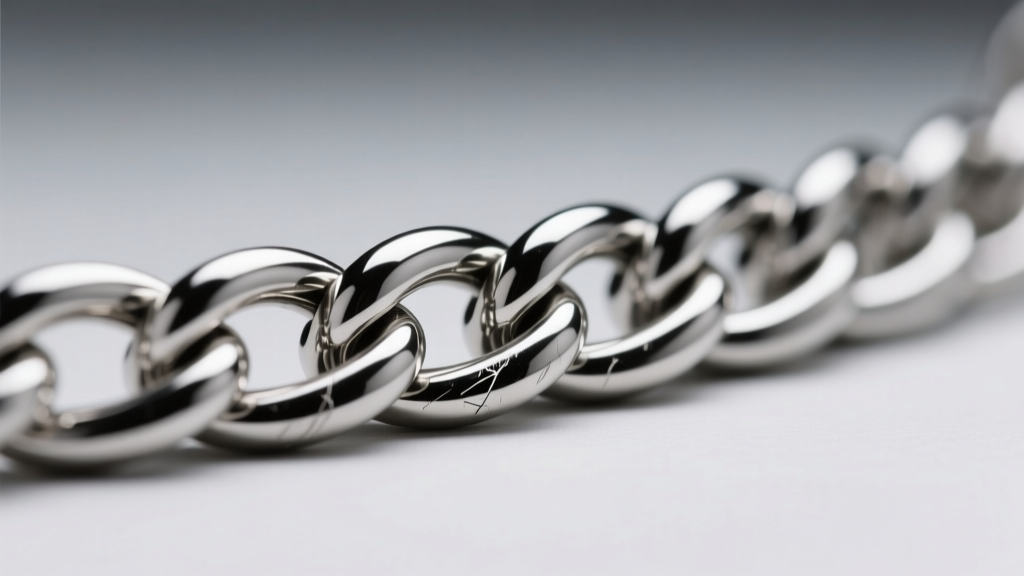
Cable and Rolo chains, constructed from continuous drawn or stamped round wire, distribute kinetic energy evenly across the interlocking joints. When subjected to extreme force, the soldered link joints will cleanly separate, preventing the jagged metal shearing associated with box chains.
Clasp Mechanics: The 5-Pound Breakaway Rule
The most critical safety component of any childrens silver necklace is the clasp mechanism. A toddler's trachea is protected by the cricoid cartilage, which is highly susceptible to compression. Biomechanical studies indicate that sustained pressure of just 15 to 20 Newtons (approximately 3.3 to 4.5 pounds of force) can cause severe ischemic injury or tracheal fracture in children under five. Therefore, a safe necklace must incorporate a mechanical fail-safe.
- Magnetic Breakaway Clasps: These utilize neodymium magnets calibrated to decouple precisely at 4 pounds of tensile load. They are the gold standard for children under 6.
- Spring-Ring Clasps: These require manual dexterity that children under 7 lack, leading to frustration and broken nails. Worse, they do not release under pressure, transferring the full force of a pull directly to the child's neck or the chain links.
- Lobster Clasps: While secure and easy for parents to operate, standard lobster clasps will not release under tension. If used, the chain's solder joints must be engineered to be the weakest link, yielding at 5 pounds of force.
For comprehensive safety parameters, jewelers and parents should consult the CPSC Children's Jewelry Safety Guidelines, which outline strict pull-test and choke-tube testing requirements for all juvenile accessories.
Gauge, Weight, and Dimensional Standards
Selecting the correct wire gauge and necklace length is vital for both comfort and safety. A chain that is too thick becomes heavy and cumbersome, while one that is too thin risks slicing into the skin under pressure.
The Age-to-Length Matrix
Proper sizing prevents the necklace from slipping over the chin (a strangulation hazard) or sitting too tightly against the carotid artery. According to ASTM F2923-20 (Standard Specification for Consumer Product Safety for Children’s Jewelry), jewelry intended for children must undergo rigorous dimensional and mechanical testing.
- Ages 2-4: 12 to 14 inches. Width: 0.8mm to 1.0mm (20-22 gauge). Weight: Under 5 grams.
- Ages 5-8: 14 to 16 inches. Width: 1.0mm to 1.2mm (18-20 gauge). Weight: 5 to 8 grams.
- Ages 9-12: 16 to 18 inches. Width: 1.2mm to 1.5mm (16-18 gauge). Weight: 8 to 12 grams.

Maintenance and Toxicity: The Danger of Chemical Dips
Because children's skin has a thinner stratum corneum than adult skin, it is highly permeable to chemical residues. When a childrens silver necklace tarnishes, parents often reach for commercial 'silver dip' solutions. These liquid cleaners rely on thiourea, a known carcinogen and potent skin sensitizer. Even after rinsing, microscopic thiourea residues become trapped in the porous solder joints of the chain and pendant bail. When the child sweats, these toxic residues leach onto the skin, causing severe contact dermatitis.
The Electrolytic Cleaning Alternative
The only expert-approved, non-toxic method for restoring a tarnished childrens silver necklace is electrolytic reduction. By lining a glass bowl with aluminum foil, adding hot water, a tablespoon of sodium bicarbonate (baking soda), and a pinch of non-iodized salt, you create a galvanic cell. When the silver necklace touches the aluminum foil in this solution, the sulfur atoms causing the tarnish are ionically transferred from the silver to the aluminum. This process leaves zero chemical residue on the metal, ensuring the necklace remains completely hypoallergenic and safe for prolonged wear against a child's delicate skin.


