The Anatomy of a Floral Statement Necklace: Expert Guide
Explore the technical anatomy of a floral statement necklace, from CAD modeling and alloy selection to clasp mechanics and weight distribution.

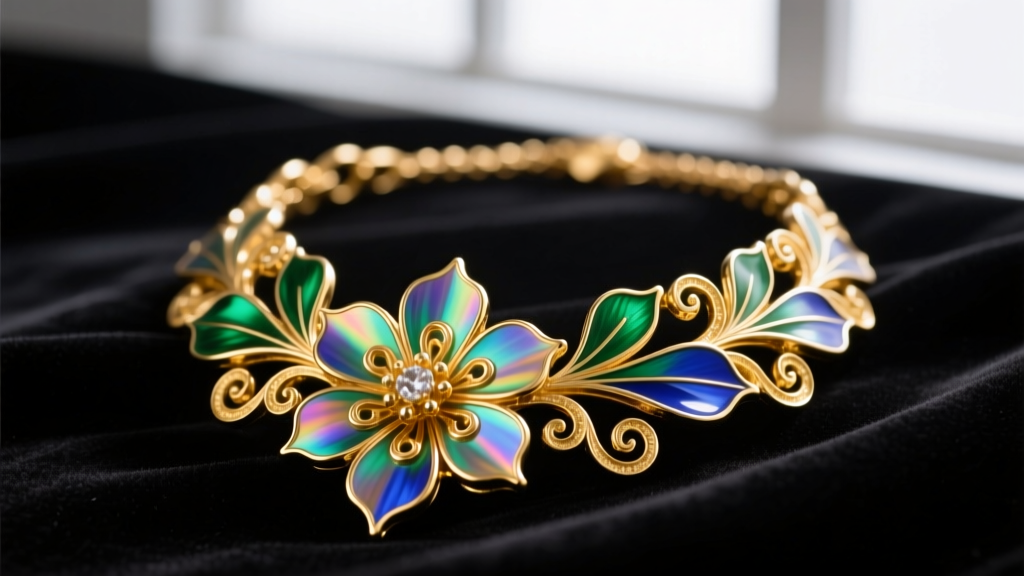
Introduction to Botanical Jewelry Engineering
When evaluating high-impact jewelry, the floral statement necklace stands as a masterclass in structural engineering and artistic expression. Unlike delicate, minimalist chains, a true statement piece commands visual weight, often exceeding 40 grams and spanning over 50 millimeters in diameter. In 2026, the construction of these botanical centerpieces has evolved significantly, merging centuries-old enameling techniques with advanced computational design. For collectors, designers, and serious enthusiasts, understanding the technical anatomy of these pieces is crucial for assessing quality, longevity, and value.
A common failure mode in mass-market botanical jewelry is structural collapse under the piece's own weight. Petals warp, bails snap, and chains stretch. To avoid these pitfalls, one must examine the material science, weight distribution, and manufacturing methodologies that separate heirloom-quality floral statement necklaces from fast-fashion accessories.
Material Science: Alloys, Resins, and Enamels
The visual depth of a floral statement necklace is frequently achieved through enameling or high-polish metal texturing. The choice of base metal and surface treatment dictates the piece's resistance to thermal shock, impact, and everyday wear. According to research published by GIA's Gems & Gemology, the fusion temperature and coefficient of thermal expansion (CTE) between the metal substrate and the enamel must be perfectly matched to prevent micro-fracturing.
Comparing Enameling Techniques
| Technique | Material Composition | Durability Rating | Price Impact |
|---|---|---|---|
| Vitreous Enamel | Fused glass powder (1400°F+) | High (Scratch-resistant, brittle on impact) | High |
| Cold Enamel | Epoxy or UV-cured resin | Medium (Prone to yellowing, scratches easily) | Low |
| Plique-à-jour | Transparent glass in open-back cells | Low (Extremely fragile, stained-glass effect) | Premium |
| Guilloché | Vitreous enamel over engine-turned metal | High (Exceptional light refraction) | Premium |
For a floral statement necklace intended for frequent wear, vitreous enamel over a sterling silver or 18k gold base remains the gold standard. Cold enamel (resin) is frequently used in sub-$150 market tiers but will inevitably degrade, scratch, and discolor when exposed to UV light and cosmetics over a 3-to-5-year period.
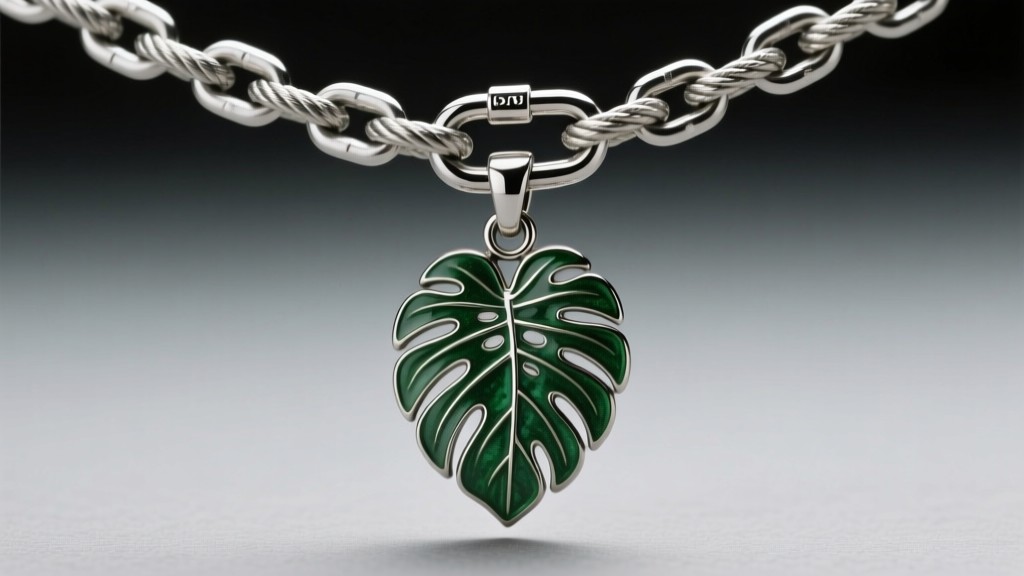
Structural Integrity and Weight Distribution
The physics of a large, asymmetric floral pendant present unique engineering challenges. The center of gravity in a multi-petal design often sits low and off-center, creating continuous torque on the bail (the loop connecting the pendant to the chain). If the bail is cast too thinly or soldered poorly, metal fatigue will cause it to snap.
Bail Mechanics and Chain Gauge
An expertly crafted floral statement necklace utilizes an integrated or hidden bail that distributes the pendant's weight across a wider surface area of the top petal or central stem. Furthermore, the chain must possess adequate tensile strength. A general rule of thumb in jewelry engineering is that the chain's breaking strength should exceed the pendant's weight by a factor of ten to account for dynamic loads (e.g., the pendant swinging or catching on clothing).
- Pendants under 20g: Can be supported by 1.5mm to 2.0mm cable or curb chains.
- Pendants 20g - 45g: Require 2.5mm to 3.5mm rope, rolo, or Figaro chains to prevent link ovalization.
- Pendants over 45g: Demand 4.0mm+ chains, often reinforced with a box clasp and a figure-8 safety catch.
Expert Insight: The most frequent point of failure in heavy botanical necklaces is not the chain itself, but the jump ring connecting the chain to the clasp. Always inspect the gauge of the jump ring; it should be soldered closed or feature a locking mechanism to prevent the heavy pendant from pulling the ring open.
Advanced Manufacturing: CAD vs. Lost-Wax Casting
The year 2026 has seen a massive shift in how complex floral statement necklaces are prototyped and produced. While traditional hand-carved wax models are still revered in high jewelry, the majority of mid-tier and premium commercial pieces now utilize advanced CAD (Computer-Aided Design) software paired with high-resolution DLP (Digital Light Processing) 3D resin printers.
This technological leap allows designers to engineer internal lattice structures within thick metal petals, reducing the overall weight of the gold or silver by up to 30% without sacrificing the external volume or visual impact. This weight reduction is critical for wearer comfort. However, as noted by industry analysts at JCK Online, the transition from digital model to physical cast requires meticulous management of casting porosity. If the sprue (the channel through which molten metal flows) is not correctly sized in the CAD file, the resulting floral petals may suffer from internal gas pockets, leading to pitted surfaces and structural weakness.
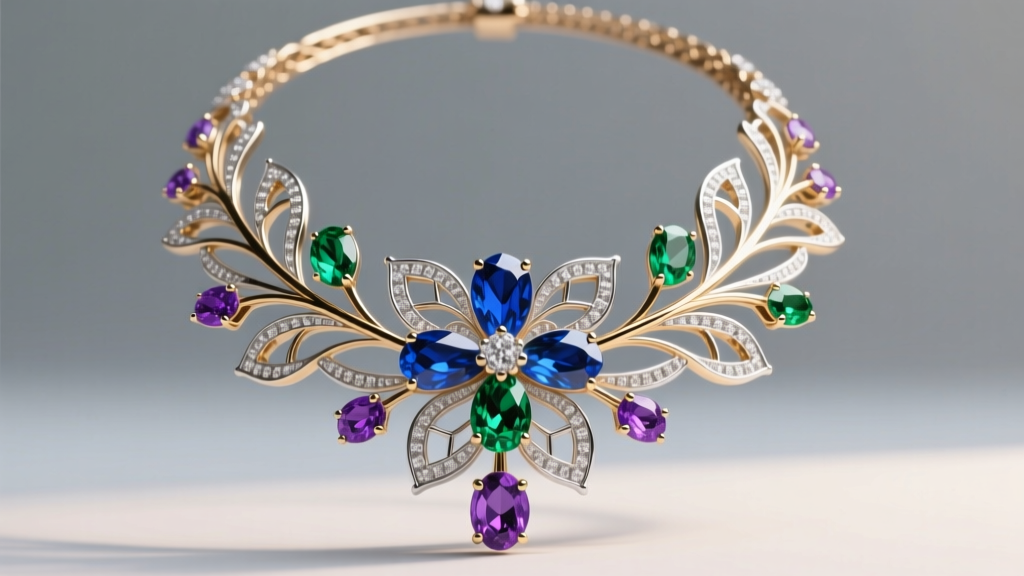
Pricing Tiers and Value Assessment
When appraising or purchasing a floral statement necklace, understanding the pricing architecture helps identify true value versus brand markup. The market is distinctly segmented by manufacturing method and material grade.
Market Segmentation Chart
- Tier 1: Mass-Produced Fashion ($40 - $150)
Materials: Brass or zinc alloy base, flash gold plating (under 0.5 microns), cold enamel. Cast in multi-piece rubber molds. High porosity, low longevity. - Tier 2: Premium Demi-Fine ($250 - $800)
Materials: Solid 925 sterling silver or 10k/14k gold, vermeil plating (2.5+ microns), vitreous enamel or AAA-grade cubic zirconia accents. CAD-designed with optimized weight distribution. - Tier 3: Fine & High Jewelry ($2,500 - $25,000+)
Materials: 18k gold or platinum, hand-fabricated or precision-cast. Features plique-à-jour enameling, natural unheated sapphires, or diamonds set in micro-pavé. Articulated petals that move independently.
Styling Geometry and Neckline Integration
Beyond construction, the technical success of a floral statement necklace relies on how its geometry interacts with human anatomy. A rigid, flat-cast floral piece will sit awkwardly on the collarbone, gaps forming at the edges. Superior designs incorporate a slight convex curvature or articulated hinges between the petals, allowing the necklace to drape naturally against the sternum.
For optimal visual framing, the focal point of the floral pendant should rest precisely at the suprasternal notch (the hollow at the base of the neck) for a choker-style botanical piece, or 2 to 3 inches below it for a standard matinee length. Pairing these substantial pieces requires minimalist necklines—such as a structured boatneck or a deep V-neck—to provide negative space that allows the intricate metalwork and enamel gradients to command attention without visual clutter.
Conclusion
A masterfully engineered floral statement necklace is a triumph of metallurgy, physics, and art. By scrutinizing the enamel type, chain gauge, bail construction, and manufacturing techniques, buyers and collectors can confidently navigate the market. Whether you are investing in a high-jewelry articulated lotus or a premium demi-fine enamel rose, prioritizing structural integrity ensures the piece remains a wearable masterpiece for decades to come.


