The Ultimate Technical Guide to the Gold Cable Chain Necklace
An expert technical deep dive into gold cable chain necklaces, covering link metallurgy, gauge tolerances, soldering methods, and clasp engineering.

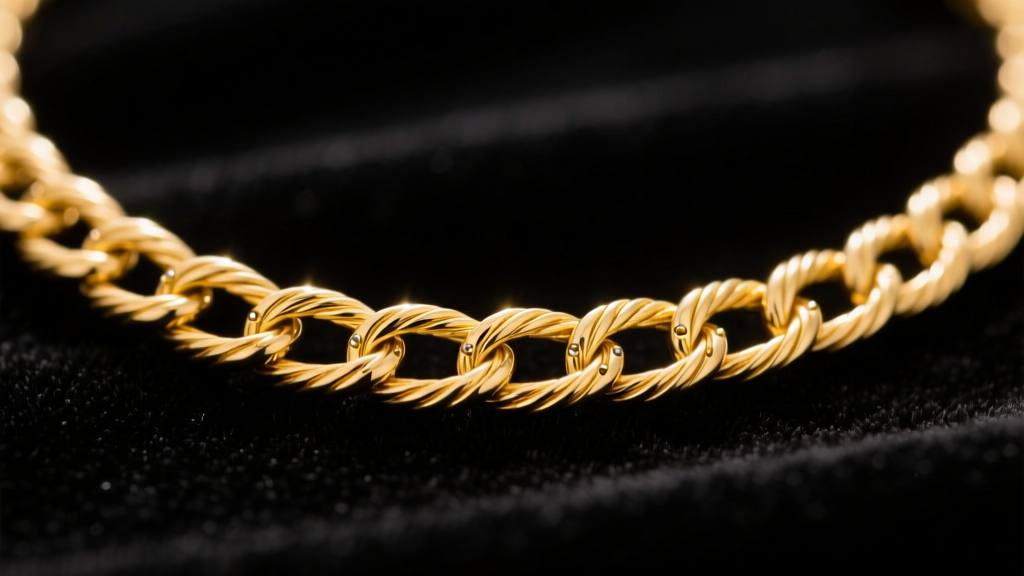
The Anatomy of a Gold Cable Chain: Link Geometry and Tolerances
The gold cable chain necklace is often dismissed as a basic jewelry staple, but from a metallurgical and engineering perspective, it is a marvel of micro-mechanics. At its core, a standard cable chain consists of uniform oval or round links connected in a simple, continuous sequence. However, the structural integrity of the necklace relies entirely on the aspect ratio of these links—specifically, the inner diameter relative to the wire thickness. An optimal aspect ratio of 3:1 ensures maximum flexibility and drape while minimizing the friction that leads to internal link wear. When the tolerance drops below 2.5:1, the chain becomes stiff and prone to kinking; above 4:1, the links are vulnerable to crushing and deformation under lateral pressure.
Modern chain manufacturing utilizes high-speed automated stamping presses that cut, bend, and interlock wire at speeds exceeding 600 links per minute. To achieve the precise geometric tolerances required for luxury jewelry, the gold wire must undergo a rigorous drawing process through tungsten carbide dies, followed by continuous annealing to relieve internal crystalline stresses before the stamping phase.
Metallurgy and Karat Alloys: Tensile Strength vs. Purity
Pure 24-karat gold possesses a Vickers hardness of approximately 25 HV, making it entirely unsuitable for the mechanical stresses endured by a daily-wear cable chain. To engineer a durable gold cable chain necklace, metallurgists must introduce alloying metals—primarily copper, silver, and zinc—to alter the crystalline lattice structure and increase yield strength. According to educational resources from the Gemological Institute of America (GIA), the specific alloy ratios dramatically dictate the chain's tensile limits and oxidation resistance.
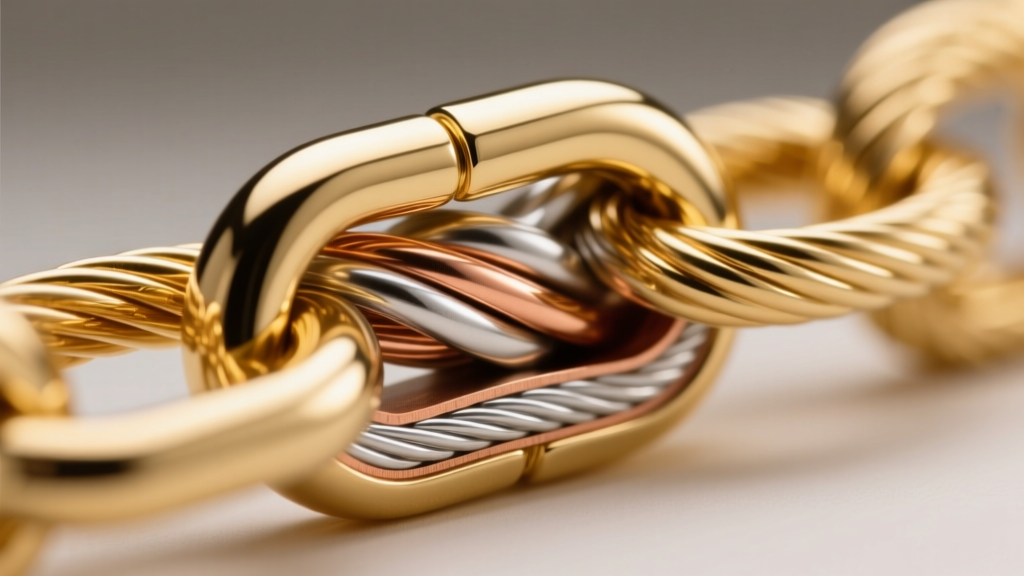
14K vs. 18K Gold: The Durability Matrix
- 14K Gold (58.5% Au): With a Vickers hardness ranging from 130 to 150 HV, 14K gold offers the highest tensile strength among standard jewelry alloys. The higher copper content provides excellent structural memory, allowing thin-gauge cable chains to resist permanent stretching. However, the copper increases the risk of galvanic corrosion when exposed to chlorinated water.
- 18K Gold (75.0% Au): Registering between 110 and 125 HV, 18K gold is significantly softer. While it offers superior color saturation and hypoallergenic properties, an 18K cable chain requires a thicker wire gauge to achieve the same load-bearing capacity as its 14K counterpart. It is highly susceptible to work hardening and micro-fractures if subjected to repetitive bending.
Industry experts featured in JCK trade publications frequently note that the shift toward sustainable, recycled gold alloys has introduced trace elements like palladium and silicon into modern cable chains, which can improve fluidity during casting but occasionally create brittle zones in drawn wire if not properly homogenized.
Soldered vs. Unsoldered Links: Structural Failure Points
The most critical point of failure in any gold cable chain necklace is the link closure. Unsoldered chains, where the link ends merely butt against one another, rely entirely on the mechanical interlock and the tensile strength of the wire. Under a sudden dynamic load (such as the chain catching on a garment), an unsoldered 14K 18-gauge link will typically pull apart at just 2 to 3 pounds of tension.
To mitigate this, premium cable chains undergo a soldering process. Traditional torch soldering uses a 10K or 14K 'easy' solder with a melting point roughly 50°C lower than the chain body. While effective, torch soldering can leave visible seams and create localized heat-affected zones that alter the alloy's color. Today, high-end manufacturers utilize laser micro-welding. Laser welding fuses the exact same alloy at the seam without introducing foreign solder metals, resulting in a joint that possesses 95% of the tensile strength of the continuous wire itself. This technique allows jewelers to manufacture ultra-fine micro-cable chains (down to 0.4mm) that can still support lightweight pendants without catastrophic unzipping.
Gauge Thickness and Pendant Load-Bearing Capacity
Selecting the correct American Wire Gauge (AWG) for a gold cable chain necklace is a strict mathematical exercise based on the mass and center of gravity of the intended pendant. The pendant's bail creates a fulcrum point, concentrating kinetic energy on the three to five links immediately surrounding it. Below is a technical framework for matching chain gauge to pendant weight.
| Gauge (AWG) | Diameter (mm) | Tensile Limit (Soldered 14K) | Recommended Pendant Mass |
|---|---|---|---|
| 22 | 0.64 | 4.5 lbs | Under 2g (Micro-charms) |
| 18 | 1.02 | 12.0 lbs | 3g - 8g (Standard Solitaires) |
| 14 | 1.63 | 28.0 lbs | 10g - 25g (Heavy Lockets) |
| 10 | 2.59 | 65.0+ lbs | 30g+ (Statement Medallions) |
When pairing a heavy pendant with a chain, always account for the 'whiplash effect.' A 15-gram pendant swinging freely generates exponentially higher localized force on the central cable links than its static weight implies. For pendants exceeding 10 grams, transitioning to a 14-gauge or thicker cable chain is mandatory to prevent plastic deformation of the links.
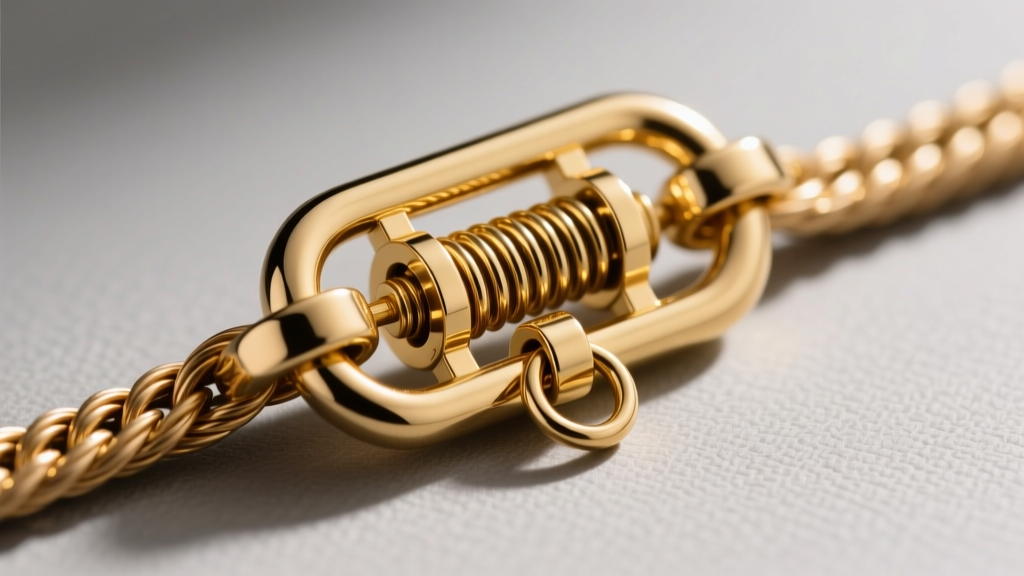
Clasp Engineering: Spring Rings vs. Lobster Mechanisms
A gold cable chain necklace is only as secure as its clasp assembly. The ubiquitous spring ring clasp is a marvel of compact engineering, but it harbors a hidden vulnerability: the internal spring. Because gold alloys lack the elastic memory required for thousands of compression cycles, the internal spring must be manufactured from stainless steel. Over time, moisture and skin acids penetrate the microscopic gap in the spring ring housing, leading to galvanic corrosion of the steel spring. When the steel fails, the clasp snaps shut permanently or fails to engage.
For chains 16-gauge and thicker, the cast lobster clasp is the superior engineering choice. Lobster clasps feature a larger internal cavity, allowing for a heavier, more robust stainless steel spring and a thicker gold lever arm. More importantly, the jump ring that attaches the lobster clasp to the cable chain benefits from a larger surface area for laser welding. When inspecting a high-value cable chain, always verify that the jump ring connecting the clasp is fully soldered or laser-welded shut; an open, unsoldered jump ring will inevitably stretch and separate under the asymmetric pulling forces exerted during daily wear.
Maintenance and Ultrasonic Cleaning Protocols
The interlocking geometry of the cable chain creates microscopic friction points that trap sebum, cosmetic powders, and environmental grit. This abrasive paste accelerates wear at the contact points of the links. While ultrasonic cleaners are highly effective at cavitation cleaning, they pose a specific risk to certain gold cable chains. If the chain features soldered links repaired with low-temperature lead-bearing solders (common in vintage pieces), the high-frequency vibrations and localized heat of an ultrasonic bath can shatter the solder joints. For modern, laser-welded 14K and 18K cable chains, a 3-minute cycle in a heated ultrasonic bath with a mild alkaline detergent is the industry standard for restoring the alloy's original luster without compromising structural integrity.


