Technical Guide to Buying a Small Gold Crucifix Necklace
Master the technical specs of a small gold crucifix necklace. Compare karat weights, chain gauges, casting methods, and pricing for an informed purchase.


Defining "Small": Exact Dimensions and Proportions
When master jewelers and serious collectors refer to a small gold crucifix necklace, they are not relying on subjective visual estimates. In technical terms, a "small" crucifix pendant is defined by a vertical drop strictly between 10mm and 18mm. The horizontal crossbar typically spans 60% to 75% of that vertical drop, creating the traditional Latin cross proportion. Thickness is the most critical, yet frequently overlooked, dimension. A high-quality small crucifix should measure between 1.2mm and 2.5mm at its thickest point (usually the center intersection). Pendants milled thinner than 1.0mm are highly susceptible to torsional warping, while those exceeding 3.0mm become disproportionately heavy for their footprint, causing the chain to ride up the back of the neck. Weight tolerances for this category generally fall between 0.8 grams and 2.8 grams, ensuring the piece remains unobtrusive while maintaining structural integrity.
Metallurgy and Karat Purity: 14K vs. 18K vs. 22K
The longevity of a small gold crucifix necklace is directly tied to its alloy composition. Pure 24K gold is far too malleable for daily wear jewelry. According to the Gemological Institute of America (GIA), alloying gold with metals like copper, silver, and zinc alters both its color and its Vickers Hardness (HV). Understanding these metallurgical differences is vital for selecting a pendant that will not bend or scratch prematurely.
Alloy Composition and Durability Matrix
- 14K Gold (58.5% Pure): With a Vickers Hardness of approximately 140-160 HV, 14K gold is the optimal choice for small, lightweight crucifixes. The higher alloy content provides superior tensile strength, ensuring that thin arms (under 1.5mm width) will not bend if snagged on heavy winter clothing.
- 18K Gold (75% Pure): Sitting at 120-130 HV, 18K gold offers a richer, deeper yellow hue due to the higher gold concentration. However, an 18K crucifix milled at 1.2mm thickness requires careful wear, as the metal is more prone to micro-abrasions and structural deformation under sudden impact.
- 22K Gold (91.6% Pure): Measuring roughly 70 HV, 22K gold is entirely unsuitable for small, structural pendants. It is reserved for heavy, solid cast pieces where the sheer mass of the metal compensates for its extreme malleability.
For those preferring a silver-toned metal, 14K or 18K white gold crucifixes rely on nickel or palladium alloys. These require a rhodium flash to achieve a bright white finish. Be aware that the high-friction area where the chain rubs against the bail will inevitably wear through the rhodium plating within 12 to 18 months, requiring periodic re-plating.
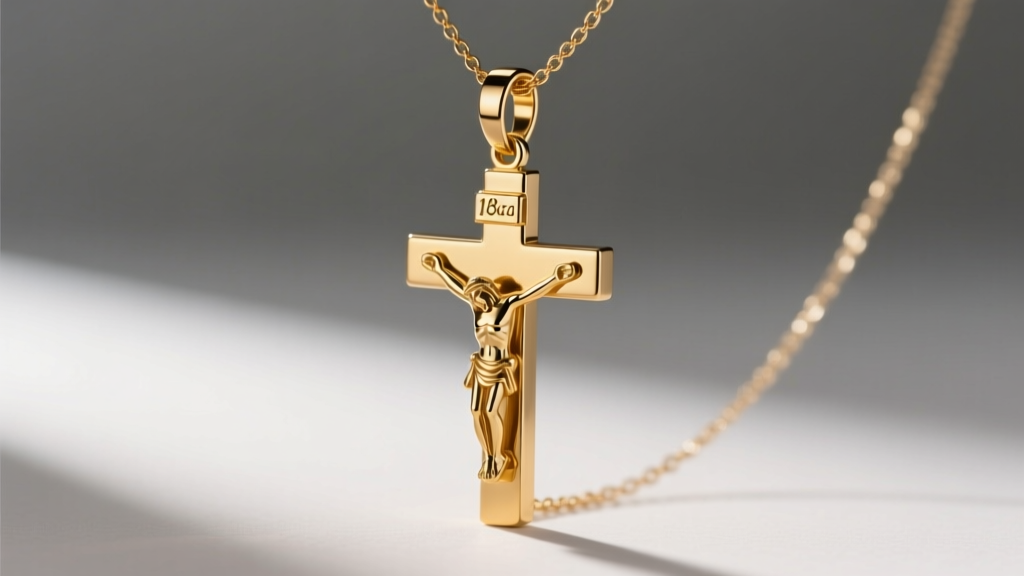
Manufacturing Techniques: Cast vs. Die-Struck vs. CNC
The method used to form the crucifix dictates its density, edge sharpness, and long-term durability. As detailed in manufacturing resources like Ganoksin, the jewelry industry relies on three primary fabrication methods for pendants, each with distinct technical trade-offs.
Lost-Wax Casting: The most common and cost-effective method. Molten gold is poured into a plaster mold created from a wax prototype. While excellent for complex, three-dimensional designs, cast pieces can suffer from microscopic porosity (gas bubbles trapped during cooling). If a cast crucifix is polished too aggressively, these pores can become visible as tiny surface pits.
Die-Striking: This process involves using immense hydraulic pressure to force gold sheet metal between two hardened steel dies. Die-striking compresses the metal's grain structure, resulting in a pendant that is significantly denser and harder than a cast equivalent. Die-struck small crucifixes feature incredibly sharp, precise beveled edges and are highly resistant to denting.
CNC Milling: Carved directly from a solid billet of gold using computer-controlled precision tools. CNC milling eliminates porosity entirely and allows for micro-chamfered edges and perfectly flat surfaces that are impossible to achieve by hand-casting. This method is typically reserved for high-end, modern, geometric crucifix designs.
Chain Engineering: Gauge, Link Type, and Clasp Mechanics
A small gold crucifix necklace is only as secure as the chain and clasp supporting it. The pendant's bail (the loop at the top) dictates the maximum chain width. A standard small crucifix features a bail with an inner diameter of roughly 2.5mm x 3.5mm, restricting the chain to a maximum width of 1.2mm. Exceeding this width causes excessive friction, rapidly wearing down both the chain links and the bail interior.
| Chain Style | Optimal Gauge | Tensile Strength | Snag & Kink Risk |
|---|---|---|---|
| Standard Cable | 0.8mm - 1.0mm | Moderate | Low |
| Box Chain | 0.9mm - 1.2mm | High | Very Low |
| Hollow Rope | 1.5mm - 2.0mm | Low (Crush risk) | High |
| Wheat (Spiga) | 0.9mm - 1.1mm | Very High | Moderate |
Clasp selection is equally critical. Avoid spring-ring clasps; the tiny internal spring and the single solder joint on the ring represent a high-probability failure point. A forged 5mm or 6mm lobster clasp provides a secure, self-closing mechanism with a much higher threshold for accidental unhooking.
Bail Mechanics and Soldering Integrity
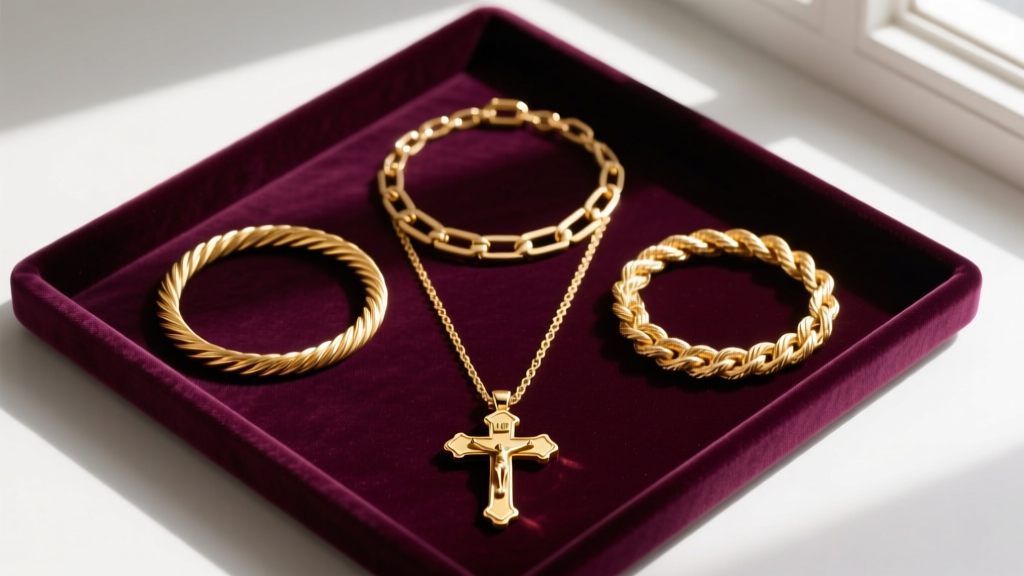
The bail is the structural nexus of the necklace. On premium small gold crucifix necklaces, the bail is not merely glued or loosely wrapped; it is integrated into the casting or permanently soldered to the pendant body. When evaluating a piece, inspect the solder joints where the bail meets the cross. Laser welding is the superior technique here, as it fuses the metal without the need for lower-karat solder alloys, maintaining a uniform color and preventing the joint from oxidizing or turning green over time. If the bail features a visible jump ring (a small circular wire loop), ensure the jump ring is fully soldered closed. An unsoldered jump ring will eventually pry open under the lateral tension of a snagged chain, resulting in the loss of the pendant.
Pricing Framework and Market Tiers
Understanding the pricing architecture of a small gold crucifix necklace protects consumers from severe retail markups. The baseline cost is the melt value of the gold. For example, a 1.5-gram 14K gold pendant contains approximately 0.87 grams of pure gold. Depending on current spot markets, the raw material value might be $60 to $80. However, retail pricing incorporates manufacturing complexity, finishing labor, and brand positioning.
- Mass-Market / Cast (Retail: $150 - $250): Typically 10K or 14K, hollowed out on the back to save weight, with basic machine polishing.
- Specialty Manufacturer / Die-Struck (Retail: $280 - $450): Solid 14K or 18K, precision milled or struck, featuring hand-chased edge detailing and laser-welded bails.
- Luxury Designer (Retail: $800 - $2,500+): Pricing is entirely decoupled from melt value, driven by brand heritage, proprietary design patents, and premium packaging.
Long-Term Maintenance and Failure Prevention
Proper maintenance of a small gold crucifix necklace requires an understanding of how abrasion affects precious metals. Every time a gold pendant is professionally polished, a microscopic layer of metal (approximately 0.01mm to 0.02mm) is removed. Over-polishing a small, thin crucifix will eventually round off its sharp beveled edges and thin the arms, compromising its structural integrity.
Expert Tip: For routine cleaning, avoid ultrasonic cleaners if your crucifix features any tension-set micro-pave diamonds, as the high-frequency vibrations can loosen the stones. Instead, use a soft-bristled brush with a mild, phosphate-free dish soap and warm water, focusing specifically on the bail area where skin oils and lotions accumulate and cause the gold to look dull.
Store the necklace laid flat or hung vertically. Tossing a box chain or rope chain into a jewelry box in a crumpled heap guarantees the formation of micro-kinks, which severely weaken the tensile strength of the links and lead to premature snapping.


