Mastering the Necklace Display Stand: An Expert Technical Guide
Discover the technical specifications, material grades, and structural engineering behind the perfect necklace display stand for fine jewelry.

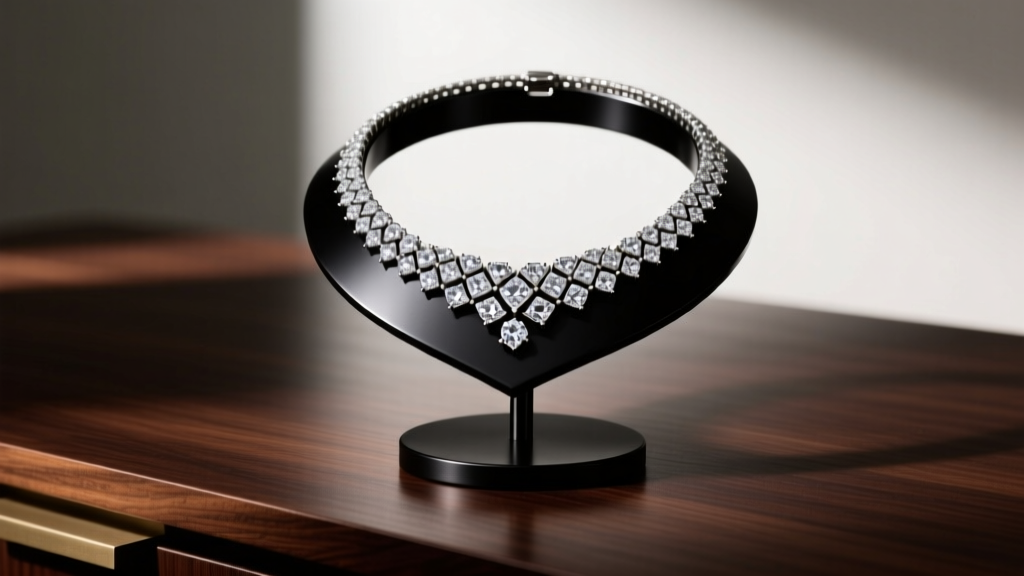
The Engineering of Elegance: Beyond Basic Presentation
When curating a high-end jewelry collection, the presentation hardware is just as critical as the pieces themselves. A professional-grade necklace display stand is not merely a decorative prop; it is a precision-engineered tool designed to manage structural load, prevent metallurgical degradation, and optimize spatial geometry. For serious collectors, boutique owners, and museum archivists, selecting the right display hardware requires a deep understanding of material science and physics. Cheap, mass-produced stands can actively damage fine jewelry through chemical off-gassing, structural tipping, and chain kinking. This expert deep dive explores the technical specifications you must evaluate when investing in archival-quality necklace display hardware.
The Physics of Presentation: Weight Distribution and Center of Gravity
The most common failure mode in mid-tier jewelry displays is structural tipping. A necklace display stand must counteract the torque generated by heavy collars, multi-strand pearl necklaces, and solid gold chains. To evaluate a stand's stability, you must analyze its base-to-height ratio and material density.
Calculating the Tipping Point
A standard T-bar stand with a 14-inch vertical clearance requires a base footprint of at least 7x9 inches to safely support a 300-gram statement collar without risking a top-heavy collapse. However, footprint alone is insufficient; mass distribution is key. High-end stands utilize a weighted core—often a concealed steel or lead-free brass plate embedded within the base—lowering the center of gravity. When shopping, look for a base weight of no less than 2.5 lbs (1.13 kg) for a standard 14-inch display.
Surface Friction and Durometer Ratings
The interface between the stand's base and your display surface (glass, polished wood, or acrylic shelving) is critical. Premium stands feature bottom pads made from neoprene or silicone. You should look for a Shore A durometer rating between 40 and 50. This specific hardness provides enough grip to prevent sliding when bumped, while remaining soft enough to avoid scratching high-gloss display cases. Avoid stands with standard EVA foam pads, which degrade, compress permanently, and leave adhesive residue over time.
Material Science: Anti-Tarnish and Archival-Grade Surfaces
The chemical interaction between your jewelry and the display surface can cause irreversible damage. According to the Getty Conservation Institute, volatile organic compounds (VOCs) and sulfur-bearing gases are the primary culprits behind accelerated tarnishing in silver and copper alloys.
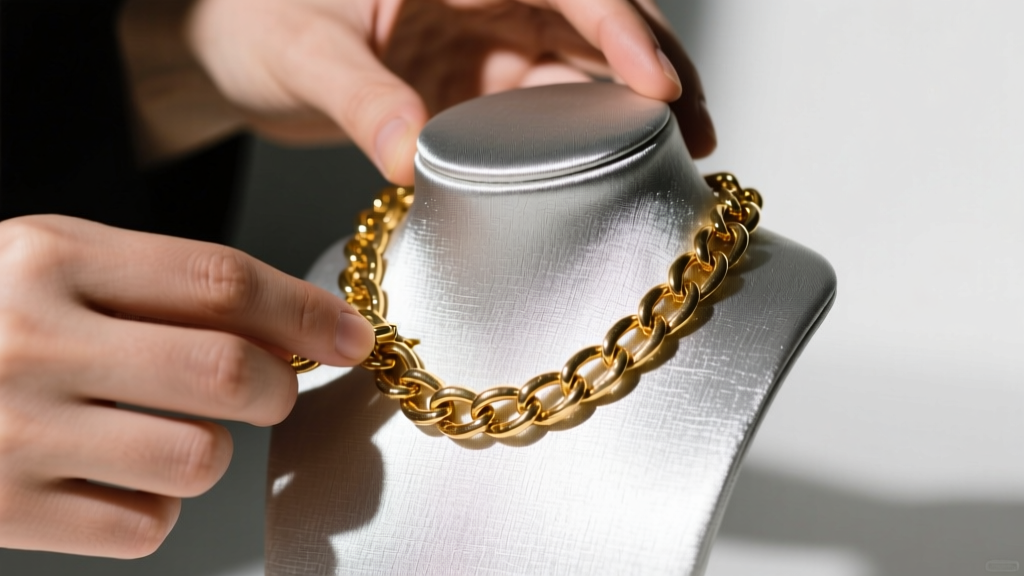
The Danger of MDF and Synthetic Velvets
Many commercial necklace display stands are constructed from Medium-Density Fiberboard (MDF) and wrapped in synthetic rayon velvet. MDF utilizes urea-formaldehyde resins that continuously off-gas formaldehyde and acetic acid. In an enclosed display case, these gases create a micro-climate that rapidly accelerates the formation of silver sulfide (tarnish). Furthermore, cheap synthetic velvets often contain sulfur-based dyes that transfer directly to porous metals and soft gemstones like pearls and turquoise.
Archival Solutions: Powder Coating and Pacific Silvercloth
For true archival preservation, the structural core of the stand should be 6061-T6 aluminum or kiln-dried hardwood sealed with a water-based, non-yellowing polyurethane. The exterior finish should be a chemically inert powder coating or a wrapping of genuine Pacific Silvercloth. Pacific Silvercloth is a specialized cotton flannel embedded with microscopic silver particles. As noted by The Silver Institute, these embedded particles act as a sacrificial anode, absorbing and neutralizing hydrogen sulfide (H2S) gases before they can react with your actual jewelry. If a stand advertises "anti-tarnish velvet," demand certification that it is free of sulfur-based dyes and acid-free.
Spatial Geometry: Clearance, Angles, and Bending Radii
The geometry of the T-bar dictates how your chains behave. A common mistake is purchasing a stand with a rod diameter that is too thin. While a 1/4-inch rod might look sleek, it forces delicate chains into a tight bending radius, leading to permanent kinking and metal fatigue.
Matching T-Bar Diameter to Chain Architecture
Chains with rigid geometries, such as Omega, Herringbone, and Box chains, require a wider bending radius to prevent the links from buckling or permanently warping. Conversely, flexible chains like Cable or Rope can tolerate tighter curves. Below is a technical specification table for matching T-bar diameters to necklace types.
| Chain Type | Minimum T-Bar Diameter | Risk Factor if Undersized |
|---|---|---|
| Omega / Herringbone | 1.0" - 1.25" (25-32mm) | Severe kinking, link separation, permanent structural warping. |
| Box / Snake | 0.75" - 1.0" (19-25mm) | Micro-fractures in the interlocking links, leading to snapping. |
| Cable / Curb / Rope | 0.5" - 0.75" (12-19mm) | Minor stress on soldered jump rings; generally low risk. |
| Pearl Strands (Knotted) | 1.25"+ (32mm+) | Silk thread stretching, knot slippage, nacre abrasion. |
Additionally, the vertical drop from the T-bar to the base must accommodate the longest pendant drops. A standard 14-inch stand provides roughly 12 inches of usable clearance, which is insufficient for opera-length necklaces (28-34 inches) or pieces with 4-inch pendant drops. For these, a modular stand with a 20-inch vertical clearance is mandatory.
Commercial vs. Collector Grade: A Technical Comparison
Understanding the market segmentation helps justify the investment in superior hardware. Here is how the two primary tiers compare in real-world metrics:
Commercial Grade ($15 - $45): Typically constructed from injection-molded polystyrene or lightweight MDF. Joints are secured with standard cyanoacrylate (superglue) or basic friction fittings. The surface is wrapped in sulfur-dyed rayon velvet. Expected lifespan in a high-traffic retail environment is 6 to 12 months before joint degradation or velvet crushing occurs.
Archival / Collector Grade ($120 - $350+): Machined from 6061-T6 aluminum or cast PMMA (polymethyl methacrylate). Joints utilize threaded stainless steel hardware with nylon lock nuts. Surfaces are wrapped in acid-free Pacific Silvercloth or feature a chemically inert matte powder coat. Designed for a multi-decade lifespan with zero off-gassing.
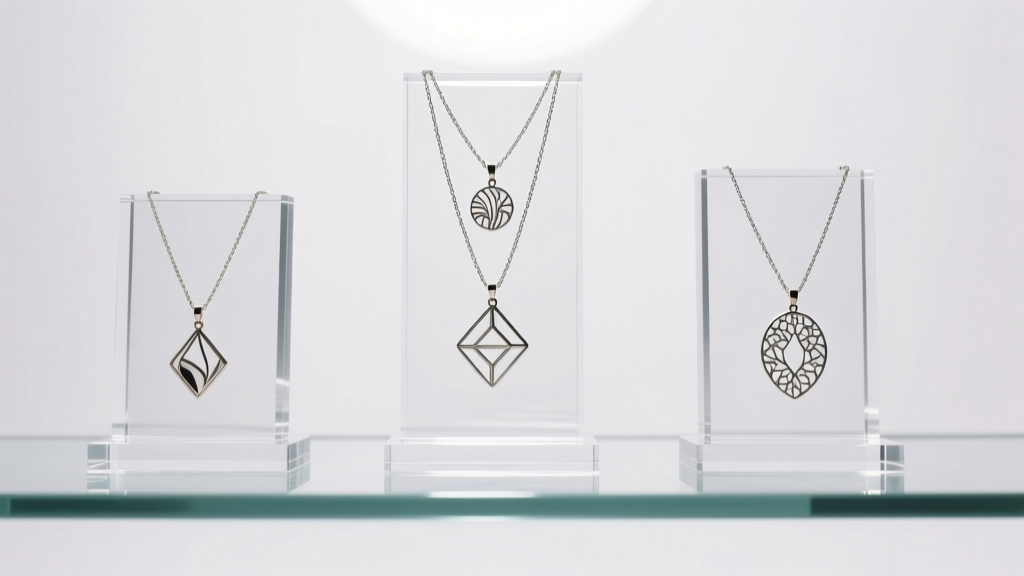
Troubleshooting Common Display Stand Failures
Even high-end displays can experience mechanical issues over time. Recognizing these failure modes allows you to perform preventative maintenance.
1. Joint Loosening and T-Bar Sag
The Problem: The horizontal T-bar begins to droop under the weight of heavy chains, caused by the degradation of the connection joint.
The Fix: Avoid stands that use simple friction-fit or glued dowel joints. If your current stand uses a threaded bolt connection, apply a micro-drop of blue Loctite (threadlocker) to the threads to prevent rotational loosening caused by vibrations when the display case is opened and closed.
2. UV Degradation in Acrylic Stands
The Problem: Clear acrylic stands turn yellow and become brittle over time.
The Fix: This is caused by UV exposure breaking down the polymer chains in standard polystyrene or low-grade acrylic. Always verify that clear stands are manufactured from UV-stabilized PMMA (often branded as Optix or Lucite), which includes UV-absorbing additives that prevent yellowing for up to 10 years under standard gallery lighting.
3. Velvet Crushing and Fiber Shedding
The Problem: The velvet surface compresses, leaving permanent indentations, and sheds micro-fibers that tangle in prong settings.
The Fix: Switch to a tightly woven, low-pile microfiber or a specialized archival felt. If you must use velvet, use a soft-bristled brass brush to gently lift the pile every six months, and use compressed air to blow away loose fibers before placing jewelry on the stand.
Conclusion: Engineering Your Final Selection
Selecting the ideal necklace display stand requires looking past the aesthetic surface and evaluating the structural and chemical realities of the hardware. By prioritizing a low center of gravity, insisting on VOC-free and sulfur-neutral materials, and matching the T-bar geometry to the specific bending radii of your chains, you transform a simple display prop into a vital preservation tool. Whether you are outfitting a high-security boutique or archiving a private estate collection, demanding these technical specifications ensures your jewelry remains pristine, secure, and perfectly presented for decades to come.


