Teething Necklaces: Material Properties & Safety Guide
An expert material comparison of teething necklaces, analyzing Baltic amber, silicone, and wood properties, safety risks, and pediatric guidelines.


The term teething necklaces encompasses two entirely distinct categories of jewelry: baby-worn necklaces (most notably Baltic amber) designed to rest on an infant's chest, and parent-worn nursing or sensory necklaces designed for a baby to chew on while being held. As jewelry material scientists and style experts, we must evaluate these pieces not just on aesthetics, but on molecular stability, structural integrity, and biological safety. In 2026, the jewelry market is saturated with claims regarding pain relief and non-toxic materials. This guide strips away the marketing fluff to examine the exact material properties, failure modes, and pediatric safety baselines of amber, silicone, and hardwood teething jewelry.
The Pediatric Baseline: Safety Warnings and Definitions
Before analyzing specific polymers and resins, we must establish the medical consensus. Major pediatric organizations universally warn against baby-worn teething jewelry. The U.S. Food and Drug Administration (FDA) has issued explicit warnings against amber teething necklaces, citing severe risks of strangulation and choking. Similarly, the American Academy of Pediatrics (AAP) advises parents to avoid any jewelry on infants. Consequently, the safest application of teething jewelry is the parent-worn nursing necklace, where the mother or caregiver wears a robust, break-resistant piece specifically engineered for an infant to chew on under direct supervision. The material analysis below evaluates these substances based on their suitability for parent-worn applications and their inherent chemical properties.
Baltic Amber: Succinic Acid and Polymer Science
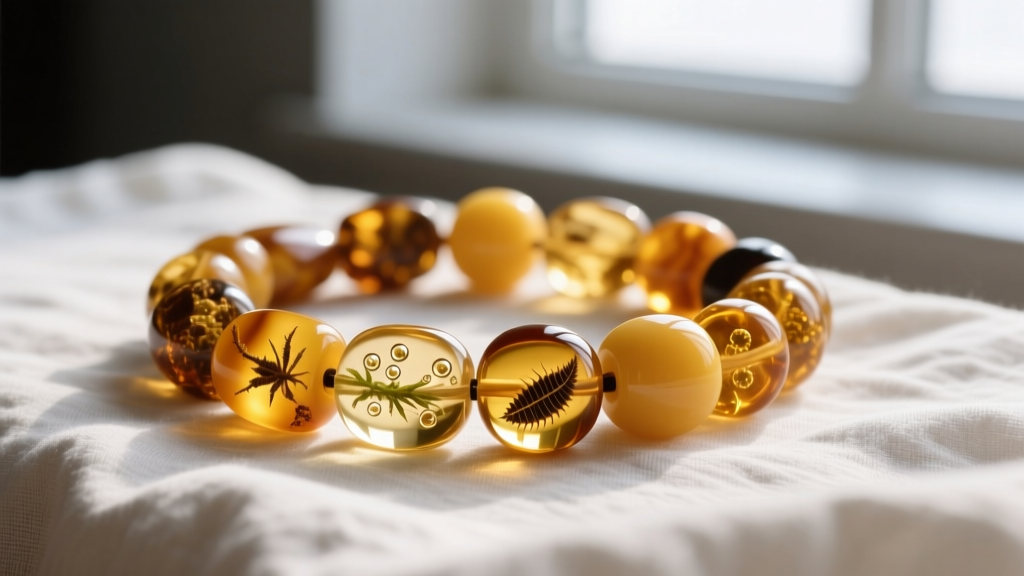
Baltic amber (succinite) is a fossilized tree resin dating back roughly 44 million years. It is the most controversial material in the teething jewelry space due to pervasive claims that it releases succinic acid into the skin to act as an analgesic. From a material science perspective, this claim fails basic thermodynamic scrutiny.
The Myth of Dermal Absorption
Succinic acid is indeed present in Baltic amber, typically comprising 3% to 8% of its total mass. However, succinic acid is bound within a complex, cross-linked polymer matrix. To release this compound, the amber must be heated to its melting or sublimation point, which occurs between 200°C and 387°C (392°F - 729°F). Human skin temperature rests around 37°C (98.6°F). At this temperature, the vapor pressure of succinic acid within the amber matrix is effectively zero. There is no scientifically validated mechanism for transdermal absorption of succinic acid from amber worn against the skin.
Structural Failure Modes
Amber is relatively soft, ranking between 2.0 and 2.5 on the Mohs hardness scale. This makes it highly susceptible to micro-fractures and chipping when subjected to the repetitive, high-PSI bite force of a teething infant. Furthermore, authentic amber necklaces are strung on cotton or silk cords and individually knotted between each bead. While knotting is designed to prevent a cascade of beads if the cord snaps, the organic cord itself degrades rapidly when exposed to the amylase enzymes and moisture in human saliva, creating a critical tensile failure point.
Food-Grade Silicone: Molecular Stability and Certifications
For parent-worn nursing necklaces, platinum-cured food-grade silicone is the gold standard. Silicone is a synthetic elastomer made of siloxane polymers (alternating silicon and oxygen atoms). Its extreme thermal stability, chemical inertness, and high tensile strength make it vastly superior to organic resins for chewing applications.
Platinum-Cured vs. Peroxide-Cured
Not all silicone is created equal. The manufacturing process dictates its safety profile. Platinum-cured (addition-cure) silicone uses a platinum catalyst to cross-link the polymer chains. This process produces zero chemical byproducts, resulting in a completely inert, odorless, and tasteless material. Conversely, peroxide-cured silicone can leave behind volatile organic compounds (VOCs) and requires extensive post-curing baking to be considered food-safe. When sourcing silicone teething necklaces, always verify that the manufacturer utilizes 100% platinum-cured silicone.
Shore A Hardness and LFGB Standards
The tactile feel and gum-safety of silicone are measured using the Shore A durometer scale. A Shore A hardness of 40 to 50 is optimal for teething jewelry; it provides enough resistance to massage inflamed gingival tissue without being so rigid that it causes micro-abrasions on delicate infant gums. Furthermore, look for pieces certified under the European LFGB standard rather than just the US FDA food-contact standard. LFGB testing is significantly more rigorous, specifically testing for the migration of heavy metals and volatile organic compounds that FDA testing sometimes overlooks.
Hardwoods: Porosity, Splintering, and Finish Toxicity
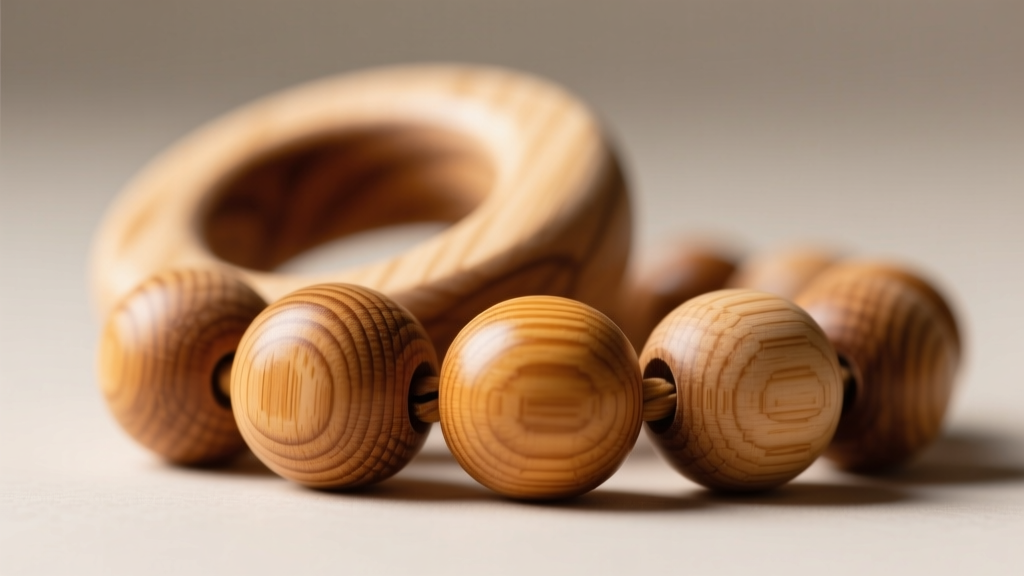
Wooden teething beads and pendants offer a natural, earthy aesthetic, but wood is a hygroscopic, anisotropic material. This means it absorbs moisture from the environment (or saliva) and expands at different rates depending on the grain orientation. Selecting the correct species and finish is critical to prevent bacterial harboring and structural failure.
The Janka Hardness Scale
Teething jewelry must be crafted from tight-grained hardwoods to prevent splintering. The Janka hardness test measures the force required to embed a steel ball into the wood, providing a reliable metric for bite resistance. Hard Maple (1,450 lbf) and Beech (1,300 lbf) are excellent choices due to their high density and closed cellular structures. Woods like Pine or Cedar must be strictly avoided; their low Janka ratings and open pores make them prone to splintering and bacterial colonization once saturated with saliva.
End-Grain vs. Edge-Grain Orientation
The way the bead is cut from the log dictates its moisture absorption rate. End-grain (cut perpendicular to the tree's growth rings) acts like a bundle of microscopic straws, rapidly wicking moisture deep into the core of the bead. This leads to internal swelling, warping, and eventual cracking. High-quality wooden teething beads should be cut along the edge-grain or face-grain to minimize capillary action and maintain dimensional stability.
Non-Toxic Finishes
Raw wood will quickly degrade and harbor mold when exposed to constant moisture. It must be sealed. Commercial polyurethanes or lacquers contain VOCs and can chip off into an infant's mouth. The only acceptable finishes for teething jewelry are 100% organic, cold-pressed oils (like fractionated coconut oil) blended with pure, unadulterated beeswax. These create a hydrophobic barrier that is entirely non-toxic if ingested in micro-quantities.
Material Comparison Matrix
The following table summarizes the physical properties and safety profiles of the three primary materials used in teething and nursing jewelry.
| Material | Hardness / Scale | Moisture Resistance | Primary Failure Mode | Best Application |
|---|---|---|---|---|
| Baltic Amber | 2.0 - 2.5 (Mohs) | Poor (Degrades cord) | Chipping, cord snapping | Decorative only (Not for chewing) |
| Platinum Silicone | 40 - 50 (Shore A) | Excellent (Impervious) | Extreme tensile tearing | Parent-worn nursing necklaces |
| Hard Maple | 1,450 lbf (Janka) | Moderate (Requires sealing) | Grain raising, splintering | Parent-worn sensory pendants |
Safer Alternatives and Best Practices
Given the strict warnings from the FDA and AAP regarding infant-worn jewelry, the most responsible approach to teething relief is to separate the jewelry from the baby's neck entirely. For direct infant use, opt for standalone, single-piece silicone teething toys that can be easily sterilized in boiling water or a dishwasher. These toys are engineered with thick, tear-resistant geometries that eliminate choking hazards.
Checklist for Parent-Worn Nursing Necklaces
If you choose to wear a nursing necklace to keep your baby's hands occupied while feeding or carrying them, adhere to this strict safety checklist:
- Continuous Supervision: Never allow a baby to chew on a parent-worn necklace while the parent is asleep or distracted.
- Breakaway Clasps: Ensure the necklace features a magnetic or tension-based breakaway clasp that snaps open under 5 lbs of pressure, preventing maternal strangulation if the baby pulls aggressively.
- Knot Integrity: Inspect silicone bead knots weekly. If the silicone stretches and the knots become loose enough for a bead to slide over the knot, retire the necklace immediately.
- Sanitization: Choose materials (like platinum silicone) that can be fully submerged in boiling water for 3 minutes to eliminate oral bacteria transferred from the infant.
By understanding the molecular and structural realities of these materials, parents and jewelry enthusiasts can make informed, safety-first decisions that prioritize infant well-being without sacrificing style.


