The Necklace Dateline: Expert Guide to Dating Antique Necklaces
Master the necklace dateline with our expert appraisal guide. Learn to date antique and vintage necklaces using clasps, hallmarks, and solder marks.

Decoding the Necklace Dateline: An Appraiser’s Framework
In the realm of antique and vintage jewelry authentication, appraisers and historians rely on a systematic methodology known as the necklace dateline. This framework is not a single physical marker, but rather a composite timeline constructed from clasp evolution, chain link morphology, solder signatures, and hallmarking legislation. As we navigate the jewelry market in 2026, where advanced laser welding and 3D-printing replicas have become increasingly sophisticated, understanding the foundational technical markers of historical jewelry production is more critical than ever for collectors, estate buyers, and gemologists.
Dating a necklace requires moving beyond superficial design motifs. An Art Deco geometric pendant might be a 1920s original, a 1970s revival piece, or a modern reproduction. By applying the necklace dateline framework, you can forensically analyze the structural components of the piece to pinpoint its decade of origin. According to the Gemological Institute of America (GIA), structural anomalies and anachronistic findings are the most reliable indicators of a piece’s true age and subsequent alterations.
The Clasp Chronology: Your First Diagnostic Tool
The clasp is the most frequently replaced component on any vintage necklace, but when original, it serves as the most rigid chronological anchor on the necklace dateline. Examining the clasp mechanism under a 10x triplet loupe reveals manufacturing techniques that are strictly bound to specific eras.
| Clasp Type | Primary Era of Use | Technical Identifiers |
|---|---|---|
| Plain C-Clasp | Pre-1890s | No safety mechanism; pin relies on tension. Often hand-filed with visible tool marks on the underside. |
| Early Safety Catch | 1890s – 1920s | A small secondary lever or chain added to a C-clasp to prevent the pin from slipping out of the C-catch. |
| Trombone (Push-Pull) | 1890s – 1930s | European origin; a tubular sleeve slides over the pin. Look for hand-soldered end caps and slight patina buildup inside the tube. |
| Spring Ring | 1920s – Present | Patented in 1914 but mass-adopted in the 1920s. Early versions feature a tiny, flat thumb-lever; modern ones have a rounded, knurled lever. |
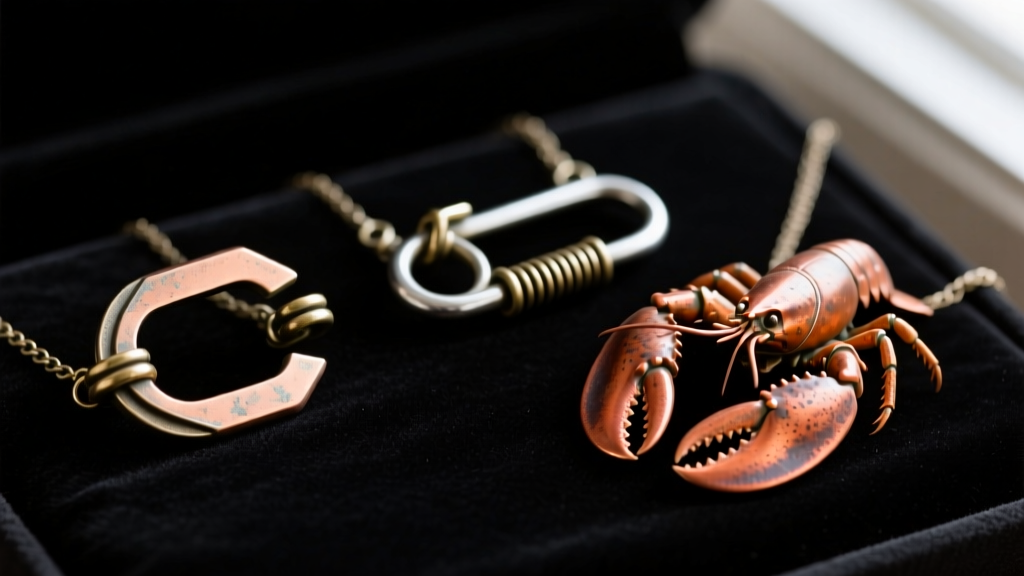
| Lobster Claw | 1970s – Present | Heavy-duty, cast or stamped mechanism. If found on a purportedly Victorian piece, it is an immediate red flag for a replacement or reproduction. |
When evaluating a piece, always check the jump ring connecting the clasp to the chain. If the jump ring is machine-snapped rather than hand-soldered closed, but the chain itself features hand-soldered links, the clasp has likely been replaced in the last thirty years.
Link Morphology and Solder Signatures
The chain itself holds microscopic clues that anchor the piece to the necklace dateline. Before the widespread adoption of automated chain-making machinery in the mid-20th century, chains were drawn, cut, and soldered by hand.
Hand-Soldered vs. Machine-Soldered Links
Under 10x to 20x magnification, antique chains (pre-1930) exhibit distinct solder seams. A bench jeweler would use a blowpipe to apply hard solder to the butt-joint of each individual link. This results in a slightly raised, sometimes uneven seam that may show minor oxidation or patina differences from the base metal. Conversely, modern machine-made chains utilize flash-soldering or laser welding, creating seams that are virtually invisible or perfectly uniform. If you are examining a heavy, ornate Edwardian-style chain and the link seams are flawless and lack microscopic file marks, you are likely looking at a late 20th-century or contemporary reproduction.
Gauge Inconsistencies
Wire drawing in the 19th and early 20th centuries was less standardized than today’s laser-calibrated extrusion processes. It is common to find slight gauge variations (e.g., fluctuating between 1.1mm and 1.25mm) within a single antique chain. Modern reproductions typically feature mathematically perfect gauge uniformity throughout the entire length of the necklace.
Hallmarks and Legislative Milestones
Hallmarks are the legal fingerprints of jewelry, and their presence (or absence) provides hard data points for the necklace dateline. The Victoria and Albert Museum’s Jewellery Collection emphasizes that understanding regional hallmarking laws is essential for accurate dating.
- The 1906 US National Gold and Silver Stamping Act: Before this act, American jewelry was rarely stamped with purity marks, relying instead on the maker’s mark or retailer’s guarantee. If a purportedly 1880s American gold necklace features a crisp "14K" stamp alongside a registered trademark symbol (®), it is an anachronism. The trademark symbol was not widely used in US jewelry stamps until the mid-20th century.
- The French Eagle Head (1838–Present): Introduced in 1838, the eagle head (<i>tête d'aigle</i>) guarantees a minimum of 18k gold. On antique French necklaces, this mark is often stamped on the clasp tongue or the primary jump ring. Over decades of wear, the stamp can become filled with polish and patina; a pristine, sharp eagle head on a heavily worn chain suggests a modern recasting or a replaced clasp.
- British Date Letters: The UK assay system includes a letter stamp that changes annually, paired with a specific shield shape and font. Cross-referencing the date letter with the London Assay Office databases allows appraisers to pinpoint the exact year a necklace was hallmarked, providing the most definitive anchor on the necklace dateline.
Material Transitions: Platinum, White Gold, and Plastics
The metallurgical composition of a necklace is deeply tied to global events and technological advancements, forming another critical layer of the dateline.
The Platinum Boom and Bust
Platinum became the premier metal for fine necklaces during the Edwardian era (1901–1915) due to its strength, which allowed for the intricate, lace-like pierced openwork designs of the period. However, during World War I, platinum was classified as a strategic military metal and banned for civilian jewelry use. If you encounter a delicate, pierced filigree necklace that tests as white gold but features design motifs strictly associated with 1910, it is likely a 1920s piece created during the platinum shortage, or a later white-gold revival.
Early White Gold and Rhodium Plating
White gold was patented in the early 20th century as a platinum substitute. Early white gold alloys (often mixed with nickel and palladium) retained a distinct yellowish-grey tint. To mask this, jewelers began electroplating the pieces with rhodium. Under magnification, vintage white gold necklaces from the 1920s and 1930s will often show rhodium wear in the crevices of the links, revealing the warmer, yellowish undertone of the original alloy beneath. Modern white gold alloys are formulated to be naturally whiter, and contemporary rhodium plating techniques are vastly superior, meaning heavy flaking in crevices is a strong indicator of age.
Troubleshooting "Frankenstein" Necklaces
A "Frankenstein" necklace is a piece cobbled together from different eras, either to repair a broken chain or to artificially inflate its perceived value by attaching an antique pendant to a modern chain. The necklace dateline helps you spot these composite pieces through three primary technical failures:
- Solder Flow Discrepancies: If the jump ring attaching the pendant to the chain exhibits modern, smooth laser-soldering, while the pendant’s bail shows rough, oxidized 19th-century torch soldering, the components were married recently.
- Patina Mismatch: Silver and low-karat gold develop a microscopic layer of oxidation (patina) over decades. A genuine Victorian chain will have patina built up in the inner curves of the links where polishing cloths cannot reach. If the chain is bright and polished but the clasp is heavily tarnished, the chain is likely a modern replacement.
- Gauge and Wear Incompatibility: Look at the hole in the pendant’s bail. If a pendant has been worn on a chain for 100 years, the friction of the metal jump ring will carve a distinct, elongated wear groove into the bail. If the bail is perfectly round but the pendant shows heavy surface wear, it has spent most of its life in a jewelry box, not on a necklace.
By rigorously applying the necklace dateline—scrutinizing clasps, analyzing solder seams under magnification, decoding hallmarks, and understanding historical metallurgy—you can confidently separate genuine historical artifacts from clever reproductions and composite imitations. This technical diligence is the hallmark of true expertise in the vintage jewelry market.


