Tiny Cross Necklace Gold: An Expert Guide to Alloys, Gauges, and Bails
Discover the technical anatomy of a tiny cross necklace gold. Expert insights on 14k vs 18k alloys, chain gauges, bail types, and micro-soldering.
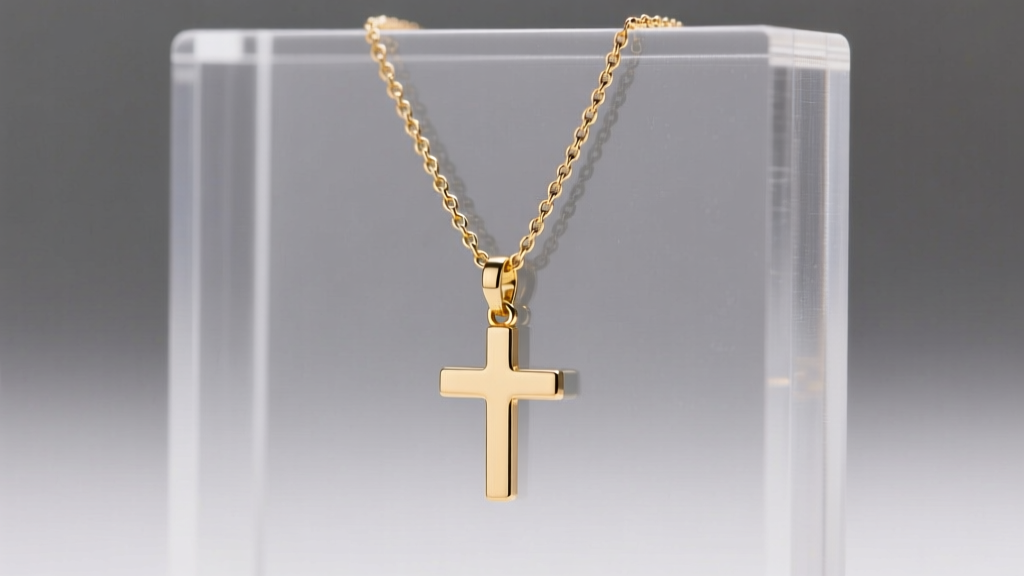

When evaluating a tiny cross necklace gold design, the untrained eye sees a simple symbol of faith or fashion. However, from a master jeweler’s perspective, micro-pendants—typically defined as ranging from 8mm to 15mm in height—present a unique set of metallurgical and structural challenges. Crafting a piece this small requires precise engineering to ensure the bail withstands daily friction, the alloy resists bending, and the chain pairing maintains visual harmony. In this technical deep dive, we deconstruct the anatomy of micro-cross pendants, exploring alloy hardness, bail mechanics, and chain gauge matrices to help you make an informed, expert-level purchase.
Metallurgy and Alloy Selection for Micro-Pendants
The structural integrity of a tiny gold cross is entirely dependent on its alloy composition. Pure 24k gold is far too malleable for micro-jewelry; a 10mm 24k cross would bend under the slightest tension. Therefore, alloying metals like copper, silver, and zinc are introduced to increase the Vickers hardness (HV) of the material.
- 10k Gold (41.7% Pure): With a Vickers hardness of roughly 130-150 HV, 10k is highly durable but lacks the rich, warm color saturation desired in fine jewelry. It is prone to oxidation and tarnishing over time due to the high copper content.
- 14k Gold (58.5% Pure): The industry standard for everyday micro-pendants. 14k gold sits at an optimal 120-140 HV, providing excellent resistance to warping while maintaining a beautiful color. According to the Gemological Institute of America (GIA), 14k offers the best compromise between durability and gold content for delicate chains and small pendants.
- 18k Gold (75% Pure): Softer and warmer in color, 18k gold measures around 90-110 HV. While it offers superior hypoallergenic properties and a luxurious hue, an 18k tiny cross is more susceptible to scratching and bail wear over a decade of continuous use.
For a tiny cross necklace gold design that will be worn daily in the shower and during sleep, 14k solid gold is the undisputed technical choice for longevity.
The Mechanics of the Bail: Soldered vs. Integrated
The bail—the loop that connects the pendant to the chain—is the primary failure point in micro-jewelry. Because the cross itself is so small, the bail must be proportionally microscopic, often measuring less than 2mm in interior diameter.
Integrated Bails
In high-quality manufacturing, the bail is cast as a single, continuous piece with the cross pendant. This eliminates the need for a solder joint, removing the risk of shear-stress failure. However, integrated bails limit the thickness of the chain that can pass through, usually capping out at 1.2mm.
Soldered Jump Ring Bails
Lower-cost or custom micro-crosses often utilize a tiny jump ring soldered to the top of the cross. If this is torch-soldered, the heat can sometimes warp the thin arms of a 10mm cross. Expert jewelers use laser welding for micro-bails, which concentrates heat into a 0.2mm spot, fusing the joint without thermally stressing the surrounding gold.
Solid Casting vs. Electroformed Hollow Gold
Not all tiny gold crosses are created equal beneath the surface. When shopping, you must determine whether the piece is solid cast or electroformed.
Electroforming is a process where gold is deposited over a wax or resin core, which is later melted or dissolved away. This creates a lightweight, hollow pendant that looks substantial but is incredibly fragile. A hollow 12mm cross can easily be crushed if slept on. Conversely, solid centrifugal casting ensures the pendant is dense gold throughout. While a solid 14k tiny cross weighing 1.2 grams will cost significantly more in raw material than a 0.3-gram hollow version, it will survive decades of wear without denting.
Chain Gauge and Profile Pairing Matrix
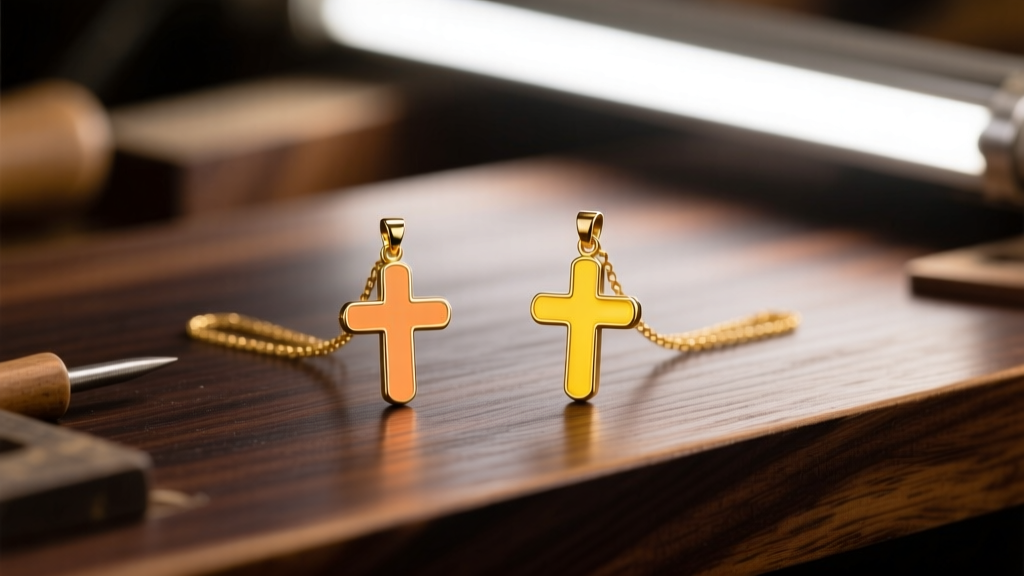
Pairing the correct chain with a tiny cross necklace gold pendant is an exercise in visual weight and mechanical tolerance. A chain that is too thick will overpower the micro-pendant and cause excessive friction inside the bail, acting like a file that slowly wears away the gold. A chain that is too thin (under 0.8mm) is prone to kinking and snapping.
| Pendant Height | Ideal Chain Width | Recommended Chain Profile | Friction Risk Level |
|---|---|---|---|
| 8mm - 10mm | 0.8mm - 1.0mm | Cable or Fine Box | Low |
| 11mm - 13mm | 1.0mm - 1.2mm | Box or Rope | Medium |
| 14mm - 15mm | 1.2mm - 1.5mm | Rope or Wheat | Medium-High |
As noted by Jewelers of America, matching the chain's metal hardness to the pendant's bail is crucial. If you use a hardened steel-clasped chain or a chain with sharp, unpolished links, it will aggressively erode a soft 18k gold bail over time. Always opt for polished, rounded link profiles like the classic cable or box chain for micro-pendants.
Prong Integrity and Gemstone Setting in Tiny Crosses
Many tiny gold crosses feature a single diamond or a micro-pavé array of accent stones. When the entire pendant is only 12mm tall, the arms of the cross may be just 2mm wide. Setting a 1.5mm round brilliant diamond into a 2mm wide arm leaves less than 0.25mm of gold for the prongs.
At this micro-scale, traditional four-prong settings are highly vulnerable to snagging on textiles, which can lift the microscopic prongs and result in stone loss. Expert gemologists and setters prefer micro-bezel or flush (gypsy) settings for tiny cross necklaces. These settings encircle the stone's girdle or bury it entirely within the gold, offering maximum protection against impact and snagging without sacrificing the piece's minimalist aesthetic.

Pricing Tiers and Value Assessment
Understanding the pricing structure of a tiny cross necklace gold piece prevents overpaying for brand markup while ensuring you don't underpay for fragile, hollow merchandise. Prices are dictated by three main factors: gold spot price, labor complexity, and brand prestige.
- Entry-Level ($80 - $150): Typically hollow electroformed gold or very low gram-weight (under 0.8g) solid 10k/14k gold. Chains are usually 0.6mm to 0.8mm and prone to tangling.
- Mid-Tier Artisan ($180 - $350): Solid 14k gold, weighing between 1.0g and 2.0g. Features integrated bails, high-polish finishes, and paired with a durable 1.0mm box chain. This is the sweet spot for value and longevity.
- Luxury / Designer ($500 - $1,200+): Solid 18k gold, often featuring precision-set VVS diamonds in micro-bezel settings. You are paying for advanced CAD design, luxury packaging, and brand heritage rather than raw gold weight.
Expert Maintenance Protocols
To maintain the structural integrity of your micro-pendant, avoid ultrasonic cleaners if the cross features gemstones. The high-frequency vibrations can easily shake loose micro-prongs that are already under immense stress due to the tiny surface area. Instead, clean your tiny gold cross using a soft-bristled baby toothbrush, warm water, and a drop of mild dish soap, gently brushing the bail loop where skin oils and lotions accumulate and cause dullness. By understanding the technical nuances of alloys, bails, and chain gauges, you can select a piece that remains both structurally sound and visually striking for a lifetime.