Triple Crown Necklaces: Material Guide for Layered Strands
Discover the best metals for triple crown necklaces. Compare tensile strength, tarnish resistance, and ideal chain gauges for 3-strand jewelry designs.

The Engineering Challenge of Triple Crown Necklaces
When jewelers and collectors discuss triple crown necklaces, they are typically referring to one of two distinct styles: a structured three-strand layered chain, or a statement piece featuring three distinct equestrian-themed pendants representing the Kentucky Derby, Preakness, and Belmont Stakes. Regardless of the aesthetic, the physics remain the same. These designs carry two to three times the dead weight of a standard solitaire pendant chain, placing immense mechanical stress on the posterior links, the solder joints, and the clasp assembly.
As we navigate the jewelry market in 2026, advancements in metallurgical alloys and precision laser welding have shifted how we evaluate chain durability. However, the fundamental properties of precious metals dictate how a triple-strand or tri-pendant piece will survive daily wear. Choosing the wrong metal grade or chain gauge for a triple crown design is the leading cause of catastrophic clasp failure and link elongation.
Metal Tensile Strength & Chain Gauge Requirements
The structural integrity of any multi-strand necklace relies heavily on the yield strength of the chosen alloy. Yield strength measures the point at which a metal will permanently deform (stretch) rather than return to its original shape. In a triple crown necklace, the bottom strand or the central pendant bail experiences the highest vector of gravitational pull.
Below is a comparative analysis of common jewelry metals, their yield strengths, and the minimum recommended wire gauge for a triple-strand configuration supporting 30 to 50 grams of total weight.
| Metal Alloy | Yield Strength (MPa) | Minimum Gauge (mm) | Est. Price (per gram) |
|---|---|---|---|
| Sterling Silver (925) | ~170 MPa | 1.5mm | $1.20 - $2.00 |
| 14k Yellow Gold | ~250 MPa | 1.2mm | $35.00 - $45.00 |
| 18k Yellow Gold | ~180 MPa | 1.4mm | $45.00 - $55.00 |
| Platinum (950) | ~280 MPa | 1.0mm | $30.00 - $40.00 |
| Grade 5 Titanium | ~880 MPa | 0.8mm | $5.00 - $10.00 |
According to metallurgical data from the World Gold Council, alloying pure 24k gold with copper and silver not only changes the color but drastically alters the work-hardening capabilities of the metal. A 14k yellow gold chain work-hardened during the drawing process can achieve a tensile strength exceeding 800 MPa, making it highly suitable for the fine but strong links required in delicate triple crown designs.
Friction & Micro-Abrasion: Why Metal Hardness Matters
In a three-strand triple crown necklace, the chains are in constant kinetic contact. As the wearer moves, the links grind against one another, creating a localized environment of micro-abrasion. This is where the Mohs hardness scale and the metal's wear resistance become critical factors.
The Mohs Scale in Multi-Strand Wear
Sterling silver (925) sits at a Mohs hardness of roughly 2.5 to 3. When three strands of sterling silver rub together daily, the friction literally sands the metal away. Over a period of three to five years, it is common to see up to 15% material loss in the posterior links of a silver multi-strand necklace.
Platinum (950 alloy), conversely, has a Mohs hardness of 4 to 4.5. More importantly, platinum exhibits high ductility and a unique displacement property. When platinum links scratch against each other, the metal is displaced rather than shed. This creates a patina but preserves the structural mass of the chain. The Gemological Institute of America (GIA) frequently highlights platinum's superior durability for heavy, multi-stone, or multi-strand settings precisely because of this non-shedding characteristic.
Pro-Tip for White Gold: If your triple crown necklace is crafted from 14k or 18k white gold, it is likely plated with rhodium. The friction between three strands will strip this rhodium plating from the contact points within weeks, revealing the yellowish-grey alloy beneath. For multi-strand white metal pieces, unplated 950 Platinum or Palladium is vastly superior to rhodium-plated white gold.
Clasp Failure Modes in Heavy Tri-Strand Pieces
The clasp is the single most vulnerable point of failure on any triple crown necklace. A standard 10mm spring ring clasp is rated for approximately 10 to 15 grams of static tension. A robust triple-strand piece with solid metal pendants can easily exceed 45 grams, not counting the dynamic kinetic shock of the wearer walking or jogging.
- Spring Ring Clasps: High failure rate. The internal steel spring will fatigue, or the hollow outer shell will crush under the dynamic load of three heavy strands.
- Lobster Claw Clasps: Moderate reliability. A solid 15mm lobster claw can handle the weight, but the lever mechanism is prone to bending if the necklace is caught on clothing.
- Magnetic Clasps: Generally discouraged for heavy triple crown pieces. Unless the clasp utilizes a high-grade N52 neodymium core with a secondary mechanical locking sleeve, the kinetic shock of three bouncing strands will easily break the magnetic field's hold.
- Box Clasps with Figure-8 Safeties: The gold standard. A tongue-and-groove box clasp distributes the tensile load across a wide surface area, while the dual figure-8 wire safeties catch the chain if the primary box mechanism fails.
Casting Porosity in Equestrian Triple Crown Motifs
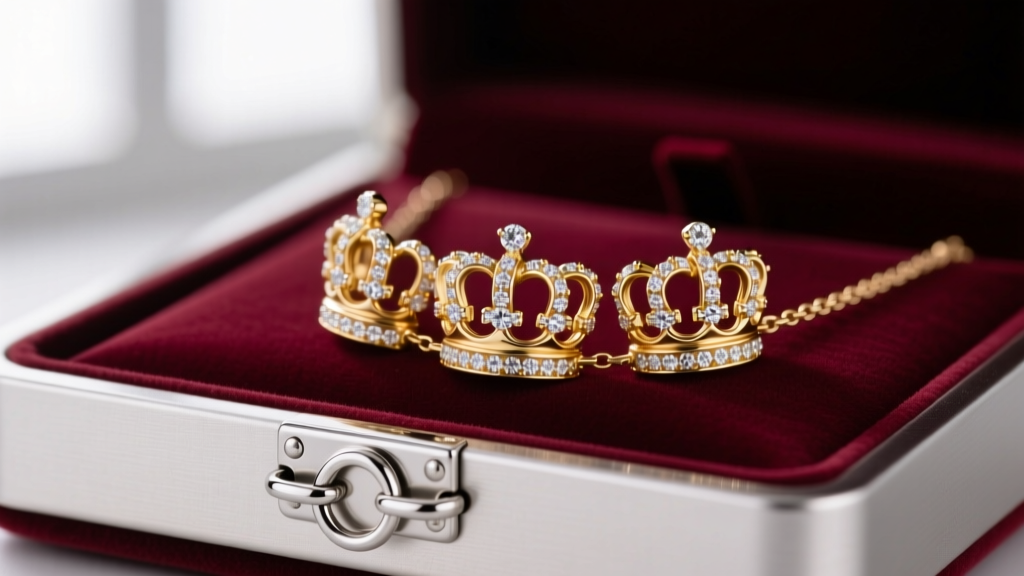
For those whose triple crown necklace features the iconic equestrian motif—three intricate 3D medals, crowns, or horseshoes—the manufacturing method introduces another material variable: casting porosity. Intricate pendant designs require the molten metal to flow into extremely fine mold cavities.
If the alloy is not properly deoxidized, microscopic gas pockets (porosity) become trapped inside the pendant. While hidden from the naked eye, these voids act as stress concentrators. If a heavy triple crown medal is dropped or struck, it will fracture exactly at the site of internal porosity. Modern master casters utilize silicon-bearing master alloys (such as 14k gold with a 0.1% silicon addition) to improve metal fluidity and act as a deoxidizer, resulting in dense, pore-free castings that can withstand the pendulum-like swinging of a heavy triple-strand chain.
Galvanic Corrosion: Mixing Metals in Layered Designs
Some avant-garde triple crown necklaces mix metals across the three strands—for example, an oxidized silver inner strand, a 14k yellow gold middle strand, and a copper outer strand. While visually striking, this introduces the risk of galvanic corrosion.
When two dissimilar metals are in physical contact in the presence of an electrolyte (such as human sweat, which is rich in sodium chloride), an electrochemical cell is formed. The more anodic metal will corrode at an accelerated rate.
In the galvanic series, copper is highly anodic compared to gold. If a copper strand constantly rubs against a gold strand while the wearer is sweating, the copper will rapidly oxidize and degrade, leaving dark, corrosive residue on the gold links. To prevent this, mixed-metal triple crown necklaces must utilize physical separators, such as silicone micro-tubing or PTFE-coated wire wraps, at the junction points where the strands meet the primary clasp ring.
Final Verdict: Choosing Your Metal
Selecting the right material for a triple crown necklace requires balancing aesthetic preference with mechanical reality. If you prioritize heirloom longevity and are investing in a heavy, intricate equestrian motif or a thick three-strand design, 950 Platinum or 14k Yellow Gold (work-hardened) are the undisputed champions. They offer the necessary yield strength to prevent link elongation and the wear resistance to survive years of inter-strand friction.
Conversely, if you are opting for Sterling Silver, you must compensate for its lower tensile strength and hardness by increasing the chain gauge to a minimum of 2.0mm and committing to regular ultrasonic cleaning and polishing to manage the inevitable micro-abrasion. By understanding the metallurgical properties outlined above, you can ensure your triple crown necklace remains a structural triumph for decades to come.