Troubleshooting the Average Necklace Length for Women: A Fit Guide
Discover why the average necklace length for women fails your proportions. Learn bust-to-chain math, gauge rules, and troubleshooting fixes.


If you have ever ordered a piece of jewelry online, only to find it sitting awkwardly on your chest, you are not alone. The jewelry industry frequently cites 18 inches as the average necklace length for women. However, treating this single measurement as a universal standard is one of the most common styling mistakes in modern accessorizing. An 18-inch chain might drape perfectly on a 5'4" woman with a 34-inch bust, but it will choke a woman with a broader ribcage or disappear entirely into the neckline of a modest blouse.
Troubleshooting necklace fit requires moving beyond generic size charts and understanding the biomechanics of how chains interact with your unique anatomy, clothing, and pendant weights. In this guide, we will diagnose the most common length disasters and provide actionable, mathematical solutions to ensure your necklaces sit exactly where they should.
The Myth of the "Average" Measurement
According to industry guidelines from experts like Brilliant Earth, standard necklace lengths are categorized into distinct tiers: choker (14-16 inches), princess (18 inches), matinee (20-24 inches), and opera (28-36 inches). The 18-inch princess length is mass-produced as the default. But mass production does not account for human variance.
| Industry Standard Length | Intended Placement | Common Fit Failure | Best Troubleshooting Fix |
|---|---|---|---|
| 16 Inches (Choker/Base) | Wraps snugly around the neck base | Feels restrictive; clasp digs into the nape | Upgrade to 17" or add a 1" extender chain |
| 18 Inches (Princess) | Rests on the collarbone | Dips into the cleavage on larger busts | Size up to 20" for a true collarbone drape |
| 20-22 Inches (Matinee) | Falls just above the bustline | Gets tangled in button-down shirts | Pair strictly with V-necks or scoop necks |
| 24+ Inches (Opera) | Falls below the bust | Pendant flips outward; chain swings wildly | Use a heavier gauge chain (2.0mm+) for weight |
Troubleshooting Common Length & Fit Disasters
When the average necklace length for women fails you, the issue usually manifests in one of three specific ways. Here is how to diagnose and fix them.
Problem 1: The "Floating" Choker (14-16 inches)
The Symptom: A 16-inch chain is supposed to sit at the base of the neck. Instead, it slides up, choking you, or the clasp constantly rotates to the front.
The Diagnosis: Your neck circumference is likely over 14.5 inches, or you have a prominent C7 vertebra (the bone at the base of your neck) that pushes the chain upward. Furthermore, lightweight chains (under 1.0mm gauge) lack the physical mass to anchor themselves against the friction of skin and hair.
The Fix: Abandon the 16-inch standard. Opt for a 17-inch chain, which is an often-overlooked "in-between" size that accommodates the average adult female neck (13-15 inches) while allowing a half-inch of breathing room. If you must use a 16-inch chain, choose a heavier gauge, such as a 1.5mm rope chain, which provides enough downward gravitational pull to keep the clasp anchored at the nape.
Problem 2: The Disappearing Pendant (18 inches)
The Symptom: You bought an 18-inch chain with a beautiful pendant, but it hides inside your shirt or rests awkwardly on the slope of your bust rather than your collarbone.
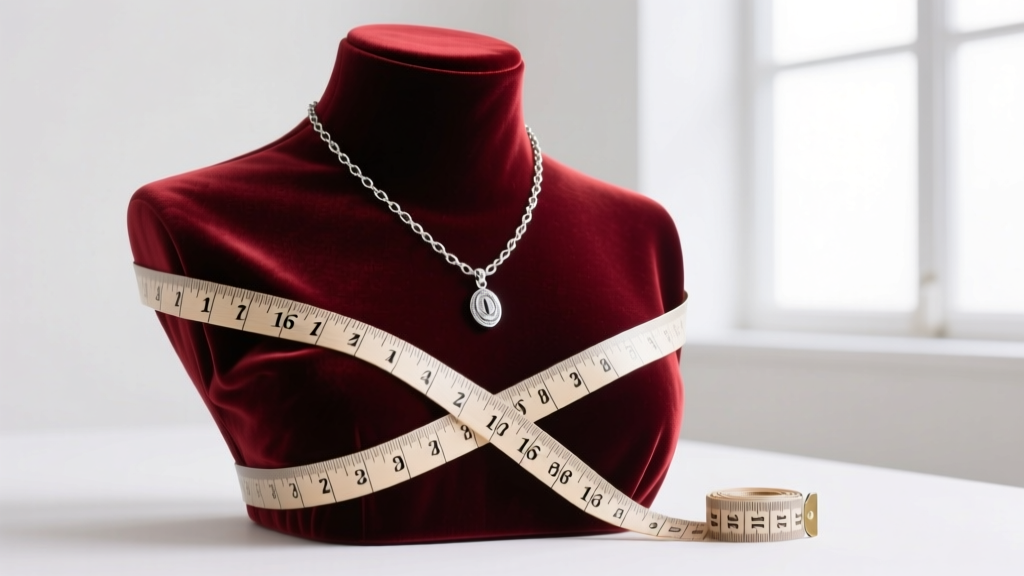
The Diagnosis: The "average" 18-inch measurement is calculated on a flat, standard dress form. As James Allen notes in their fitting guides, bust volume drastically alters chain geometry. For every 2 inches your bust measures over a 34-inch baseline, an 18-inch chain will ride approximately 0.5 inches higher on the chest, pushing it into the hollow of the cleavage rather than resting on the sternum.
The Fix: Apply the Bust-to-Chain Ratio. If your bust is 38 inches, you need a 19-inch chain to achieve the visual effect of an 18-inch chain on a standard mannequin. If your bust is 42 inches, size up to a 20-inch matinee length.
Problem 3: The Matronly Drop (20-24 inches)
The Symptom: A 22-inch chain looks elegant on the hanger but makes your torso look disproportionately short and boxy when worn.
The Diagnosis: You are pairing a matinee-length necklace with the wrong neckline. A 22-inch chain that hits exactly at the apex of a high crew neck creates a harsh horizontal line that cuts the torso in half, visually widening the ribcage.
The Fix: Matinee lengths require negative space. They must be paired with deep V-necks, scoop necks, or open blouses. The chain should frame the skin, not compete with a high fabric hemline.
How to Perform the Tape Measure Test
Never guess your size based on a product description. Before purchasing, perform this 60-second diagnostic test:
- Step 1: Use a flexible tailor's measuring tape, not a rigid metal ruler.
- Step 2: Stand in front of a mirror wearing the exact neckline you intend to pair with the necklace.
- Step 3: Loop the tape around your neck and adjust it to the desired drop point.
- Step 4: Note the measurement. If you plan to add a pendant that is 1 inch long, subtract 1 inch from your tape measure reading to account for the pendant's drop.
- Step 5: Check the back of your neck. Ensure the tape isn't catching on your hairline or collar.
Pro-Tip: Always account for the clasp hardware. A standard lobster clasp and jump ring add roughly 0.5 inches to the total wearable length of a chain. If a jeweler lists a chain as 18 inches, that usually includes the hardware, but custom handmade pieces may measure 18 inches in chain plus the clasp.
Material, Gauge, and Clasp Troubleshooting
Length is only half the battle; the physical properties of the metal dictate how the necklace behaves in three-dimensional space.
Pendant Weight vs. Chain Gauge
A common troubleshooting nightmare is a pendant that constantly flips backward, hiding against your skin. This happens when the chain is too rigid or too thick to slide smoothly through the pendant bail. Conversely, if your chain is a delicate 0.8mm cable chain and you attach a 5-gram gemstone pendant, the chain will kink, stretch, and eventually snap at the soldering point near the clasp.
The Golden Ratio: The pendant should weigh no more than 3 times the weight of the chain. For a standard 1.2mm cable chain (which weighs roughly 1.5 grams per 18 inches), your pendant should not exceed 4.5 grams. If you prefer heavy pendants (10g+), you must upgrade to a 2.0mm to 3.0mm box or wheat chain to provide adequate structural support.
The 2-Inch Extender Rule
If you are buying jewelry as a gift or are caught between two standard sizes (e.g., you measure 17.25 inches), always prioritize chains that include a 2-inch extender chain. This small addition transforms a rigid 16-inch choker into a versatile 18-inch princess piece. Ensure the extender chain is made of the same metal alloy (e.g., 14k gold or 925 sterling silver) to prevent galvanic corrosion and uneven tarnishing at the connection points.
Final Thoughts on Finding Your True Fit
The concept of an "average" is a manufacturing convenience, not a styling rule. By understanding how your bust volume, neck circumference, and clothing choices interact with chain geometry, you can stop wasting money on ill-fitting jewelry. Ditch the generic size charts, grab a tailor's tape, and apply the troubleshooting frameworks above to curate a necklace collection that actually flatters your unique proportions.


