Troubleshooting a Broken Blue Lace Agate Bead Necklace
Is your blue lace agate bead necklace breaking or fading? Learn expert troubleshooting tips for restringing, cleaning, and authenticating your stones.

The Anatomy of Blue Lace Agate Bead Failures
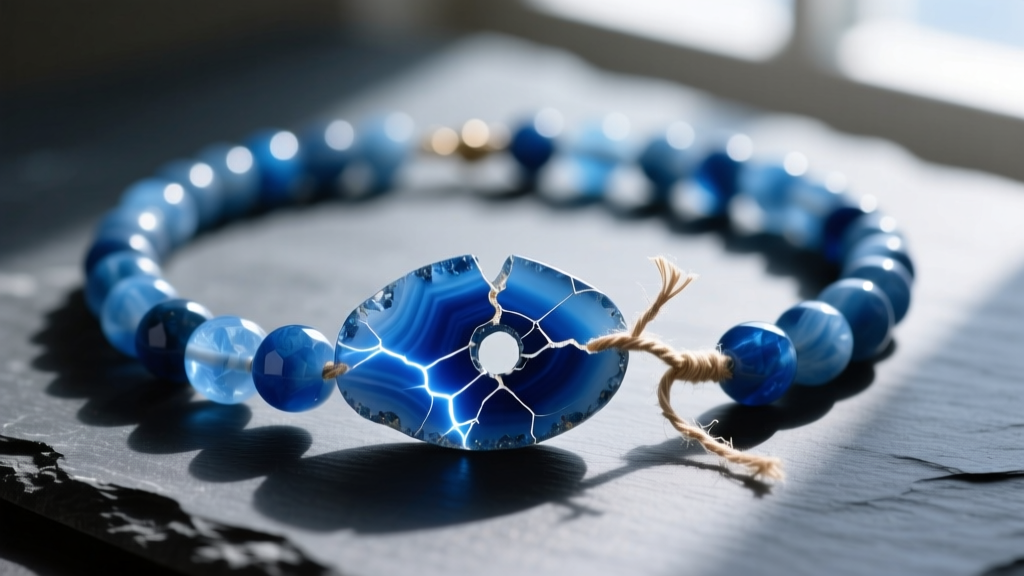
Blue lace agate, a stunning banded variety of chalcedony, is prized for its delicate, wavy blue patterns and soothing aesthetic. However, owning and maintaining a blue lace agate bead necklace comes with unique structural and chemical challenges. According to the Gemological Institute of America (GIA), chalcedony ranks between 6.5 and 7 on the Mohs hardness scale. While this makes the stone relatively hard and resistant to surface scratching, it also means the material is inherently brittle and prone to chipping or fracturing under sudden impact.
The most common point of failure in stone bead necklaces is not the bead itself, but the interaction between the bead's drill hole and the stringing material. Mass-produced agate beads are often drilled quickly using diamond-tipped core bits. If the lapidary does not properly ream or polish the inside of the drill hole, microscopic silica burrs are left behind. These sharp, glass-like edges act like tiny knives, slowly sawing through stringing threads every time the necklace bends or flexes against the wearer's collarbone.
Troubleshooting Stringing and Breakage
Why Silk Thread Fails on Heavy Stone Beads
A frequent mistake made by amateur jewelry makers is stringing heavy stone beads on traditional silk thread. Silk is the gold standard for freshwater pearls because pearls are lightweight and have smooth, rounded drill holes. An 8mm round blue lace agate bead, however, weighs approximately 0.85 grams. A standard 18-inch princess-length necklace requires roughly 55 of these beads, creating nearly 47 grams of continuous tensile stress on the thread. Over time, the weight of the agate stretches the silk, causing the necklace to sag and eventually snap at the clasp or the center bead.
The Best Stringing Materials for 0.8mm Drilled Beads
To solve chronic breakage, you must upgrade your stringing medium. For standard 6mm to 8mm agate beads with 0.8mm to 1.0mm drill holes, multi-strand braided beading wire is the industry standard. Specifically, a 49-strand stainless steel wire coated in nylon offers the perfect balance of drape and tensile strength. If your beads have particularly sharp internal burrs that you cannot smooth out with a bead reamer, consider using a high-performance braided polyethylene line, which resists abrasion far better than standard nylon-coated wire.
| Stringing Material | Diameter | Tensile Strength | Best Use Case |
|---|---|---|---|
| Silk Thread (Size F) | 0.38mm | 12 lbs | Lightweight pearls, knotting between beads |
| Nylon Power Pro | 0.20mm | 15 lbs | Seed beads, lightweight gemstones |
| 49-Strand Beading Wire | 0.018 in | 20 lbs | Standard 6mm-8mm agate and quartz beads |
| 49-Strand Beading Wire | 0.024 in | 40 lbs | Heavy 10mm+ stone beads, large focal pendants |

Solving Color Fading and Cloudiness
One of the most distressing issues for collectors is noticing their vibrant blue lace agate bead necklace fading to a dull gray or developing a cloudy, opaque film. To troubleshoot this, you must first determine if your stones are naturally colored or dyed. While natural blue lace agate exists, a significant portion of the commercial market consists of pale gray or white chalcedony that has been chemically dyed to enhance the blue banding.
If your necklace is dyed, exposure to ultraviolet (UV) light, harsh perfumes, or acetone-based cosmetics will cause the dye molecules to break down or leach out, resulting in uneven fading. To test for dye, dampen a cotton swab with a small amount of nail polish remover (acetone) and rub it gently against an inconspicuous bead near the clasp. If blue transfers to the swab, your stones are dyed. You must keep dyed agate away from direct sunlight and chemical cleaners.
Furthermore, never clean a blue lace agate necklace in an ultrasonic jewelry cleaner. The high-frequency cavitation bubbles created by ultrasonic machines can easily penetrate the microscopic fissures along the natural banding planes of the chalcedony, causing the beads to crack or shatter internally. Instead, use a soft, damp microfiber cloth and a drop of mild, phosphate-free dish soap to gently wipe the beads, drying them immediately.
Authenticating Your Blue Lace Agate
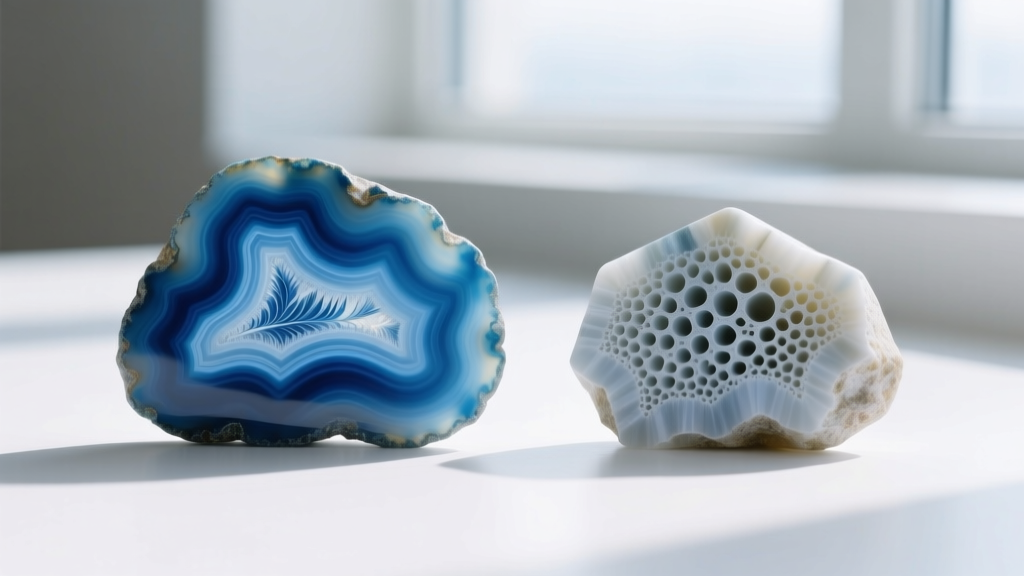
Because high-quality blue lace agate commands a premium price, the market is flooded with convincing imitations. The most common substitute is dyed howlite, a porous borate mineral that mimics the wavy banding of agate when dyed blue. Troubleshooting a suspected fake requires a few simple gemological tests, supported by guidelines from the American Gem Society.
- The Scratch Test: Howlite is very soft, ranking at 3.5 on the Mohs scale. A standard steel sewing needle (Mohs 5.5) will easily scratch howlite, leaving a white powdery mark. True blue lace agate (Mohs 6.5-7) will not be scratched by steel.
- Magnification Inspection: Using a 10x jeweler's loupe, examine the surface of the beads. Dyed howlite will show dye concentrating deeply inside the natural porous veins of the stone, looking like dark blue spiderwebs. Natural agate will show smooth, wavy, concentric silica banding without porous dye pockets.
- Temperature Test: Chalcedony is a dense form of quartz and feels distinctly cold to the touch, taking several seconds to warm up against the skin. Howlite and glass imitations will warm up much faster.
- Refractive Index (RI): If you have access to a refractometer, true chalcedony will show an RI of 1.53 to 1.54, whereas glass imitations will often show higher or highly variable readings, and howlite will show an RI around 1.59.
Step-by-Step Restringing and Repair Guide
If your blue lace agate bead necklace has suffered a catastrophic stringing failure, follow this professional repair protocol to ensure it lasts for decades:
- Inspect and Ream: Before restringing, run a diamond-coated bead reamer through the drill hole of the bead that originally caused the break. Lubricate with water and gently smooth out any sharp silica burrs.
- Prepare the Wire: Cut a length of 0.018-inch 49-strand beading wire, leaving 4 inches of excess on both ends for finishing.
- Secure the Clasp: Thread a 2mm silver crimp tube onto the wire, followed by a wire guardian (French wire) to protect the wire from abrasion at the clasp loop. Pass the wire back through the crimp tube.
- Crimp and Trim: Use micro-crimping pliers to fold and round the crimp tube securely. String your agate beads, ensuring they sit flush but not so tight that the wire lacks flexibility.
- Finish the End: Repeat the crimping process on the opposite side, using crimping pliers to pull the wire taut before securing the final fold. Tuck the tail end of the wire back through the first three agate beads and snip flush with flush-cutters.
Expert Maintenance Checklist
To prevent future troubleshooting, adopt a proactive maintenance routine. Inspect the wire near the clasp every six months for signs of kinking or nylon coating wear. Store your blue lace agate bead necklace flat in a fabric-lined jewelry box; hanging heavy stone necklaces on vertical hooks can cause permanent stretching of the stringing medium and stress the drill holes. By understanding the specific material properties of chalcedony and utilizing the correct lapidary and stringing techniques, you can preserve the structural integrity and ethereal beauty of your jewelry for a lifetime.