Troubleshooting a Gold Safety Pin Necklace: Expert Fixes
Is your gold safety pin necklace tangling, catching, or losing its clasp tension? Discover expert troubleshooting tips and repair solutions.

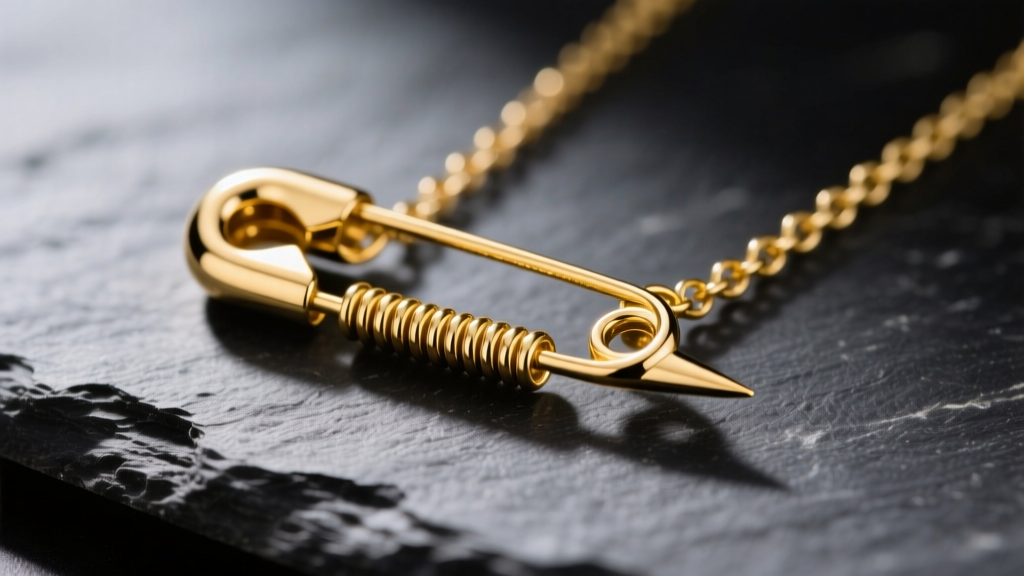
The Anatomy of a Safety Pin Pendant: Why They Fail
The gold safety pin necklace has transcended its punk-rock origins to become a staple of modern, edgy fine jewelry. However, the very mechanics that give this pendant its iconic shape also make it uniquely prone to functional failures. Unlike standard bail pendants that simply slide along a chain, a safety pin pendant features moving parts: a pin wire, a tension coil spring, a hood (or cap), and often a micro-safety chain. When any of these components fall out of alignment, the necklace becomes a frustrating liability.
As jewelry specialists, we see three primary complaints with this specific pendant style: the clasp failing to stay closed (the 'pop-open' issue), the chain constantly tangling in the pin gap, and severe grime buildup within the coil spring. Troubleshooting a gold safety pin necklace requires an understanding of both metallurgy and mechanical tension. Below, we break down exactly how to diagnose and resolve these issues to restore your necklace's functionality and aesthetic appeal.
Troubleshooting Clasp Tension and the 'Pop-Open' Issue
Nothing is more anxiety-inducing than wearing a valuable gold pendant only to feel the clasp give way. The safety pin mechanism relies on the spring tension of the pin wire pressing firmly into the interior of the hood. Over time, repetitive opening and closing, or accidental snagging on heavy fabrics, can pull the pin wire slightly outward, reducing the tension.
The 3-Point Tension Test
Before attempting any repairs, perform the 3-Point Tension Test to diagnose the exact failure point:
- Point 1 (The Hinge): Check for lateral play. If the pin wiggles side-to-side at the base hinge, the hinge tube is worn or the rivet is loose.
- Point 2 (The Coil): Gently press the coil spring. It should offer immediate, snappy resistance. If it feels mushy, the coil has suffered metal fatigue.
- Point 3 (The Hood Fit): Close the pin. It should produce an audible 'click' or 'snap'. If it slides in silently and pulls out without resistance, the pin wire is bent away from the hood's interior wall.
The Fix: If the issue is Point 3, you can carefully adjust the pin wire. Using nylon-jaw pliers (never bare metal pliers, which will mar the gold), apply extremely gentle pressure to the pin wire, bending it microscopically toward the hood. Gold is highly malleable, so a fraction of a millimeter is all it takes. If the hinge (Point 1) is loose, do not attempt a DIY fix; the hinge pin requires professional re-tipping or re-riveting by a bench jeweler.
Solving the Tangling Problem: Chain and Pendant Dynamics
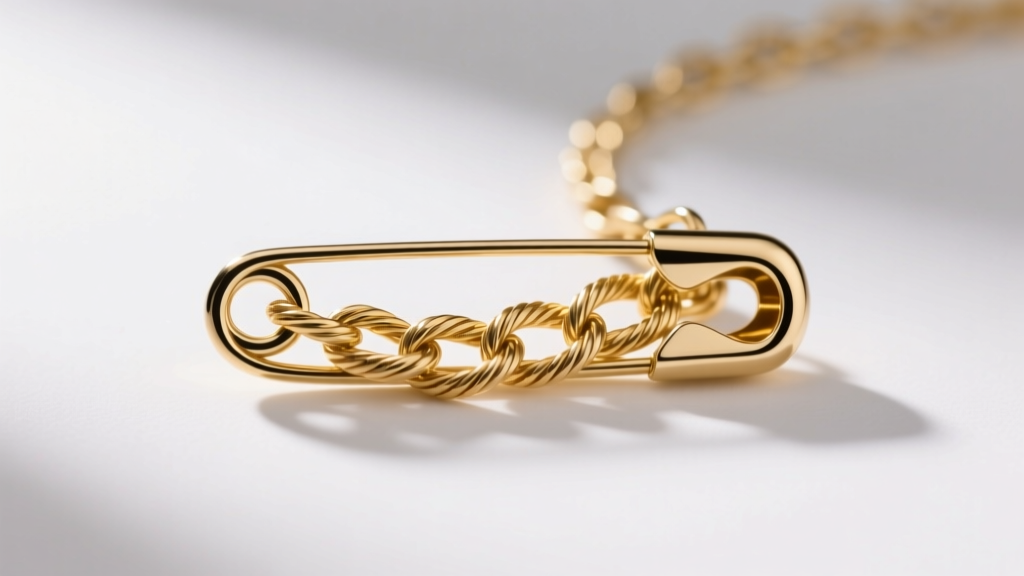
The most pervasive issue with a gold safety pin necklace is the chain slipping into the gap between the pin wire and the pendant body, effectively hooking itself and causing severe tangling. This is not a defect in the necklace; it is a mismatch in chain geometry.
The 'Link-to-Gap' Ratio
Tangling occurs when the individual links of your chain are small enough, and the wire gauge thin enough, to slide into the V-shaped gap of the safety pin. Standard 1.0mm or 1.2mm cable chains are notorious for this. To solve this permanently, you must alter the chain dynamics.
- Upgrade Chain Thickness: Switch to a chain with a minimum width of 2.5mm. A thicker rope, curb, or Figaro chain physically cannot fit into the narrow gap of the safety pin hood.
- Use Soldered Jump Rings: If you prefer a delicate chain, ensure the jump ring connecting the chain to the pin's top loop is soldered closed and is significantly larger than the pin gap. A 5mm or 6mm thick jump ring acts as a physical barrier, preventing the chain links from sliding down into the danger zone.
- Install a Fixed Bail: Some jewelers can solder a fixed, closed bail directly to the top loop of the safety pin, completely eliminating the open gap where chains migrate.
Material Wear: Karat Hardness and Mechanism Lifespan
Not all gold is created equal, especially when it comes to moving mechanical parts. The Gemological Institute of America (GIA) notes that pure gold is far too soft for functional jewelry components. Therefore, understanding the karat of your safety pin necklace is critical for troubleshooting its longevity and spring tension.
| Gold Karat | Vickers Hardness (Approx.) | Spring Tension Retention | Troubleshooting Profile |
|---|---|---|---|
| 10K Gold | 135 - 150 HV | Excellent | Highly durable; holds hinge and pin shape well, but prone to surface scratching. |
| 14K Gold | 120 - 140 HV | Very Good | The industry standard. Offers the best balance of rich color and mechanical memory for the pin wire. |
| 18K Gold | 110 - 125 HV | Fair to Good | Softer alloy. The pin wire is more susceptible to bending outward and losing tension over time. |
| 22K/24K Gold | 60 - 90 HV | Poor | Too soft for functional hinges. Usually cast as solid, non-moving decorative safety pins. |
If you own an 18K gold safety pin necklace, you will need to perform the 3-Point Tension Test more frequently, as the higher gold content makes the pin wire more prone to warping when snagged on clothing.
Deep Cleaning Crevices Without Damaging the Spring

The coiled spring at the base of the safety pin is a magnet for sebum, dead skin cells, lotion, and environmental dust. Over time, this buildup creates a hardened, dark ring that not only looks unsanitary but can actually impede the mechanical movement of the hinge, causing the pin to feel stiff or fail to close flush against the hood.
The Safe Soak and Agitate Method
While ultrasonic cleaners are fantastic for solid gold, they can sometimes vibrate micro-stones loose if your safety pin features pave diamonds. Furthermore, harsh chemical dips can degrade the solder points on the hinge. According to guidelines aligned with FTC jewelry care standards, gentle mechanical agitation is the safest route.
- Step 1: Mix warm (not hot) water with a few drops of mild, phosphate-free dish soap in a glass bowl.
- Step 2: Submerge the pendant for exactly 10 minutes to soften the sebum. Do not leave it for hours, as prolonged water exposure can trap moisture inside the hinge tube, leading to oxidation of the internal alloy metals.
- Step 3: Using an extra-soft baby toothbrush, gently scrub the coil spring in a circular motion. Do not pull or pick at the coil with a needle or pin, as this can stretch the spring and ruin the tension.
- Step 4: Rinse thoroughly under lukewarm running water, ensuring the hinge is fully flushed.
- Step 5: Use a can of compressed air or a hair dryer on the 'cool' setting to blow water out of the hinge tube. Moisture left in the hinge will cause stiffness.
When to Seek Professional Jeweler Intervention
While minor tension adjustments and deep cleaning can be performed at home, certain failure modes require the steady hand of a master bench jeweler. If your safety pin necklace exhibits any of the following symptoms, cease wearing it immediately and seek professional repair:
- Micro-Cracks at the Hinge: Inspect the base of the pin wire with a jeweler's loupe. If you see hairline fractures in the gold near the coil, the metal is suffering from severe fatigue and will snap without warning.
- Broken Safety Chain: Many high-end safety pin pendants feature a microscopic chain connecting the hood to the base to prevent loss if the main pin pops open. If this chain snaps, a jeweler must laser-weld it back into place.
- Stripped Hood Interior: If the pin wire is perfectly straight but still won't stay closed, the interior of the hood may be worn smooth. A jeweler can carefully add a microscopic bead of gold solder inside the hood to create a new friction catch.
By understanding the mechanical nuances of your gold safety pin necklace, you can transition it from a frustrating, tangled mess into a reliable, edgy statement piece that withstands the rigors of daily wear.


