Troubleshooting Your Real Seashell Necklace: Fixes & Care
Learn to clean, repair, and maintain your real seashell necklace. Expert troubleshooting for cracking, discoloration, and string degradation.

The Anatomy of Shell Degradation: Why Your Necklace is Failing
A real seashell necklace is more than just a beachy accessory; it is an organic artifact composed primarily of calcium carbonate (in the form of aragonite or calcite) and conchiolin, a complex protein matrix. While this combination creates stunning iridescence and natural durability, it also leaves the material highly vulnerable to environmental stressors. Unlike silicate-based gemstones, shells are porous, sensitive to acidic pH levels, and prone to structural fatigue. When your favorite necklace begins to show signs of wear—whether it is fraying at the drill holes, yellowing at the edges, or developing micro-fractures—understanding the underlying material science is the first step toward effective restoration.
Human sweat, with an average pH ranging from 4.5 to 7.0, acts as a mild acid that slowly dissolves the calcium carbonate surface. Over time, this chemical erosion compromises the nacre layers, leading to the dull, chalky appearance that plagues heavily worn shell jewelry. Furthermore, the inner edges of drilled holes are often sharp and unpolished, acting like microscopic saws against organic threading materials. To properly troubleshoot your jewelry, we must address both the biological decay of the shell and the mechanical failure of the stringing medium.
Troubleshooting Matrix: Diagnosing Common Shell Necklace Issues
Before attempting any repairs, accurately diagnose the failure point. Use the matrix below to identify the symptoms affecting your real seashell necklace and apply the corresponding targeted solution.
| Symptom | Root Cause | Immediate Fix | Long-term Prevention |
|---|---|---|---|
| Chalky, dull surface | Acid erosion from sweat/cosmetics | Polish with diamond compound | Wipe with damp cloth after wear |
| Micro-fractures at drill holes | Mechanical stress / thin cord | CA glue and shell dust filler | Upgrade to waxed nylon cord |
| Yellowing of white shells | UV degradation / conchiolin aging | Mild hydrogen peroxide bath | Store in UV-blocking velvet pouch |
| Fraying or snapping cord | Moisture rot / sharp drill edges | Re-string using knotting technique | Use grommets or bead tips |
Issue 1: Micro-Fractures and Edge Chipping
The drill holes on mass-produced or vintage shells are rarely reinforced. The tension from a tightly knotted cord, combined with the natural brittleness of dried calcium carbonate, frequently results in hairline fractures radiating from the hole. If left untreated, the shell will eventually snap off the necklace entirely.
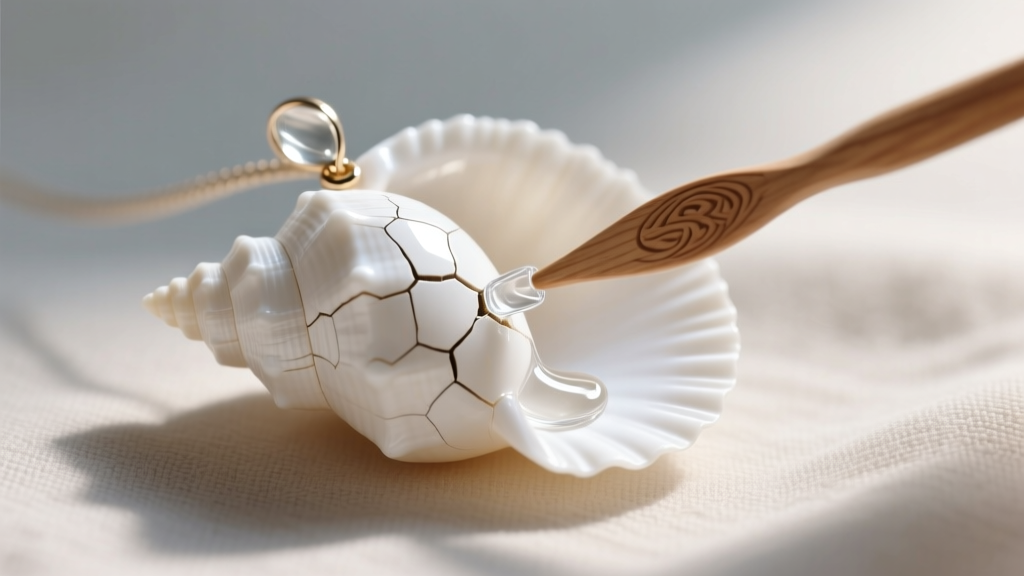
The Repair Protocol: Do not use standard craft glues, which remain flexible and trap moisture. Instead, use a thin-viscosity cyanoacrylate (CA) adhesive. For structural chips, create a custom filler by crushing a broken, color-matched donor shell into a fine powder using a mortar and pestle. Mix the shell dust with a medium-viscosity CA glue on a glass palette, then pack it into the fracture using a fine wooden applicator. Once cured (approximately 15 minutes), wet-sand the repair with 2000-grit automotive sandpaper and buff it with a jeweler's rouge to restore the natural gloss. According to conservation guidelines from the American Institute for Conservation (AIC), reversible and chemically compatible adhesives are paramount when treating organic artifacts.
Issue 2: Nacre Dulling and Yellowing
When the conchiolin proteins in a shell are exposed to prolonged ultraviolet light or acidic skin oils, they undergo oxidative degradation, resulting in a yellow or brownish tint. This is particularly noticeable on white cowrie or conch shell pendants.
The Restoration Process: Never use ultrasonic cleaners or harsh chemical dips, as these will strip the remaining nacre. Instead, prepare a solution of distilled water and a single drop of pH-neutral castile soap. Gently agitate the shell with a soft-bristled baby toothbrush. For severe yellowing, a localized application of 3% hydrogen peroxide applied with a cotton swab and exposed to indirect sunlight for one hour can bleach the conchiolin back to white. Rinse thoroughly in distilled water and seal the surface with a micro-thin layer of museum-grade microcrystalline wax to lock out moisture.
The Re-Stringing Protocol: Upgrading Your Cord
The most common point of catastrophic failure in a real seashell necklace is the stringing material. Traditional silk and cotton threads absorb sweat and environmental humidity, leading to rapid biological rot. Furthermore, the unpolished interior of a shell's drill hole will slice through organic fibers in a matter of months.
When re-stringing, abandon silk entirely. Opt instead for high-tensile, moisture-resistant synthetic alternatives:
- Waxed Polyester (e.g., Serafil or C-Lon): Ideal for medium-to-heavy shells like cowries and tiger cowries. The wax coating provides abrasion resistance against sharp drill holes, and the 0.8mm to 1.0mm diameter offers excellent drape.
- Micro-Macrame Nylon: Best for intricate puka shell chokers. Nylon is impervious to sweat acids and can be melted at the ends to create seamless, knotless closures.
- Nylon-Coated Stainless Steel (e.g., Beadalon): Use this only if the shell drill holes are lined with metal grommets or if you are using flexible wire guards. Bare steel wire will eventually act as a saw, cutting through the softer calcium carbonate of the shell itself.
Always employ a double-knotting technique between each major shell component, utilizing a micro-drop of flexible jewelry adhesive (like G-S Hypo Cement) on the knot to prevent slipping without making the cord brittle.
Authenticity Check: Real Calcium Carbonate vs. Resin Fakes
Troubleshooting is impossible if the material is misidentified. The market is flooded with polyurethane and epoxy resin replicas designed to mimic high-end conch, melo melo, and mother-of-pearl shells. Before investing time in restoring a piece, verify its authenticity using these non-destructive diagnostic tests.
Expert Tip: The Gemological Institute of America (GIA) notes that organic gems like pearls and shells share identical thermal and chemical properties. The 'tooth test' used for pearls applies equally to the edges of unpolished real shells, revealing a gritty, crystalline texture that smooth resin cannot replicate.
Thermal Conductivity Test: Real shells possess high thermal mass. When pressed against your cheek or the inside of your wrist, a genuine shell will feel distinctly cold and take several seconds to warm to your body temperature. Resin and plastic fakes will feel room-temperature and warm up almost instantly.
UV Fluorescence: Under a 365nm ultraviolet flashlight, the trace organic compounds in a real seashell will often exhibit a strong, milky-blue or pale-green fluorescence. Synthetic resins typically show no reaction or a dull, uniform purple glow from optical brighteners.
Acoustic Tap Test: Gently tap two shells together. Genuine calcium carbonate produces a dense, chalky, and slightly muted 'clack.' Hollow plastic or resin replicas produce a sharp, high-pitched, and hollow 'click.'
Preventative Storage and Environmental Controls
Once your real seashell necklace has been repaired, re-strung, and polished, proper storage is critical to preventing a recurrence of the original issues. Shells require a stable microclimate to prevent the conchiolin matrix from drying out and cracking, or absorbing excess moisture that promotes mold growth on the cord.
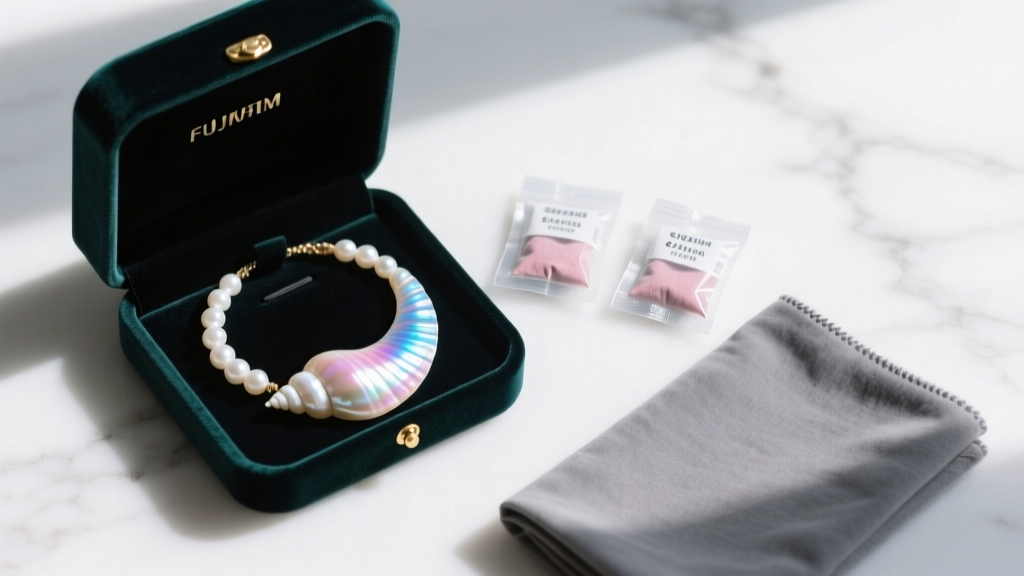
Maintain a relative humidity (RH) of 40% to 50% in your jewelry storage area. Store the necklace flat or loosely coiled in a breathable, untreated cotton or velvet pouch. Avoid airtight plastic ziplock bags, which can trap off-gassing acids from the plastic itself and accelerate the yellowing of white shells. Include a small, replaceable silica gel desiccant packet in the storage box to manage ambient moisture spikes, but ensure the packet does not rest directly against the shells, as extreme localized dryness can cause micro-crazing on the nacre surface. By treating your shell jewelry with the same rigorous conservation standards applied to museum artifacts, you ensure its structural integrity and visual brilliance for decades to come.