Chain Types for Necklaces: Troubleshooting Breakage and Tangles
Diagnose and fix common jewelry issues. Our expert troubleshooting guide to chain types for necklaces covers breakage, tangles, and clasp failures.

The Anatomy of Chain Failure: Why Your Necklaces Break
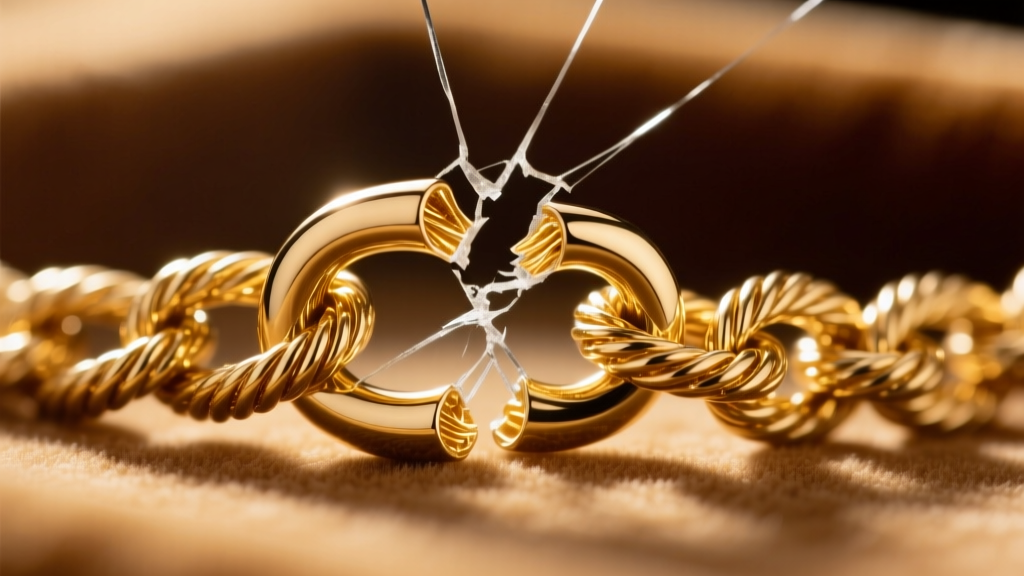
There are few things more frustrating in jewelry ownership than reaching for a favorite pendant, only to find the chain has snapped. When troubleshooting chain types for necklaces, the root cause of breakage almost always traces back to link geometry, metal purity, and gauge thickness. According to the Gemological Institute of America (GIA), the tensile strength of gold jewelry is dictated by its alloy composition. An 18k gold chain (75% pure gold) is inherently softer and more prone to stretching and snapping than a 14k gold chain (58.3% pure gold), which benefits from the structural rigidity of copper and zinc alloys.
Beyond metallurgy, the structural integrity of the chain dictates its lifespan. Chains featuring unsoldered links—such as standard cable or rolo chains—are highly susceptible to pulling apart when subjected to sudden tension. Conversely, soldered link chains like the Figaro or anchor (mariner) chains possess a microscopic weld at the seam of every individual link, effectively eliminating the weak point where links typically pull open. If you are constantly repairing a delicate 0.8mm cable chain, the issue isn't bad luck; it is a fundamental mismatch between the chain's structural design and the weight of your pendant.
Troubleshooting Tangles and Hair Pulling by Chain Type
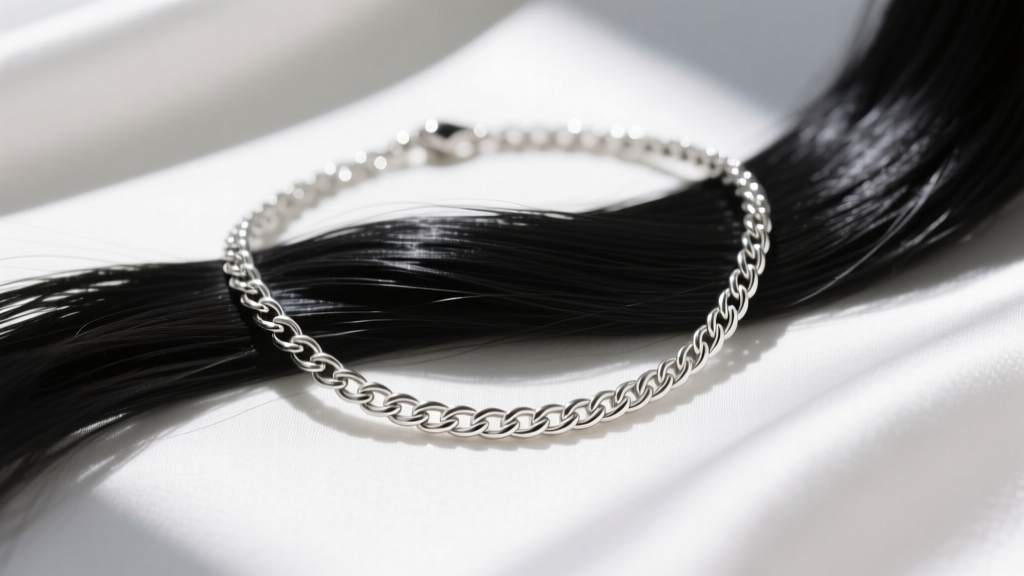
Breakage isn't the only failure mode; tangling and hair-pulling are massive pain points that drive many to abandon beautiful pieces. The culprit is usually the surface topography of the chain. Links with high friction or flush-laid geometries act like microscopic hooks against hair fibers and fabric threads.
The Worst Offenders for Tangling
- Herringbone Chains: Because the links are completely flush and laid flat, herringbone chains lack a distinct interior void. When bent against their natural flex axis, the links separate slightly, creating a jagged edge that instantly snags hair. Once kinked, a herringbone chain's structural integrity is permanently compromised.
- Omega Chains: Similar to herringbone, Omega chains rely on a rigid, interlocking plate structure over a wire mesh core. They do not drape fluidly and will permanently crease if folded or slept in.
- Rope Chains (Delicate Gauges): While thicker rope chains (2.5mm+) are incredibly durable, delicate rope chains (under 1.5mm) feature twisted links that create thousands of tiny crevices. These crevices act as gears, winding in fine hair and requiring tedious, painstaking untangling with a needle and baby oil.
The Fix: If you require a low-maintenance, tangle-free necklace for daily wear, transition to a box chain or a Wheat chain. Box chains feature smooth, squared-off links that glide past hair follicles without catching, while Wheat chains utilize tightly woven, uniform oval links that lay flat and resist knotting entirely.
The Ultimate Troubleshooting Matrix: Chain Types for Necklaces
To help you diagnose your specific jewelry issues, we have compiled a troubleshooting matrix evaluating the most common chain types for necklaces based on real-world failure modes, repair difficulty, and daily wear viability.
| Chain Type | Link Structure | Primary Failure Mode | Tangle Risk | Repair Difficulty |
|---|---|---|---|---|
| Cable | Unsoldered ovals | Link stretching & pulling apart | Low | Easy (Soldering) |
| Box | Soldered squares | Crushing / Kinking | Very Low | Moderate (Laser weld needed) |
| Rope | Twisted interlocking | Snagging, unraveling when snagged | High (if thin) | Very Difficult (Complex weave) |
| Herringbone | Flush flat plates | Permanent kinking, bending | Extreme | Impossible (Must replace) |
| Figaro | Soldered alternating | Clasp failure (chain is strong) | Low | Easy |
| Curb | Soldered, flattened | Abrasion over decades of wear | Low | Easy |
Clasp and Solder Point Failures: The Hidden Culprits
Often, the chain itself isn't breaking; the failure is occurring at the terminal ends. The connection points between the clasp and the chain endure the highest degree of mechanical stress. As noted by the Jewelers of America, proper maintenance of clasps and jump rings is critical to preventing catastrophic loss of pendants and lockets.
Spring Ring vs. Lobster Claw: A Structural Comparison
The standard 5mm spring ring clasp is the default on most commercial necklaces, yet it is a notorious point of failure. The internal steel spring can degrade, or the tiny lever can bend, causing the clasp to slide open inadvertently. Furthermore, the jump ring connecting the spring ring to the chain is rarely soldered on mass-produced jewelry, making it a prime candidate for pulling open.
Expert Troubleshooting Tip: If your necklace keeps sliding around your neck and opening at the back, the issue is likely a failing spring ring combined with an unsoldered jump ring. Upgrading to a 7mm or 9mm solid gold lobster claw clasp, and having a jeweler laser-solder the connecting jump ring shut, will eliminate 90% of accidental unclasping events.
Actionable Fixes: How to Salvage and Upgrade Your Chains
When your favorite necklace fails, don't immediately discard it. Use this step-by-step troubleshooting protocol to determine the most cost-effective and structurally sound repair method.
- Assess the Break Point: Use a jeweler's loupe (10x magnification) to inspect the break. If a single unsoldered link pulled open, a jeweler can simply close it and apply a micro-drop of solder. If the metal itself sheared or snapped, you are dealing with metal fatigue or a hollow-chain crush injury.
- Identify Hollow vs. Solid Construction: Many modern rope and box chains are manufactured with a hollow core to maximize visual size while minimizing gold weight. If a hollow chain is crushed or snapped, traditional torch soldering will melt the surrounding links due to the thin walls. You must seek a jeweler equipped with a laser welder, which uses pinpoint light energy to fuse the metal without transferring heat to the adjacent links.
- Upgrade the Gauge: If a chain repeatedly breaks at the same stress point (usually the center back of the neck), the gauge is insufficient for your lifestyle. Upgrading from a 20-gauge (0.8mm) chain to an 18-gauge (1.0mm) or 16-gauge (1.3mm) chain increases the cross-sectional metal mass, exponentially increasing its tensile strength and resistance to torsion.
- Address Platinum Chain Issues: Platinum is highly durable but has a high melting point and unique ductility. Platinum chains should never be repaired with standard silver or gold solder. They require specialized platinum laser welding or high-temperature torch soldering by a master bench jeweler to prevent the links from becoming brittle and snapping again.
When to Abandon Repair and Replace
Not all chain types for necklaces can be saved. If you own a delicate herringbone, omega, or a severely kinked hollow rope chain, the cost of repair often exceeds the replacement value. More importantly, the structural memory of the metal has been compromised. In these cases, the most practical troubleshooting step is to retire the damaged chain, melt it down for scrap credit, and reinvest in a solid-link, soldered chain style like a heavy curb or mariner link, ensuring decades of trouble-free wear.


