Troubleshooting Necklace Lengths: Fix Fit, Tangles & Clashes
Fix frustrating necklace lengths issues. Learn how to stop layering tangles, match chains to necklines, and solve pendant flipping with expert tips.

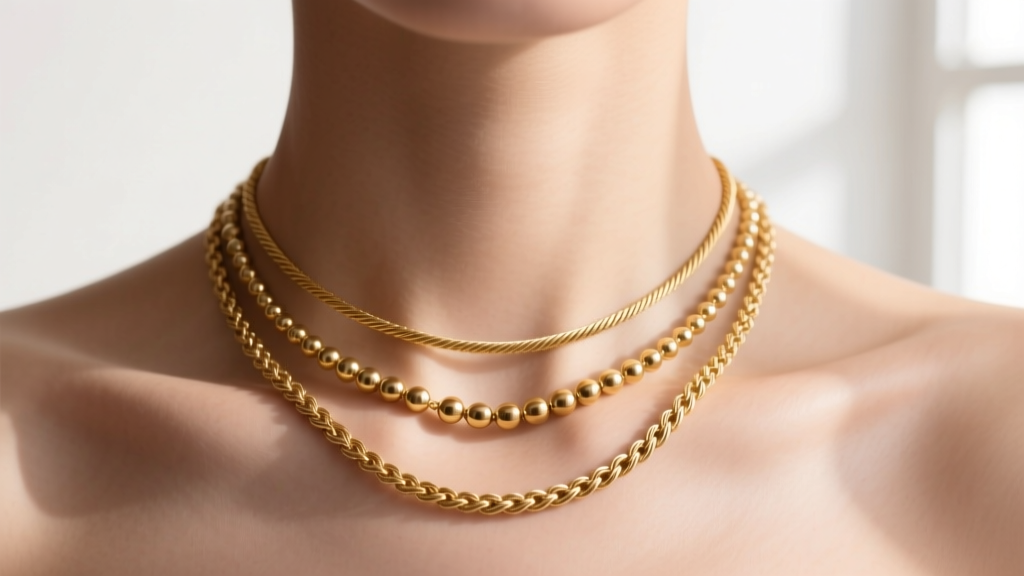
Getting the perfect drape is rarely as simple as picking a number off a size chart. While many frustrated buyers type 'necklace lenghts' into search engines when trying to fix a choker that feels more like a tourniquet or a pendant that refuses to lay flat, the root cause usually lies in the intersection of anatomy, chain physics, and hardware proportions. As a jewelry stylist, I see the same fit and function complaints daily: chains that tangle within minutes of layering, pendants that constantly flip upside down, and lengths that clash awkwardly with everyday necklines. This guide bypasses generic styling advice and dives straight into the structural troubleshooting of necklace lengths, providing exact measurements, gauge recommendations, and hardware fixes to solve your most persistent jewelry problems.
The Anatomy of a Poor Fit: Why Standard Measurements Fail
The jewelry industry relies on legacy standard lengths—14 inches for chokers, 16 inches for collars, and 18 inches for princess drops. However, these standards were established decades ago based on a very specific, narrow demographic of mannequin proportions. If you are troubleshooting a necklace that feels suffocating or slips too far down your chest, the issue is likely a mismatch between the chain's static length and your dynamic neck circumference.
A standard 14-inch choker is designed to sit snugly on a 12-inch neck, allowing for a two-inch ease for breathing and movement. If your neck circumference is 14 inches, that same choker will act as a constricting band, causing the clasp to pull upward and the chain to dig into your skin. Conversely, an 18-inch princess necklace on a person with a shorter torso or a prominent bust will often get swallowed by the neckline of a standard t-shirt, completely hiding the pendant.
The Fix: Stop buying fixed-length chains for everyday wear. Instead, invest in high-quality 50mm (2-inch) to 75mm (3-inch) extender chains. According to manufacturing specs from Rio Grande, adding a 1.2mm cable extender to a 16-inch chain allows the piece to dynamically adjust between a collar and a princess length, accommodating everything from a morning swell to a winter turtleneck. Ensure the extender links are soldered to prevent them from pulling apart under the leverage of a heavy clasp.
Troubleshooting Layering Tangles: The Physics of Chain Friction
Layering is a staple of modern styling, but the dreaded 'chain twist' ruins the aesthetic almost instantly. Tangling is not a matter of bad luck; it is a predictable result of mechanical friction and link geometry. When two chains of similar lengths and identical link styles (e.g., two 16-inch and 17-inch cable chains) are worn together, the uniform gaps in the links act like gears, interlocking with every movement of your body.
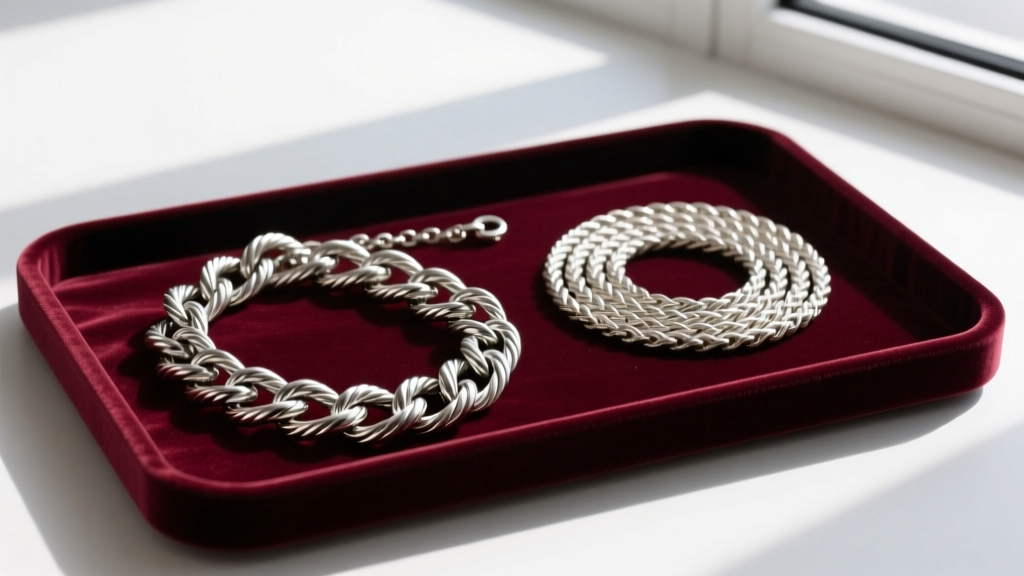
To permanently solve layering tangles, you must apply the 2-Inch, 3-Texture Framework. First, there must be a minimum two-inch gap between the lengths of any layered chains (e.g., 14 inches, 16 inches, and 18 inches). This spatial separation prevents the pendants and clasps from occupying the same physical plane. Second, you must vary the chain textures. Pair a smooth, continuous surface like a 1.5mm box chain with a highly textured, rounded profile like a 2.0mm rope chain. The differing surface friction coefficients prevent the links from catching on one another.
Furthermore, chain gauge plays a critical role. Chains thinner than 0.8mm have incredibly low torsional rigidity, meaning they act like thread and will knot themselves simply from the static electricity of your clothing. For reliable, tangle-free layering, keep your base chain at a minimum of 1.2mm in thickness, scaling up to 2.5mm for the longest layer to provide enough weight to anchor the stack against your chest.
Neckline Clashes: Matching Exact Lengths to Collars and Lapels
A necklace length that looks stunning on a bare décolletage can look chaotic when paired with the wrong fabric edge. The troubleshooting key here is to treat the neckline of your garment as a geometric frame. The necklace must either sit at least one inch inside the frame or intentionally break the frame by resting entirely on the fabric. Never let a chain rest directly on the seam of a collar, as this creates visual clutter and accelerates metal wear due to friction against heavy stitching or zippers.
| Neckline Style | Ideal Length | Chain Profile | Pendant Drop |
|---|---|---|---|
| Crew Neck | 14 - 16 inches | 1.5mm - 2.0mm Cable | None or < 10mm |
| V-Neck | 18 - 20 inches | 2.0mm - 3.0mm Rope | 15mm - 25mm |
| Scoop Neck | 16 - 18 inches | 1.2mm - 1.5mm Rolo | 10mm - 20mm |
| Turtleneck | 24 - 30 inches | 3.0mm+ Box or Snake | 30mm+ Statement |
When wearing heavy knits or wool, avoid delicate chains under 1.0mm. The microscopic scales of wool fibers will catch on the open links of a rolo or cable chain, causing micro-abrasions that eventually lead to metal fatigue and snapping. For winter fabrics, switch to closed-link styles like snake, herringbone, or solid box chains, which offer a smooth exterior that glides over textiles without snagging.
The Upside-Down Pendant: Solving Bail and Chain Friction
There is nothing more annoying than a beautiful pendant that constantly flips upside down, hiding the gemstone or engraving against your skin. This is rarely a defect in the pendant itself; it is a proportional mismatch between the chain's width and the pendant's bail (the loop that connects the pendant to the chain).
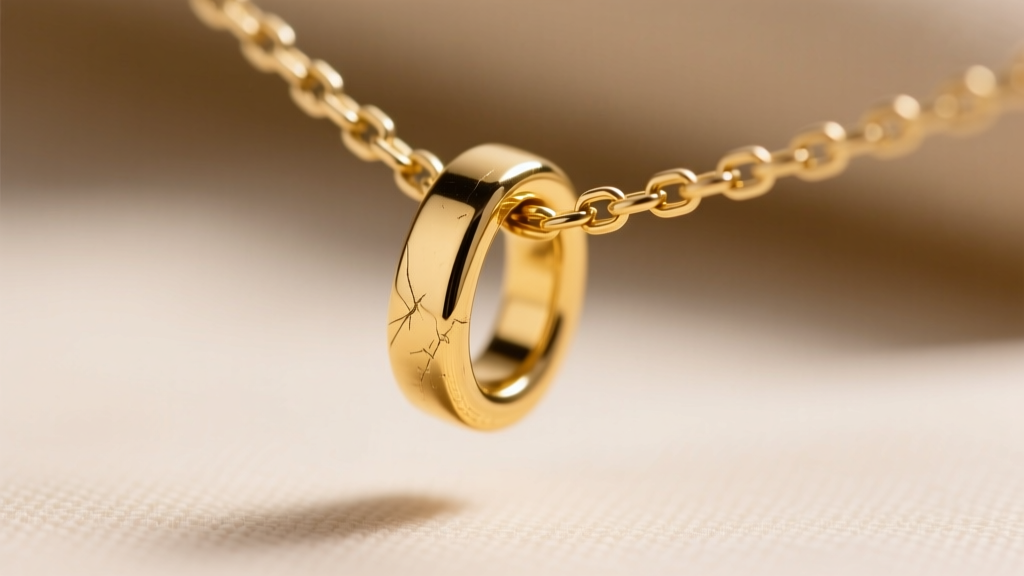
If you thread a stiff 2.5mm box chain through a standard 4mm European bail, the chain lacks the flexibility to drape naturally through the tight curve of the metal loop. As you move, the chain forces the bail to rotate, flipping the pendant. Conversely, if you use a highly flexible 0.9mm cable chain with a wide 8mm tubular bail, the chain will slide too freely, causing the pendant to migrate to the side of your neck and flip over due to uneven weight distribution.
The Fix: The bail's internal diameter should be roughly 1.5 to 2 times the width of the chain. If you have a pendant with a bail that is too large for your favorite chain, do not force it. Instead, use a silicone pendant stabilizer (a tiny, transparent o-ring that slips onto the chain inside the bail) to center the piece and add friction. For bails that are too small for your preferred heavy chain, consult a bench jeweler to solder a heavy-duty 5mm jump ring to the top of the bail, allowing thicker chains to pass through without compromising the structural integrity of the original casting. The Gemological Institute of America (GIA) frequently advises against forcing thick chains through tight bails, as the resulting metal-on-metal friction can wear down the bail over time, leading to catastrophic loss of the pendant.
Hardware Fixes: Upgrading Clasps and Extenders
The clasp is the most critical failure point on any necklace. Troubleshooting a necklace that constantly unclasps itself or is impossible to put on requires looking at the hardware's tensile strength and mechanical design.
When to Ditch the Spring Ring
Spring rings are the default clasp for mass-market jewelry, but they are fundamentally flawed for chains under 1.2mm. The internal spring mechanism in a standard 4mm or 5mm spring ring degrades quickly with daily use, resulting in a trigger that fails to snap back into place. Furthermore, the tiny lever is nearly impossible to operate with one hand. If your necklace frequently comes undone, the spring ring's tension has likely failed. Upgrade to a 7mm or 9mm lobster clasp. Lobster clasps feature a heavier internal spring and a solid cast body that resists deformation, providing a secure lock that you can easily hook onto a jump ring using a single fingernail.
The Magnetic Clasp Caveat
Magnetic clasps are heavily marketed as an accessibility solution, but they introduce a new set of problems. While neodymium magnets offer strong initial pull, they lack shear strength. If your necklace catches on a sweater, a magnetic clasp will slide apart laterally, dropping the chain. If you must use a magnetic clasp for a heavy 24-inch opera length necklace, ensure it features a secondary locking mechanism, such as a twist-lock barrel or a safety figure-eight chain, to prevent accidental lateral separation.


