The Ultimate Twisted Herringbone Necklace Buying Guide
Discover what to look for in a twisted herringbone necklace. Learn about gold karats, kink prevention, ideal widths, and clasp types in our expert guide.

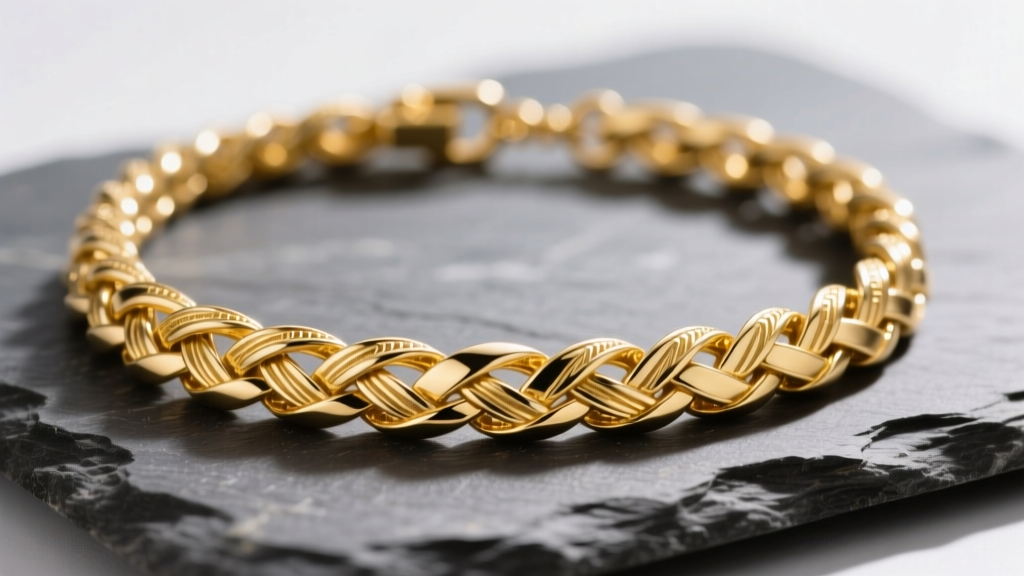
The Anatomy of a Twisted Herringbone Weave
The traditional herringbone chain has long been a staple in fine jewelry, celebrated for its fluid, liquid-metal drape and exceptional light reflection. However, the twisted herringbone necklace elevates this classic design through an advanced manufacturing technique. After the flat, parallel links are woven and passed through a roller, the entire chain is subjected to a precise torsion process. This spirals the flat ribbon into a DNA-like helix, creating a multi-dimensional texture that catches light from every angle while slightly altering the chain's structural dynamics.
From a buying perspective, understanding this torsion twist is critical. While the spiral adds visual depth and a heavier, more substantial feel on the collarbone, it also changes how the chain responds to tensile stress. This guide breaks down the exact metallurgical specs, sizing matrices, and hardware requirements you need to evaluate before investing in a twisted herringbone piece in 2026.
Metallurgy and the Kink Factor: 14k vs. 18k Gold
Let's address the most common concern with any herringbone weave: kinking. Unlike cable, curb, or rope chains, herringbone links lack interlocking structural redundancy. The links are laid flat; if bent against their natural grain, they can permanently deform. The twisted variant distributes stress slightly better along its spiral axis, but it remains vulnerable to sharp folds.
This makes your choice of gold karat the single most important durability factor. According to the Gemological Institute of America (GIA), the alloy mix in gold jewelry dictates its hardness and tensile strength.
Why 14k Gold Outperforms 18k for Herringbone
- 18k Gold (75% Pure): With a Vickers hardness of approximately 115 HV, 18k gold is softer and more malleable. While it offers a richer yellow hue, it is highly susceptible to permanent kinking and stretching in a flat weave like the herringbone.
- 14k Gold (58.3% Pure): Alloyed with higher percentages of copper, silver, and zinc, 14k gold achieves a Vickers hardness between 135 and 150 HV. This added tensile strength provides crucial resistance against the bending forces that cause herringbone chains to kink, making it the objectively superior choice for daily wear.
If you are purchasing a twisted herringbone necklace for everyday use, prioritize 14k gold. Reserve 18k or 22k variants for occasional-wear statement pieces that will be meticulously stored.
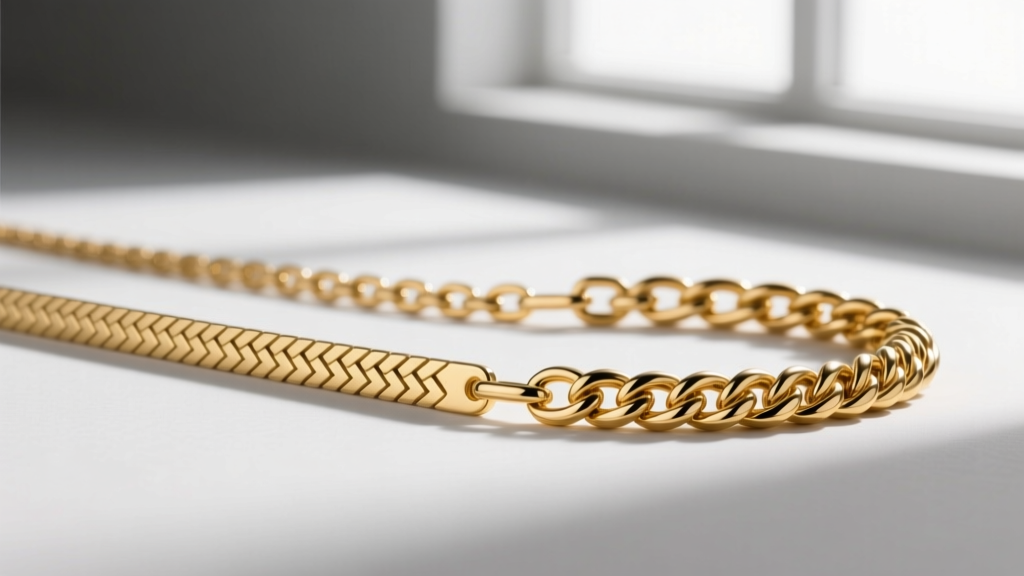
Sizing Matrix: Width, Thickness, and Drape
The width of a twisted herringbone necklace dictates not only its visual impact but also its structural integrity and clasp requirements. Because the twist compresses the visual width slightly compared to a flat herringbone, buyers often need to size up to achieve their desired look.
| Width (mm) | Thickness / Profile | Best Use Case | Kink Risk Level |
|---|---|---|---|
| 2.0mm - 3.0mm | Ultra-thin, delicate | Layering, small pendants (under 5g) | High |
| 4.0mm - 5.0mm | Medium, balanced | Standalone daily wear, chokers | Moderate |
| 6.0mm - 8.0mm | Heavy, substantial | Statement pieces, collarbone resting | Low (but heavy) |
| 10.0mm+ | Thick, rigid | High-fashion editorial, occasional wear | Low (highly rigid) |
Expert Tip: For a standard 16-inch or 18-inch princess length, the 4.5mm to 5.5mm range offers the perfect equilibrium between the signature liquid drape and the structural rigidity needed to prevent folding.
Clasp Engineering: Preventing Catastrophic Failure
The weakest point of any twisted herringbone necklace is the solder joint where the flat end-cap meets the clasp. The torsion twist creates rotational torque; if the clasp flips or catches on clothing, that torque is transferred directly to the solder joint, risking a snap.
Recommended Clasp Types by Width
- Lobster Claw (For 2mm - 3.5mm): Acceptable for lighter chains. Ensure the jump ring connecting the lobster clasp to the chain is soldered shut, not just bent closed, to prevent the flat links from slipping through.
- Box Clasp with Figure-8 Safety (For 4mm - 8mm+): Mandatory for medium to heavy twisted herringbone chains. A box clasp aligns perfectly with the flat end-caps, eliminating rotational torque. The figure-8 safety wire acts as a secondary fail-safe in case the primary tongue mechanism loosens over time.
- Magnetic Clasps: Avoid entirely. The neodymium magnets are heavy, and the sudden snapping motion when attaching them can easily misalign and kink the delicate flat links at the chain's terminus.
Layering Frameworks and Neckline Pairing
The twisted herringbone weave is inherently textured and highly reflective. It acts as a visual anchor, meaning it requires careful pairing to avoid a cluttered neckline.
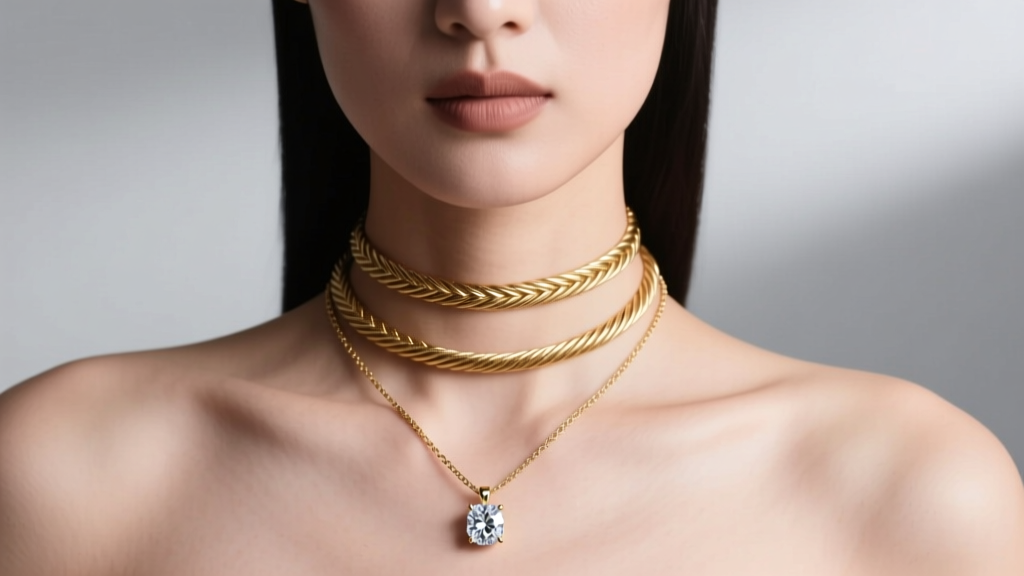
The Rule of Contrast
When layering, contrast the twisted herringbone with chains that feature open, geometric links. A 15-inch 4mm twisted herringbone choker pairs beautifully with a 20-inch cable or paperclip chain holding a single solitaire pendant. The solid, liquid reflection of the herringbone offsets the negative space of the longer chain.
Regarding necklines, the twisted herringbone excels against structured fabrics. It lays flat and flush against the skin, making it the ideal companion for deep V-necks, tailored blazers, and off-the-shoulder garments where the chain can rest uninterrupted against the collarbone.
Strict Care and Maintenance Protocol
To preserve the structural integrity of your necklace, you must adopt a strict care protocol. The Federal Trade Commission (FTC) provides guidelines on gold jewelry marking and care, emphasizing that proper maintenance is required to preserve the alloy's finish and structural links.
- The Flat Storage Rule: Never toss a herringbone chain into a jewelry box. It must be stored completely flat in a velvet pouch, or hung vertically on a wide, padded jewelry hanger. Folding it into a tight circle creates memory kinks.
- Sleeping and Showering: Remove the necklace before sleep. The tossing and turning of sleep creates the exact sharp, against-the-grain folds that destroy herringbone weaves.
- Cleaning: Avoid ultrasonic cleaners. While ultrasonic waves are safe for solid gold, the high-frequency vibrations can weaken the micro-solder joints at the clasp over time. Instead, use a few drops of mild dish soap in warm water, gently agitate with your fingers, and pat dry with a lint-free microfiber cloth, wiping strictly in the direction of the link grain.
Final Verdict: Is It Right for You?
A twisted herringbone necklace is an investment in high-impact, vintage-inspired luxury. It is not a 'gym-to-office' chain; it is a deliberate, elegant accessory that demands mindful wear and meticulous storage. By prioritizing 14k gold for tensile strength, selecting a width between 4mm and 6mm for optimal drape, and insisting on a box clasp for widths over 4mm, you will secure a piece that offers the mesmerizing liquid-metal aesthetic without the premature structural failures common to poorly engineered herringbone chains.


