Expert Guide: Buying a Two-Tone Gold and Silver Cross Necklace
Explore the metallurgy, construction, and wear mechanics of a two-tone gold and silver cross necklace in this expert technical guide.

The Metallurgy of Two-Tone Religious Jewelry
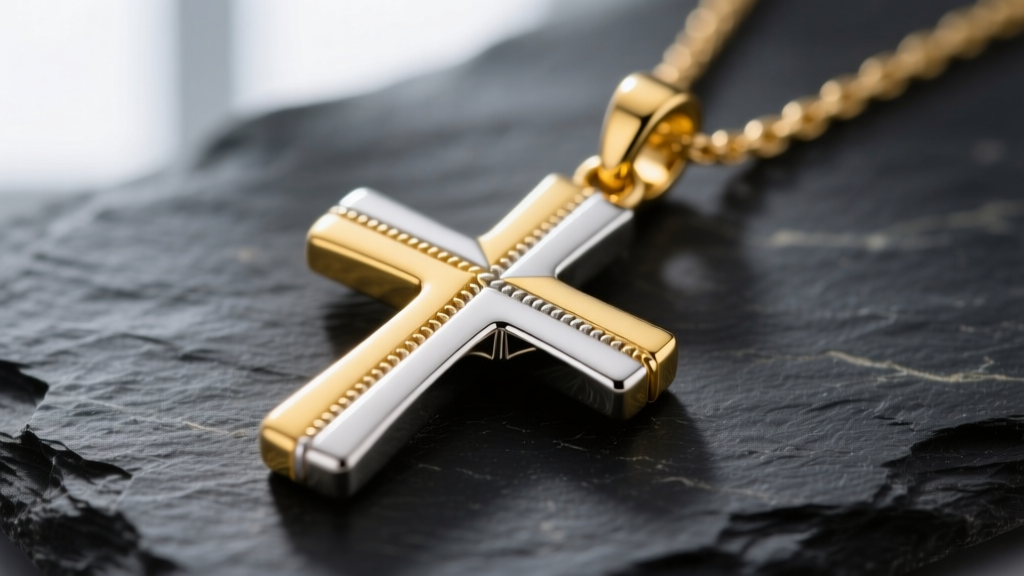
The two-tone gold and silver cross necklace represents a fascinating intersection of aesthetic contrast and metallurgical complexity. Combining the warm luster of gold with the cool, reflective surface of sterling silver in a single pendant requires a deep understanding of alloy behaviors. Unlike single-metal castings, two-tone pendants are typically fabricated in separate components and later joined, or cast using specialized multi-chamber investment techniques. For the discerning buyer or collector, understanding the underlying material science is critical to evaluating the longevity, structural integrity, and true value of the piece.
When evaluating a gold and silver cross necklace, the first technical specification to verify is the exact alloy composition. The industry standard pairs 14-karat gold (either yellow or rose) with 925 sterling silver. According to the Gemological Institute of America (GIA), 14k gold consists of 58.5% pure gold, with the remainder comprising copper, silver, and sometimes zinc to dictate color and tensile strength. Conversely, sterling silver is 92.5% pure silver and 7.5% copper. This copper content in both alloys is the primary driver of tarnish and oxidation, though the rate and visual manifestation differ drastically between the two metals.
Alloy Hardness and Wear Profiles
A critical, often overlooked factor in two-tone jewelry is the mismatch in Vickers Hardness (HV) between the gold and silver components. This disparity dictates how the piece will age, scratch, and polish over decades of daily wear.
| Metal Alloy | Standard Composition | Vickers Hardness (HV) | Melting Point Range |
|---|---|---|---|
| 14k Yellow Gold | 58.5% Au, 25% Ag, 16.5% Cu | 120 - 140 HV | 815°C - 870°C |
| 14k Rose Gold | 58.5% Au, 20% Cu, 21.5% Ag | 130 - 150 HV | 810°C - 860°C |
| 925 Sterling Silver | 92.5% Ag, 7.5% Cu | 60 HV (Annealed) to 120 HV (Work-Hardened) | 893°C |
Because sterling silver is inherently softer in its annealed state, the silver sections of a two-tone cross will accumulate micro-scratches and patina much faster than the gold sections. Over a ten-year period of daily wear, the silver may lose up to 0.05mm of surface depth due to friction and polishing, while the 14k gold remains dimensionally stable.
Construction Techniques: Laser Welding vs. Torch Soldering
The structural weak point of any gold and silver cross necklace is the junction where the two metals meet. Historically, jewelers used traditional torch soldering to fuse the components. However, this presents a severe thermal challenge. The melting point of 925 silver (893°C) is dangerously close to the flow temperature of hard 14k gold solder (around 815°C - 870°C). When applying a torch, the heat disperses globally through the pendant. The silver component can easily reach its melting point and warp or collapse before the gold solder fully flows, leading to pitted seams and structural fragility.
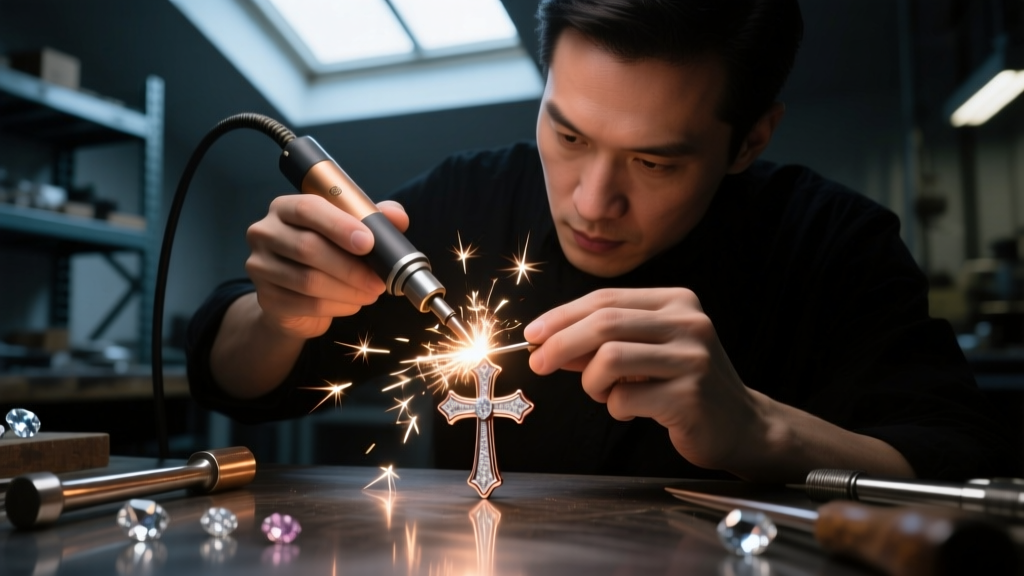
Modern master jewelers rely on laser welding to construct high-end two-tone crosses. Laser welding utilizes a highly focused Nd:YAG beam to melt a microscopic pool of metal exactly at the seam, often without the need for additional solder wire or flux. This localized heat input prevents thermal shock to the silver and eliminates the risk of fire-scale (a deep copper oxidation that occurs when silver is heated in the presence of oxygen). When inspecting a premium two-tone cross, look for a seam that is perfectly flush, devoid of porosity, and lacks the cloudy, grayish residue of pickling solutions used in traditional torch soldering.
Chain Pairing Mechanics and Bail Tolerances
The bail—the loop that connects the cross pendant to the chain—is the highest-friction point on the entire assembly. In a two-tone gold and silver cross necklace, the material chosen for the bail dictates the lifespan of the chain.
- The Soft Bail Problem: If the bail is cast entirely in 925 sterling silver, pairing it with a 14k gold chain will result in the harder gold chain acting as a file against the softer silver bail. Over 3 to 5 years, the silver bail will wear through, risking the loss of the pendant.
- The Bi-Metal Solution: Expert fabricators will solder a 14k gold inner sleeve or a hardened steel insert inside a silver bail to withstand the friction of a gold chain.
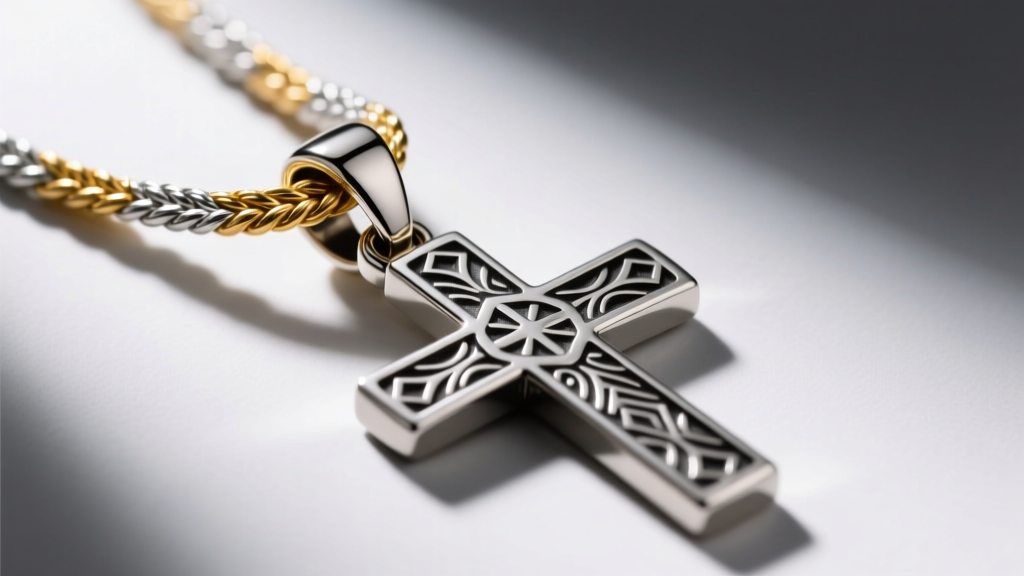
- Chain Weave Compatibility: For heavy two-tone crucifixes (weighing over 12 grams), a 2.0mm to 3.0mm solid box chain or a woven rope chain is required. Avoid hollow-cored chains, which will crush under the pendulum weight of a solid two-tone pendant.
Galvanic Corrosion and Long-Term Wear
One of the most vital technical considerations for a gold and silver cross necklace worn daily is the risk of galvanic corrosion. Gold and silver sit at different ends of the galvanic series. When the two metals are in direct physical contact and exposed to an electrolyte—such as human sweat, high humidity, or saltwater—a microscopic galvanic cell is created.
In a galvanic cell formed by gold and silver, the gold acts as the cathode and the silver acts as the anode. The presence of saltwater or acidic sweat accelerates the oxidation and localized corrosion of the silver immediately adjacent to the solder seam.
To mitigate this, high-end manufacturers often apply a micro-thin flash of rhodium plating over the silver components, or they design the pendant so that the gold and silver are separated by a non-conductive barrier, such as a blackened epoxy resin or a bezel-set gemstone (like black onyx or lapis lazuli) placed exactly on the solder line. If you live in a coastal environment or sweat heavily during exercise, removing a two-tone piece is not just about preventing tarnish; it is about preventing structural galvanic degradation.
Pricing Tiers and Authenticity Verification
Navigating the market for a gold and silver cross necklace requires a firm grasp of pricing structures based on metal weight and fabrication method. Beware of terms like 'two-tone vermeil' or 'silver with gold accents,' which often indicate a sterling silver base with a thin electroplated layer of 14k gold (usually less than 2.5 microns thick).
A genuine, solid 14k gold and 925 sterling silver cross necklace will carry dual hallmarks. Look for '14K' (or '585') stamped on the gold section and '925' stamped on the silver section. According to the Jewelers of America, proper hallmarking is a legal requirement in many jurisdictions to protect consumers from deceptive plating practices.
Real-World Pricing Framework (2026 Estimates)
- Entry-Level (Plated/Vermeil): $45 - $120. The gold tone will wear off the high-friction edges within 12 to 18 months of daily wear, revealing the silver beneath.
- Mid-Tier (Solid 10k Gold / 925 Silver, Cast): $250 - $450. Excellent for everyday wear, though 10k gold (41.7% pure) is more prone to copper oxidation and may cause skin discoloration in highly acidic sweat profiles.
- Master Fabricated (Solid 14k/18k Gold / 925 Silver, Laser Welded): $600 - $1,500+. These pieces feature hand-finished seams, hardened bails, and precise weight distribution, serving as lifetime heirlooms.
By prioritizing metallurgical integrity, advanced construction techniques, and proper chain-pairing mechanics, you can secure a gold and silver cross necklace that is not only a striking visual statement but a masterclass in enduring jewelry engineering.


