Selecting a Unique Star of David Necklace: Metals & Geometry
Discover how to select a unique Star of David necklace. We explore metal grades, geometric ratios, chain pairings, and casting techniques.

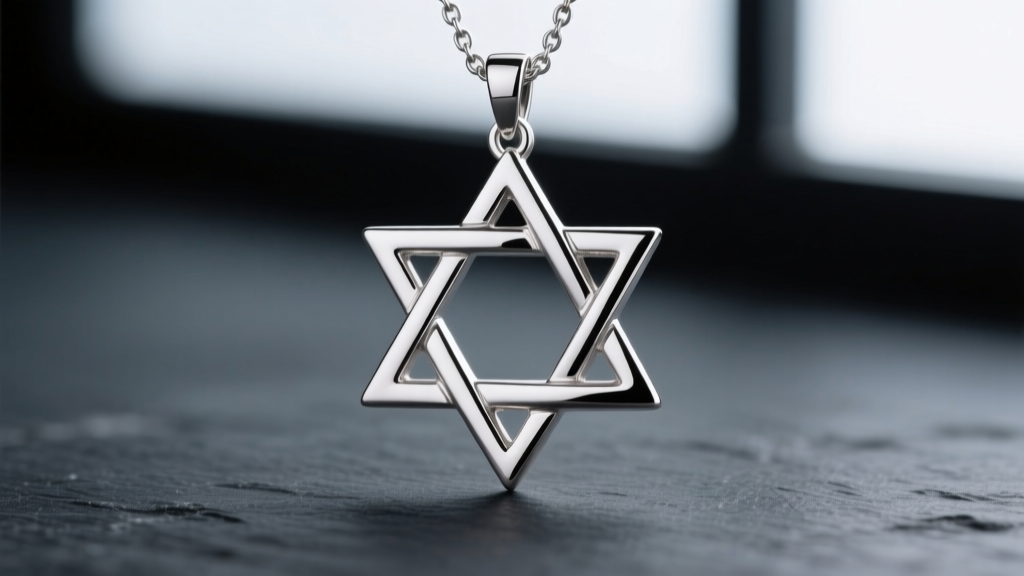
The Star of David, or Magen David, is universally recognized as a profound symbol of Jewish identity, faith, and heritage. However, from the perspective of a master jeweler or a metallurgical engineer, it is also a fascinating geometric puzzle. Composed of two overlapping equilateral triangles forming a hexagram, this shape presents specific structural challenges and opportunities in fine jewelry design. Finding a truly unique Star of David necklace requires looking past mass-produced, thinly stamped pendants and understanding the structural engineering, alloy selection, and fabrication techniques that elevate this ancient symbol into a piece of enduring, heirloom-quality art.
In this expert deep dive, we deconstruct the anatomy of the Magen David pendant, exploring the exact material grades, manufacturing methodologies, and chain-pairing mechanics required to craft a piece that is as physically resilient as it is spiritually significant.
The Geometry of the Hexagram: Structural Vulnerabilities
The defining feature of the Star of David is its six outer points and six inner acute angles (each exactly 60 degrees). While visually striking, these acute inner vertices are natural stress concentrators. When a pendant is subjected to lateral torque—such as being caught on a garment or pressed against the sternum during sleep—the force is disproportionately channeled into these narrow inner corners.
Strut Thickness and Negative Space
In a standard 25mm wide pendant, the metal struts separating the inner hexagon from the outer triangles must maintain a minimum width of 1.2mm to prevent bending or catastrophic shearing. Many commercial manufacturers reduce this strut width to 0.6mm to save on precious metal costs and increase negative space. This results in a fragile lattice that will inevitably warp. A master jeweler utilizes CAD (Computer-Aided Design) software to perform finite element analysis (FEA), optimizing the negative space while reinforcing the inner vertices with micro-fillets—tiny, curved buttresses that disperse kinetic energy away from the acute angles.
Metallurgy and Alloy Selection for Filigree and Solid Casts
The longevity of a unique Star of David necklace is inextricably linked to its metallurgical composition. The choice of alloy dictates not only the color and weight but the Vickers Hardness (HV) and tensile strength of the final piece. According to the Gemological Institute of America (GIA), the specific trace elements added to gold and platinum dramatically alter their workability and wear resistance.
| Material Grade | Composition | Vickers Hardness (HV) | Tarnish Resistance | Best Application |
|---|---|---|---|---|
| 14k Yellow Gold | 58.5% Au, Cu/Ag alloy | ~130 HV | High | Everyday solid cast pendants, high durability. |
| 18k Yellow Gold | 75% Au, Cu/Ag alloy | ~120 HV | Very High | High-end filigree, richer color but slightly softer. |
| Platinum 950 (Ru) | 95% Pt, 5% Ruthenium | ~135 HV | Superior | Intricate laser-cut designs, heavy wear, heirloom pieces. |
| Sterling Silver | 92.5% Ag, 7.5% Cu | ~75 HV | Poor (Requires Rhodium) | Budget-friendly, requires thicker struts (min 1.8mm). |
For highly intricate, interlocking Star of David designs where the two triangles are not cast as a single solid piece but rather forged and linked, Platinum 950 alloyed with Ruthenium is the undisputed champion. Its high melting point and density allow for incredibly thin, yet unbreakable, interlocking loops that would snap if cast in 18k gold.
Manufacturing Methods: Casting vs. Die-Striking vs. Laser Sintering
How the metal is formed is just as critical as what the metal is. The manufacturing technique dictates the internal grain structure of the pendant, which directly impacts its failure rate over decades of wear.
Lost-Wax Casting and Porosity Risks
Traditional lost-wax casting is ideal for three-dimensional, contoured Star of David pendants (such as those featuring a domed or braided surface). However, the 60-degree inner corners of the hexagram are prone to shrinkage porosity. As the molten metal cools, it contracts. If the cooling rate is uneven, microscopic air pockets form at the acute vertices, creating hidden weak points. Expert casters use specialized sprue placement and vacuum-assisted casting to ensure a dense, pore-free crystalline structure.
Die-Striking for Work-Hardening
For flat, minimalist, or geometric interpretations of the Star, die-striking is vastly superior to casting. A high-tonnage press forces a sheet of gold or platinum between two hardened steel dies. This immense pressure compresses the metal's grain structure, effectively work-hardening the alloy. A die-struck 14k gold Star of David will possess significantly higher tensile strength and scratch resistance than its cast counterpart, making it ideal for low-profile, everyday wear.
Direct Metal Laser Sintering (DMLS)
As of 2026, the frontier of avant-garde jewelry manufacturing is DMLS, a form of 3D printing that uses a high-powered laser to fuse microscopic layers of precious metal powder. This allows designers to create unique Star of David necklaces featuring impossible internal geometries—such as a hollow, lattice-work Star containing a freely moving, un-soldered inner hexagon that could never be achieved through traditional wax carving or casting.
Bail Engineering and Chain Pairing
The bail—the component that connects the pendant to the chain—is the most common point of mechanical failure in necklace design. The top vertex of the Star of David poses a unique engineering hurdle.
The Failure of the Soldered Jump Ring
Mass-market pendants often feature a standard jump ring soldered directly to the topmost point of the upper triangle. Because the point is narrow, the solder joint has minimal surface area. Over time, the pendulum motion of the necklace walking along the chain creates friction and lateral stress, eventually fatiguing the solder joint and causing the top point to snap off entirely.
The Saddle Bail Solution
To counteract this, expert jewelers employ a saddle bail or an integrated wrap bail. Instead of attaching to the fragile tip, the bail wraps over the entire top triangle, distributing the kinetic load across the upper horizontal strut (if the Star is oriented with a flat top) or cradling the upper vertex in a reinforced, U-shaped platinum housing. For historical context on the evolution of these symbols in wearable art, archives from The Jewish Virtual Library note how modern adaptations frequently blend traditional iconography with contemporary structural engineering.
Chain Selection Metrics
A heavy, solid platinum or 18k gold Star of David pendant requires a chain with adequate tensile strength and structural rigidity. Avoid snake chains, which are prone to kinking and trapping skin oils. Instead, opt for:
- Box Chains (1.5mm - 2.0mm): Their interlocking square links provide excellent multidirectional flexibility and high tensile strength, perfectly complementing the geometric lines of the hexagram.
- Wheat (Spiga) Chains (1.2mm - 1.8mm): Woven from figure-eight links, wheat chains offer a braided, organic texture that contrasts beautifully with the rigid, mathematical lines of the Star.
- Rolo Chains (2.0mm+): Ideal for heavy, oversized statement pieces, offering a robust, industrial aesthetic.
Surface Finishes and Enameling Techniques
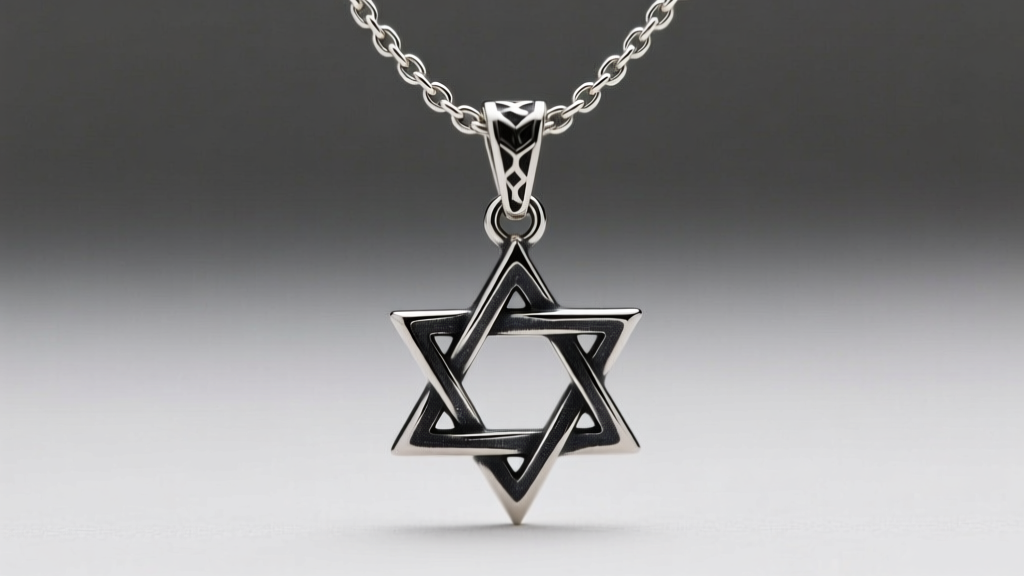
The surface treatment of the pendant dictates how it interacts with light and how it ages alongside the wearer. A high-polish finish, while classic, will inevitably accumulate micro-scratches. For a more contemporary and forgiving aesthetic, consider the following techniques:
Champlevé Enameling
Champlevé involves carving troughs into the surface of the metal (typically copper, silver, or gold) and filling them with vitreous enamel powder, which is then fired in a kiln at approximately 800°C. A unique Star of David necklace featuring deep cobalt or lapis-lazuli blue champlevé enamel within the inner hexagon creates a striking visual depth while protecting the metal from oxidation.
Sandblasted and Diamond-Cut Bevels
By combining a matte, sandblasted background with diamond-cut, high-polish bevels along the edges of the two overlapping triangles, jewelers can create a two-tone optical illusion. This makes the interlocking nature of the Star pop visually without requiring the use of contrasting metals or gemstones.
Conclusion: Investing in Structural Integrity
Selecting a unique Star of David necklace is an exercise in balancing profound cultural symbolism with rigorous material science. By prioritizing proper geometric ratios, selecting appropriate alloy grades like Platinum 950 or 14k gold, and demanding advanced fabrication techniques like die-striking or reinforced bail engineering, you ensure that the piece will endure as a flawless heirloom. For further reading on advanced jewelry manufacturing standards and metal fatigue, the Manufacturing Jewelers and Suppliers of America (MJSA) provides extensive technical resources for both jewelers and informed consumers. When you understand the engineering behind the art, you don't just wear a symbol; you wear a masterclass in metallurgical design.


