What Necklace to Wear With V Neck: A Troubleshooting Guide
Discover what necklace to wear with V neck tops. Solve proportion issues, prevent chain tangling, and find the perfect pendant drop for any neckline depth.

The Core Dilemma: Visual Competition and Physical Tangling
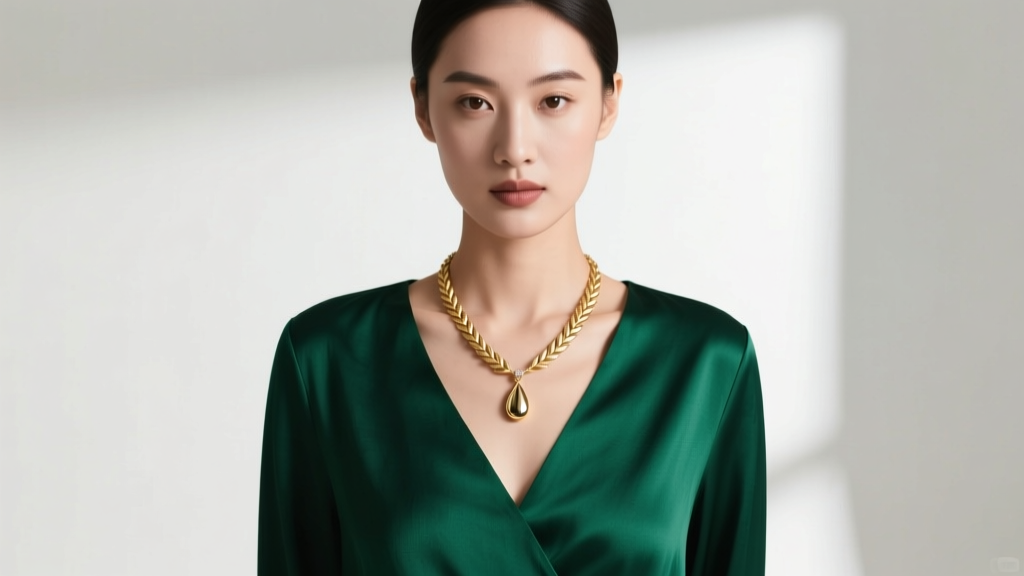
When deciding what necklace to wear with V neck tops, most people focus purely on aesthetics, only to end up with a tangled mess or a pendant that awkwardly floats above the fabric line. The V-neckline creates a strong, directional visual vector—two diagonal lines converging at a central vertex. If your necklace fights this geometry, the result is visual clutter. If the chain is too short, it chops the neck; if it is too long, it disappears into the garment. Furthermore, the physical interaction between metal and fabric introduces friction problems, especially with delicate knits or slippery silks.
This troubleshooting guide moves beyond generic styling advice. We will dissect the exact chain weaves, pendant weights, and length metrics required to solve the most common V-neck necklace failures, ensuring your jewelry complements rather than competes with your wardrobe.
The Geometry of the V-Neck: Why Proportions Fail
The most frequent mistake when pairing necklaces with V-necks is ignoring the "vertex rule." The vertex is the lowest point of the V-neckline. For a harmonious look, the pendant or the lowest point of the chain should either rest exactly one inch above the vertex, or plunge at least two inches below it. Anything in between creates a visual collision where the metal and the fabric hem fight for dominance.
According to styling principles outlined by Blue Nile's necklace length guide, the standard 18-inch princess chain works for standard crew and shallow V-necks, but fails catastrophically on deep plunge V-necks. To solve this, you must map your chain length directly to the garment's cut.
The Proportion Matrix: Matching Drop to Neckline Depth
| V-Neck Depth | Ideal Chain Length | Optimal Pendant Style | Failure Mode to Avoid |
|---|---|---|---|
| Shallow (Scoop-V) | 16" - 18" | Small geometric (0.5" drop) | Large circular pendants that mimic the neckline curve |
| Standard (T-Shirt V) | 18" - 20" | Teardrop or Marquise (1" drop) | Pendants that rest exactly on the fabric hem |
| Deep Plunge | 24" - 28" | Y-Necklace or Lariat (3"+ drop) | Standard chains that disappear beneath the fabric |
Troubleshooting Common V-Neck Necklace Failures
Even with the correct length, structural and physical issues can ruin the styling. Here is how to troubleshoot the three most common V-neck necklace failures.
1. The "Floating Pendant" Effect
The Problem: The pendant sits awkwardly on the chest, disconnected from the neckline, making the torso look disproportionately long.
The Fix: Switch to a Y-necklace or a lariat style. A lariat bypasses the traditional clasp-and-pendant structure, allowing a 4-to-6-inch vertical drop that perfectly echoes the elongating effect of the V-neck. If you prefer a standard chain, ensure the pendant bail (the loop connecting the pendant to the chain) is soldered and rigid, rather than a loose jump ring, which allows the pendant to flip and float.
2. Clasp Migration (The Slipping Nape)
The Problem: The chain is front-heavy due to a V-neck pendant, causing the lightweight clasp at the back of the neck to continuously slide around to the front, ruining the aesthetic.
The Fix: You need to rebalance the center of gravity. Take the necklace to a jeweler and have a 2-gram to 3-gram metallic counterweight bead soldered onto the chain exactly opposite the pendant. Alternatively, purchase chains with a built-in counterweight tag at the clasp, a feature common in higher-end 14k and 18k gold Italian chains priced in the $150–$300 range.
3. The Knit Snag Disaster
The Problem: Your necklace acts like a saw blade, pulling threads and destroying cashmere or wool V-neck sweaters.
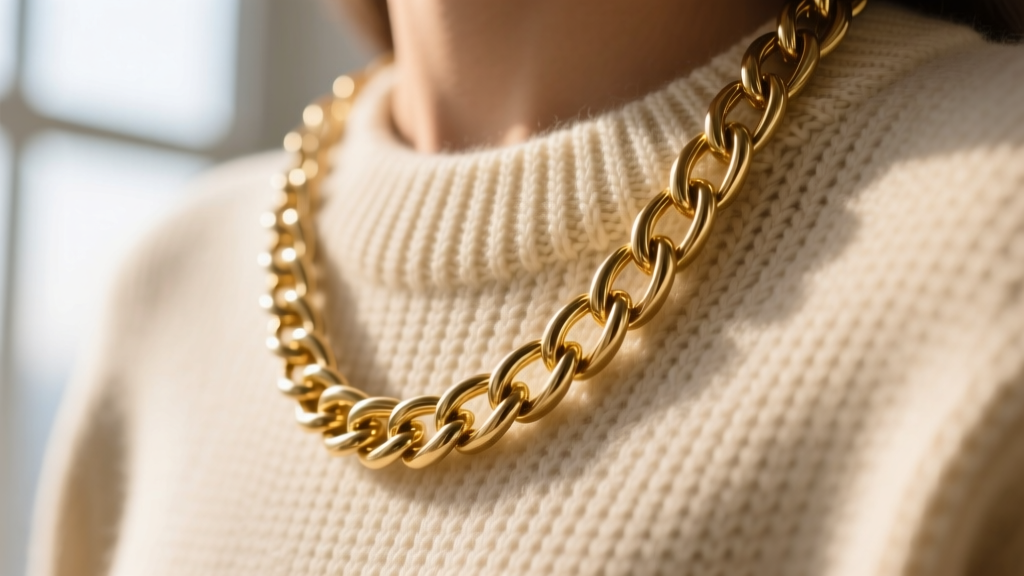
The Fix: The issue is your chain weave. Box chains and herringbone chains have micro-edges and flat surfaces that catch on textile fibers. Switch to a Wheat chain or a Rope chain. These weaves are helical and smooth, allowing the metal to glide over knitwear without snagging. For a 1.2mm to 1.5mm width, a solid 14k gold wheat chain offers the perfect balance of tensile strength and fabric-safe smoothness.
Material and Weight: Solving the Fabric Drape Issue
The weight of your chain dictates how it drapes over the V-neck collarbone area. Lightweight chains (under 5 grams) tend to kink and bend when they hit the slope of a V-neck collar, rather than laying flat against the skin. This is particularly problematic with silk or satin V-neck blouses where static cling exacerbates the kinking.
To solve this, opt for a chain with a minimum weight of 8 to 12 grams for an 18-inch length. The Gemological Institute of America (GIA) notes that 14k gold offers superior hardness and structural memory compared to 18k or 24k gold, making it the ideal metallurgical choice for chains that need to maintain a smooth, sweeping curve over the sharp angles of a V-neckline without permanently warping.
Shape Theory: Why Geometric Pendants Win
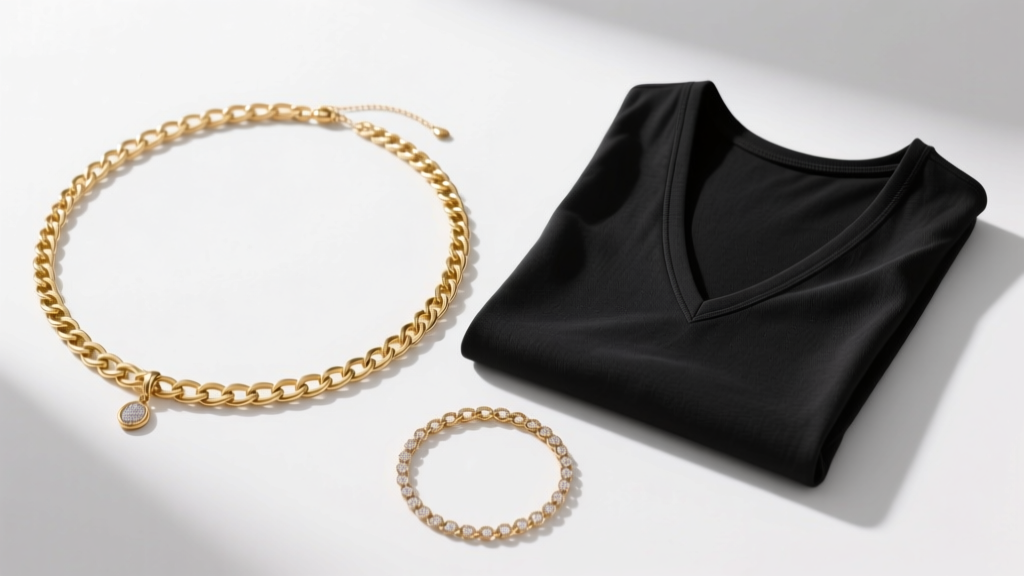
When selecting a pendant for a V-neck, avoid large circular or horizontal oval shapes. A circle visually interrupts the downward flow of the V-neck, creating a "stop sign" effect on the chest. Instead, lean into shapes that mimic or complement the acute angles of the garment.
- Teardrops and Pears: These naturally draw the eye downward, extending the visual line of the V-neck.
- Marquise Cuts: The elongated, pointed ends of a marquise gemstone echo the sharp vertex of the neckline.
- Vertical Bars: A simple 1-inch vertical gold bar pendant provides a modern, minimalist anchor that doesn't overwhelm the chest.
- Open Triangles: An open, inverted triangle pendant frames the V-neck perfectly without adding heavy visual weight.
The Lariat Advantage: A Cheat Code for Plunging Necklines
If you are wearing a deep-plunge V-neck (common in evening wear or wrap dresses), standard necklaces will fail you. The skin exposure is too vast, and a standard 20-inch chain will look like a choker by comparison. The ultimate troubleshooting tool here is the Lariat necklace.
"A lariat necklace doesn't just sit on the body; it interacts with the negative space of the garment. For a deep V-neck, the vertical drop of the lariat acts as a third line in the garment's geometry, completing the visual triangle and elongating the torso." — Principles of Sartorial Geometry
Look for lariats with a sliding silicone or silicone-lined gold bead that allows you to adjust the Y-drop in real-time. This ensures you can customize the exact depth of the pendant based on whether you are sitting or standing, preventing the metal from slipping into the garment's plunge.
Quick-Reference Decision Framework
Keep this checklist in mind when getting dressed to ensure your V-neck and necklace pairing is flawless:
- Identify the Vertex: Where does the fabric end? Choose a chain that ends 1" above or 2" below this point.
- Check the Fabric: Is it knit? Use a Rope or Wheat chain. Is it silk? Use a smooth Snake or Box chain (but keep it away from the edges).
- Evaluate the Pendant Shape: Swap out circles for teardrops, marquise, or vertical bars.
- Test the Weight: Ensure the chain is heavy enough (8g+) to drape smoothly over the collarbone slope without kinking.
- Secure the Clasp: If the pendant is heavy, ensure you have a counterweight at the nape to prevent migration.
By treating your jewelry pairing as an exercise in geometry and physics rather than just an afterthought, you will instantly elevate your styling and eliminate the daily frustration of tangled, snagged, or poorly proportioned necklaces.


