Vintage Bee Necklace Guide: Eras, Metals, and Styling
Discover how to identify, authenticate, and style a vintage bee necklace. Learn about Victorian to Retro eras, metal hallmarks, and enamel care.

The Buzz Around Vintage Bee Jewelry: Why the Motif Endures
Entomological jewelry—pieces inspired by insects—has captivated collectors for centuries, but the bee holds a uniquely revered spot in the hierarchy of antique motifs. When you begin searching for a vintage bee necklace, you are not just looking for a beautiful accessory; you are uncovering a rich tapestry of historical symbolism. From the imperial courts of France to the mourning parlors of Victorian England, the bee has represented immortality, resurrection, community, and tireless work ethic.
For beginners stepping into the estate jewelry market, the sheer volume of options can be overwhelming. Modern mass-market platforms are flooded with 'vintage-style' or 'antique-finish' pieces that are actually contemporary brass castings. True vintage bee necklaces, however, offer unparalleled craftsmanship, historical weight, and metallurgical integrity that modern replicas simply cannot mimic. This guide will equip you with the exact frameworks needed to identify eras, authenticate hallmarks, and properly care for your antique entomological treasures.
Identifying Eras: A Timeline of Vintage Bee Necklaces
To accurately value and authenticate a piece, you must first understand the design language of its specific era. According to the extensive archives at Lang Antiques University, jewelry design shifted dramatically every few decades, heavily influenced by global events and changing manufacturing capabilities.
Victorian Era (1837–1901): Sentiment and Symbolism
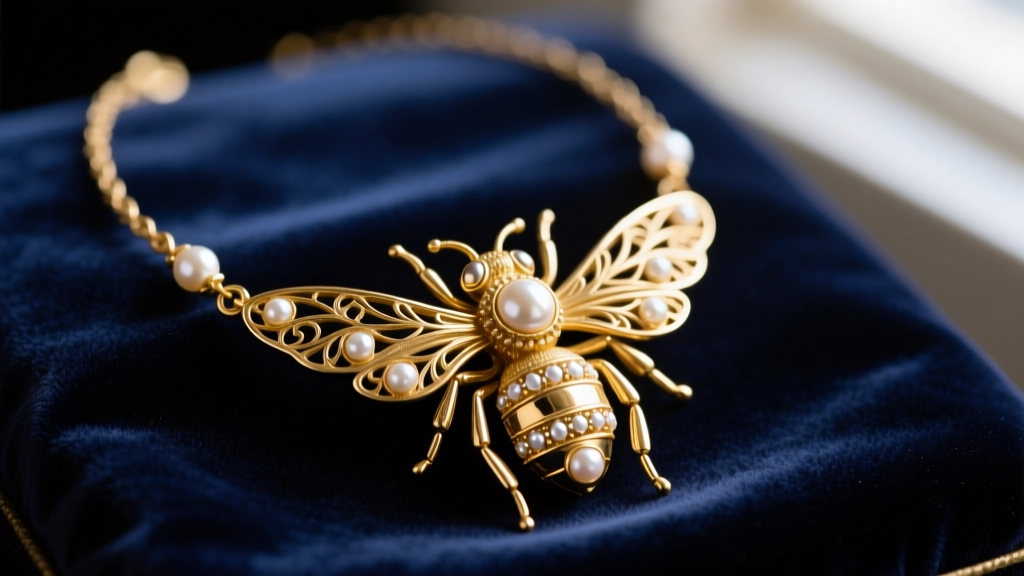
Victorian bee necklaces are highly sought after for their intricate metalwork and sentimental value. During this period, bees were often depicted with hand-chased (engraved) wings and bodies adorned with seed pearls or turquoise cabochons. Because the UK Hallmarking Act of 1932 had not yet standardized gold purities, you will frequently find authentic Victorian pieces stamped as 15k gold—a hallmark that effectively vanished after 1932. Finding a 15k stamp on a bee pendant is a strong indicator of genuine 19th-century British origin.
Art Nouveau (1890–1910): Whiplash Curves and Enamel
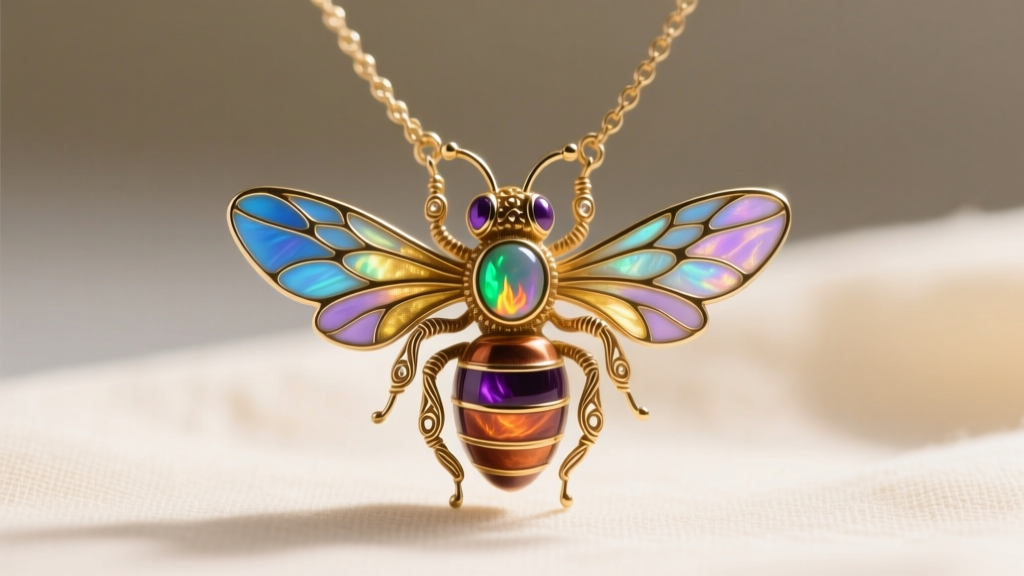
If you encounter a vintage bee necklace featuring asymmetrical lines, flowing 'whiplash' curves, and translucent enamel, you are likely looking at the Art Nouveau period. Master jewelers like René Lalique popularized plique-à-jour enamel, a technique that creates a stained-glass effect by fusing enamel into open-back metal cells. These pieces are rare, fragile, and command premium prices at auction.
Art Deco (1920–1935): Geometry and Marcasite
Art Deco bee jewelry abandoned the soft curves of the previous era in favor of sharp geometry and high contrast. Sterling silver set with marcasite (which is actually faceted iron pyrite) and black onyx became the standard. These necklaces often feature a more stylized, almost mechanical interpretation of the bee, reflecting the era's obsession with industrialization and machine-age aesthetics.
Retro & Mid-Century (1935–1960): Bold Gold and Rhinestones
During the Retro and Mid-Century periods, fine jewelry metals were often diverted for wartime efforts, leading to a boom in high-end costume jewelry. Brands like Trifari, Coro, and Boucher produced stunning vermeil (gold-plated sterling silver) bee necklaces accented with aurora borealis rhinestones—a coating invented by Swarovski in 1955. If your vintage bee necklace features AB rhinestones, it was definitively made post-1955.
Materials and Hallmarks: The Authentication Matrix
One of the most common beginner mistakes is relying solely on visual aesthetics to date a piece. A reliable authentication requires examining the metallurgy, the clasp mechanics, and the hallmarks. The Victoria and Albert Museum (V&A) notes that jewelry findings (clasps and hinges) evolved in tandem with metallurgical patents.
| Era | Primary Materials | Clasp Type | Estimated Price Range (USD) |
|---|---|---|---|
| Victorian (1837-1901) | 15k/18k Gold, Seed Pearls, Jet | C-Clasp / Tube Hinge | $450 - $2,500+ |
| Art Nouveau (1890-1910) | Silver, Gold, Plique-à-jour Enamel | C-Clasp / Trombone | $800 - $5,000+ |
| Art Deco (1920-1935) | Sterling, Marcasite, Onyx | Barrel / Early Spring Ring | $150 - $600 |
| Retro/Mid-Century (1935-1960) | Vermeil, Rhinestones, Base Metal | Roll-over / Lobster | $75 - $350 |
Beginner Mistakes to Avoid When Buying Vintage
Navigating estate sales, antique malls, and online auctions requires a critical eye. Here are the most frequent pitfalls novice buyers encounter when hunting for a vintage bee necklace:
- Confusing 'Antique Brass' with Age: Modern mass-produced jewelry often uses a dark, oxidized brass plating to simulate age. True vintage gold-filled or silver pieces will show micro-scratches and wear patterns on the high-relief areas (like the bee's wings or thorax) from decades of friction against clothing and skin. Modern fakes look uniformly dark or artificially scuffed.
- Ignoring the Clasp: If a seller claims a necklace is from the 1890s, but it features a modern lobster clasp or a lightweight, machine-stamped spring ring, be highly skeptical. While clasps can be replaced, a genuine Victorian piece should originally feature a 'C-clasp' (a simple hook with no locking mechanism) or a tube hinge.
- Overlooking Solder Joints: Examine where the jump ring connects to the bee pendant. Antique pieces were soldered by hand, often leaving a slightly visible, uneven seam. Modern laser welding or machine casting leaves perfectly uniform, seamless joints.
Styling Your Vintage Bee Necklace for Modern Wear
The beauty of a vintage bee necklace lies in its versatility. Because the motif is inherently detailed, it acts as a focal point that can elevate both casual and formal wardrobes. Here is how to style your piece based on its length and era:
The 16-Inch Choker (Victorian & Art Deco)
Shorter, 16-inch gold or silver bee necklaces sit perfectly at the collarbone. Pair these with a crisp, white button-down shirt left slightly unbuttoned, or a high-necked Victorian-style blouse with a lace collar. The contrast between the structured fabric and the organic shape of the bee creates a striking visual balance.
The 24-Inch Sautoir (Art Nouveau & Retro)
Longer, opera-length necklaces were designed to be worn over garments. A 24-inch Marcasite or enamel bee pendant looks exceptional layered over a solid-color turtleneck in the autumn, or draped over a deep V-neck maxi dress in the summer. When layering, ensure your accompanying chains are simple (like a delicate cable or rope chain) so they do not compete with the intricate enamel or stone-work of the bee pendant.
Care and Maintenance for Antique Enamel and Marcasite
Vintage jewelry requires specialized care. The materials used a century ago react poorly to modern cleaning methods.
Expert Warning: Never place a vintage bee necklace in an ultrasonic cleaner. The high-frequency vibrations will shatter fragile plique-à-jour enamel and shake the marcasite stones right out of their silver bezels.
For Marcasite Pieces: Marcasite is typically glued into sterling silver settings. Submerging these pieces in water or liquid silver polish will dissolve the adhesive, causing the stones to pop out. Instead, use a dry, untreated microfiber cloth to gently buff the silver, avoiding the stones entirely.
For Enamel Pieces: Enamel is essentially fused glass. It is highly susceptible to thermal shock. Never clean an enamel bee pendant with hot water, and avoid wearing it in environments with extreme temperature fluctuations. Clean it only with a soft, dry brush to remove skin oils and dust from the crevices of the wings.
Final Thoughts on Collecting
Acquiring a vintage bee necklace is an exercise in historical preservation. Whether you are drawn to the sentimental seed-pearl bees of the Victorian era, the stained-glass wings of the Art Nouveau movement, or the geometric marcasite designs of the 1920s, each piece tells a story of the artisan who crafted it and the generations who wore it. By understanding the hallmarks, mastering the authentication matrix, and committing to proper archival care, you ensure that your vintage bee necklace will continue to tell its story for another century to come.