Material Guide: Identifying Your Vintage Blue Necklace Stones
Explore the material properties of a vintage blue necklace. Compare lapis, turquoise, cobalt glass, and sapphires in our expert guide.

The Allure and Complexity of Blue Vintage Materials
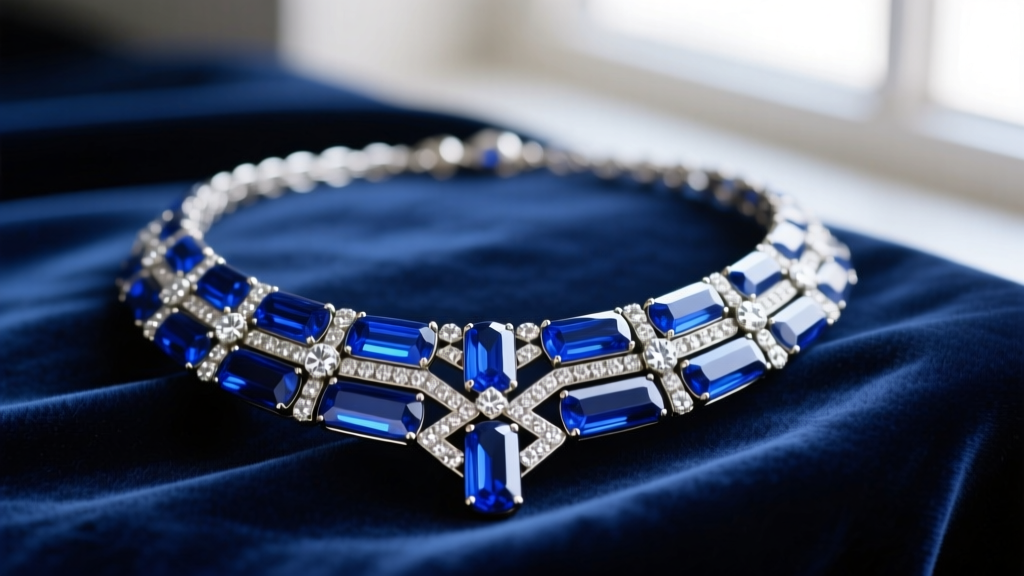
When collectors and enthusiasts search for the perfect vintage blue necklace, they are often captivated by the striking hues that define different eras of jewelry design. From the deep, starry ultramarine of 1920s Art Deco pieces to the vibrant robin's-egg blue of 1970s Southwestern turquoise, the color blue has maintained a dominant presence in antique and vintage jewelry. However, identifying the exact material is crucial for authentication, valuation, and proper care. A vintage blue necklace is rarely just a simple assembly of beads; it is a historical artifact composed of specific minerals, glass formulations, and early synthetics that each possess unique gemological properties.
Understanding the material composition of your jewelry allows you to distinguish between a priceless Art Nouveau sapphire pendant and a clever mid-century cobalt glass reproduction. In this comprehensive guide, we break down the physical properties, structural identifiers, and historical contexts of the most common blue materials found in vintage necklaces.
Decoding Blue Gemstones: Lapis Lazuli and Turquoise
Lapis Lazuli: The Royal Ultramarine
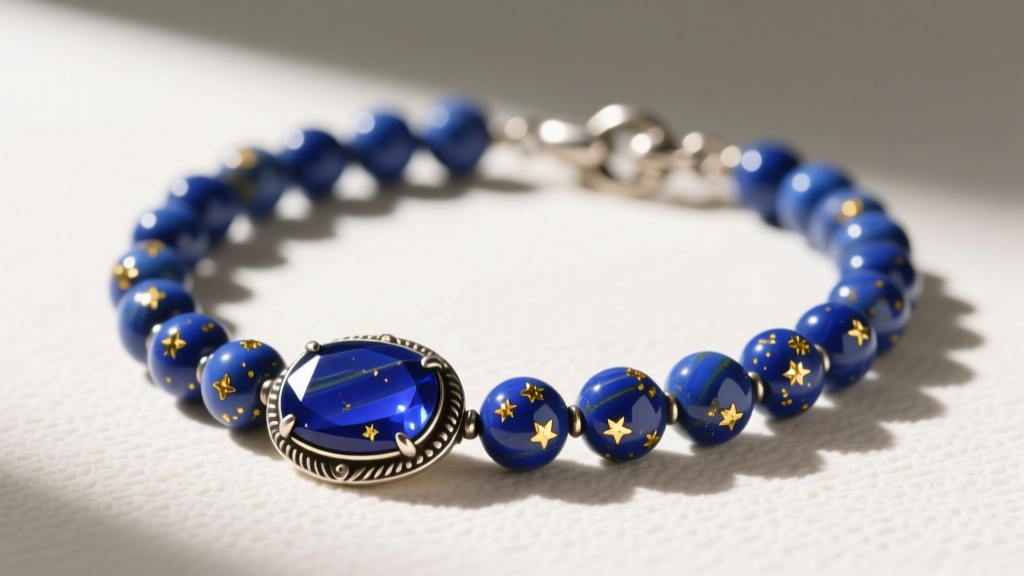
Lapis lazuli is a metamorphic rock, not a single mineral, which gives it a complex internal structure. A high-quality vintage blue necklace featuring lapis will exhibit a rich, saturated royal blue, often punctuated by metallic golden flecks of pyrite and occasional white veining of calcite. According to the Gemological Institute of America (GIA), lapis lazuli ranks between 5 and 5.5 on the Mohs hardness scale, making it relatively soft and susceptible to scratching from harder materials like quartz or topaz.
In vintage jewelry, particularly pieces originating from the Victorian era or the 1920s Art Deco movement, lapis was frequently cut into precise cabochons or carved into intricate cameos. One critical authentication step for vintage lapis is checking for dye. Lower-grade lapis with heavy white calcite veining was often dyed in the mid-20th century to mimic premium Afghan lapis. To test this, gently dab an acetone-moistened cotton swab on an inconspicuous white calcite patch; if the swab turns blue, the stone has been artificially enhanced.
Turquoise: Porosity, Matrix, and Stabilization
Turquoise is a hydrous phosphate of copper and aluminum, ranking 5 to 6 on the Mohs scale. Its defining characteristic in vintage jewelry is its porosity. In vintage Native American squash blossom necklaces or 1970s bohemian pendants, natural turquoise was widely used. Over decades of wear, natural turquoise absorbs skin oils, cosmetics, and environmental moisture, which can cause the stone to shift from a bright sky blue to a deeper, greener hue due to the oxidation of its copper content.
By the 1960s and 1970s, the demand for turquoise outpaced the supply of high-quality natural rough, leading to the widespread use of stabilized turquoise. Stabilization involves impregnating the porous "chalk" turquoise with clear epoxy or resin under pressure to harden the stone and lock in its color. While purists prefer untreated natural stones, stabilized turquoise is a legitimate and expected material in late 20th-century vintage pieces. The GIA Turquoise Guide notes that the Zachery treatment, a more modern enhancement, is harder to detect without advanced spectroscopy, but vintage pieces will typically exhibit older, simpler epoxy stabilization visible under magnification as a slight plastic-like sheen in the stone's matrix crevices.
Cobalt Glass and Paste: The Art of the Illusion
Not every vintage blue necklace is made of mined gemstones. Cobalt glass, often referred to in antique contexts as "paste" or "Bristol Blue," was heavily utilized from the Georgian era through the mid-20th century to mimic sapphires and lapis. Cobalt oxide was added to molten glass to produce an intense, penetrating blue that could rival fine gemstones in low light.
"Paste jewelry was not considered 'fake' in the 18th and 19th centuries; it was a highly respected craft in its own right, with artisans cutting leaded glass to maximize light dispersion in ways that early diamond and sapphire cuts could not achieve." — Victoria & Albert Museum
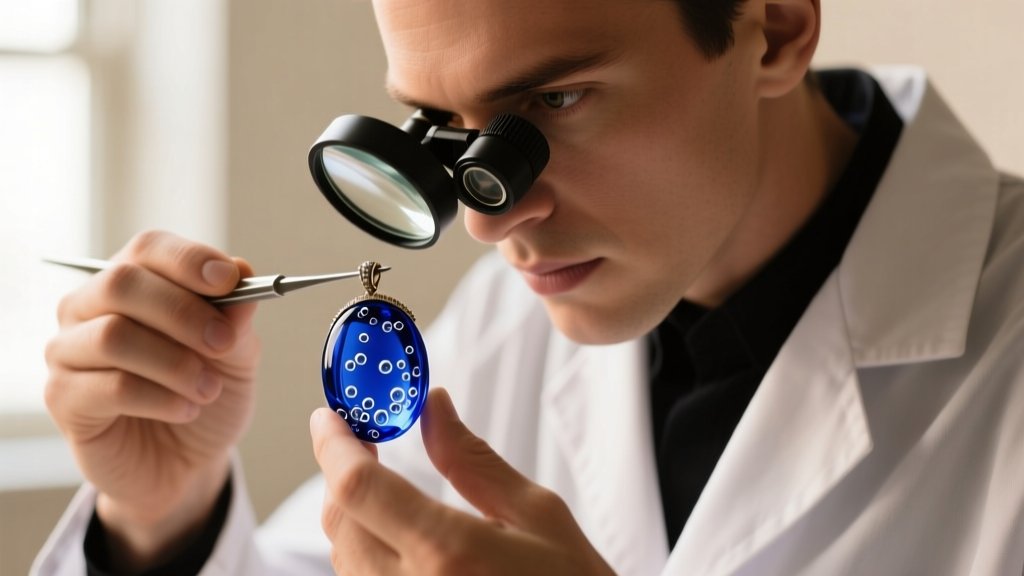
Glass possesses a conchoidal fracture (curved, shell-like break lines) and lacks the crystalline structure of natural stones. Under a 10x jeweler's loupe, vintage cobalt glass will often reveal tiny, perfectly spherical air bubbles and flow lines (swirls) from the cooling process. Furthermore, glass is an amorphous solid, meaning it is singly refractive, whereas natural blue sapphires are doubly refractive. Glass also feels noticeably warmer to the touch upon initial contact compared to the rapid heat conductivity of natural crystalline gemstones.
Material Properties & Care Comparison Chart
Proper maintenance of a vintage blue necklace depends entirely on its material composition. Using an ultrasonic cleaner on a porous or fractured stone can result in catastrophic damage. Refer to the table below for specific care parameters.
| Material | Mohs Hardness | Porosity | Common Vintage Eras | Safe Cleaning Method |
|---|---|---|---|---|
| Lapis Lazuli | 5.0 - 5.5 | Moderate | Victorian, Art Deco, 1970s | Dry, soft microfiber cloth only |
| Natural Turquoise | 5.0 - 6.0 | High | Early 20th C, Mid-Century | Damp cloth, no soaps or chemicals |
| Cobalt Glass | 5.5 - 6.0 | None | Georgian, Victorian, Art Deco | Mild soap, warm water, soft brush |
| Blue Sapphire | 9.0 | None | Edwardian, Art Deco, Retro | Ultrasonic (if no fractures) |
| Synthetic Spinel | 8.0 | None | 1930s - 1960s Costume | Warm soapy water, soft brush |
Authentication Framework: Spotting Fakes and Synthetics
When evaluating a vintage blue necklace, especially high-value pieces claiming to feature sapphire or tanzanite, you must employ a systematic authentication framework. The early 20th century saw the rise of the Verneuil process, which created flame-fusion synthetic sapphires and spinels. These stones are chemically identical to their natural counterparts but possess distinct microscopic growth patterns.
To accurately identify the blue material in your vintage piece, follow these three diagnostic steps:
- Thermal Conductivity Test: Hold the stone against your cheek or the inside of your wrist. Natural sapphire and quartz-based stones will feel distinctly cold and will take a moment to absorb your body heat. Glass and plastic resin (common in mid-century costume jewelry) will feel closer to room temperature and warm up almost instantly.
- Loupe Inspection for Inclusions: Using a 10x triplet loupe, examine the stone under bright, direct light. Natural sapphires will display angular color zoning, silk (rutile needles), or hexagonal crystal growth lines. If you observe perfectly round air bubbles or curved striae (curved growth lines), you are looking at Verneuil synthetic spinel or glass, commonly used in vintage Art Deco reproduction necklaces.
- UV Fluorescence: Many vintage blue materials react uniquely to ultraviolet light. Natural lapis lazuli often exhibits a mottled white or pale orange fluorescence due to its calcite content, whereas dyed lapis may show a patchy, unnatural glow. Synthetic blue spinels, heavily used in 1940s vintage costume necklaces, often fluoresce a chalky blue or red under long-wave UV light due to cobalt doping.
Preserving the Legacy of Your Vintage Blue Necklace
The longevity of any vintage blue necklace relies on respecting the chemical and physical boundaries of its constituent materials. Always store lapis and turquoise necklaces in soft, breathable cotton pouches rather than airtight plastic bags, which can trap moisture and promote the degradation of organic backing materials or cause epoxy stabilizers to yellow. Conversely, cobalt glass and synthetic spinel pieces should be stored away from direct, prolonged sunlight to prevent any foil-backing (a common technique used in Georgian and Victorian paste jewelry to enhance brilliance) from tarnishing or peeling. By understanding the deep material science behind these beautiful artifacts, collectors can ensure their vintage blue necklaces remain vibrant and historically intact for generations to come.


