The Ultimate Vintage Enamel Flower Necklace Buyer Guide
Discover how to authenticate, evaluate, and buy a vintage enamel flower necklace. Learn enamel techniques, era pricing, and condition red flags.

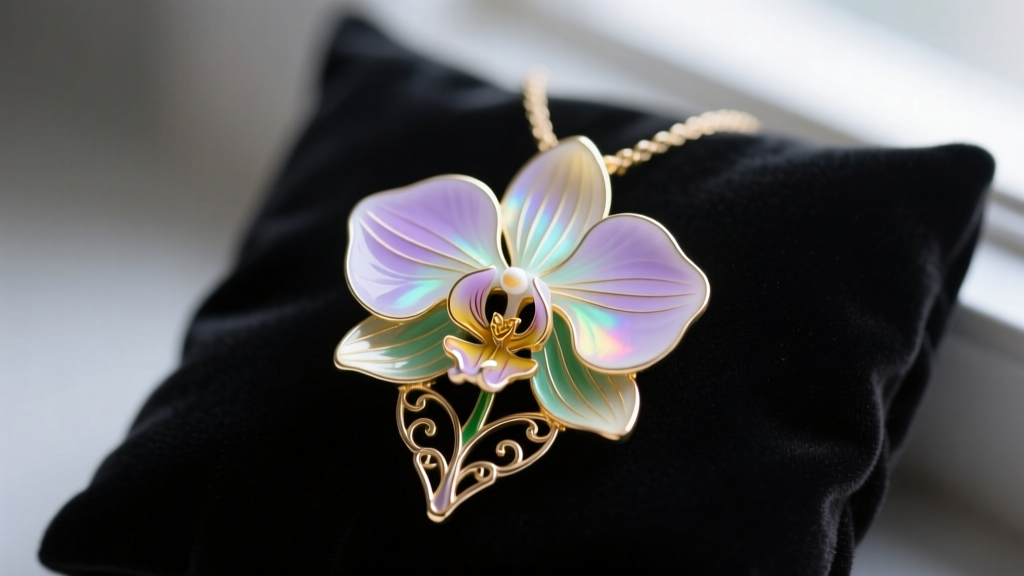
Decoding the Vintage Enamel Flower Necklace
The vintage enamel flower necklace represents a unique intersection of metallurgy, glassmaking, and botanical artistry. Unlike solid gemstone pendants, enamel florals rely on the fusion of pulverized glass to a metal substrate at temperatures between 1,380°F and 1,560°F. For collectors and style enthusiasts navigating the 2026 market, acquiring these pieces requires a trained eye. The market is currently saturated with modern 'cold enamel' (epoxy resin) replicas masquerading as antique vitreous glass. This guide provides the technical frameworks, historical context, and condition checklists necessary to authenticate and invest in genuine vintage botanical enamel jewelry.
Vitreous vs. Cold Enamel: The Authentication Test
Before evaluating a piece's era or maker, you must verify the material. True vintage enamel is vitreous glass. Cold enamel is a modern two-part epoxy resin poured into metal cavities. Distinguishing between the two is critical for valuation.
- Thermal Conductivity: Vitreous glass feels noticeably cold to the touch and takes longer to warm to body temperature than epoxy resin.
- Hardness Testing: Glass enamel ranks around 5.5 to 6.5 on the Mohs scale. A fine steel needle will not scratch it. Epoxy resin (Mohs 2-3) will easily scratch and yield to pressure.
- UV Fluorescence: Under a 365nm UV flashlight, modern synthetic resins often fluoresce bright white or milky blue due to optical brighteners. Antique vitreous glass generally remains inert or shows very faint, natural inclusions.
- Acoustic Resonance: Gently tapping vitreous enamel with a metal probe produces a high-pitched, glassy 'clink,' whereas epoxy yields a dull, plastic 'thud.'
Mastering Historical Enamel Techniques
The value of a vintage enamel flower necklace is heavily dictated by the complexity of the enameling technique employed by the original artisan. According to the Lang Antiques University, understanding these methods is mandatory for serious collectors.
Plique-à-Jour (The Holy Grail)
Translating to 'letting in daylight,' plique-à-jour is essentially stained glass for jewelry. The enamel is suspended within a delicate metal framework (usually gold or silver) with no metal backing. Light passes directly through the translucent floral petals. Because it lacks structural support, it is incredibly fragile. Authentic Art Nouveau plique-à-jour orchid or lily pendants are exceedingly rare and command premium prices, often exceeding $5,000 for pristine examples.
Guilloché (Engine-Turned Translucency)
Guilloché involves machining a precise, repetitive geometric pattern into a silver or gold base using a rose engine lathe. Translucent enamel is then fired over the grooves. The light catches the engraved metal beneath the glass, giving the flower petals a mesmerizing, three-dimensional moiré effect. 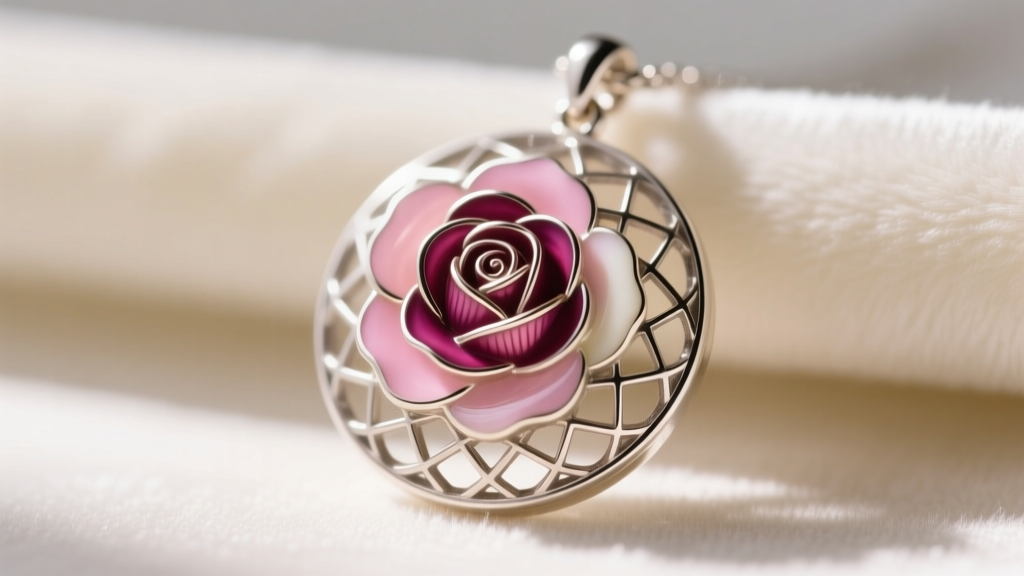 When inspecting guilloché florals, look for the crispness of the underlying engraving; blurred lines indicate a later, inferior cast replica rather than a machined original.
Champlevé and Cloisonné
In champlevé, troughs are carved or etched into a thick metal base and filled with opaque or translucent enamel. Cloisonné uses flattened silver or gold wires soldered to the base to create the 'cells' (cloisons) that hold the enamel. For floral motifs, cloisonné allows for incredible color blocking—perfect for the intricate, multi-colored petals of Mid-Century botanical designs or Victorian sentimental brooches converted into pendants.
Era Identification and Floral Symbolism
Botanical motifs have dominated jewelry design for centuries, but the execution of the enamel flower varies wildly by era. The Victoria and Albert Museum notes that floral jewelry was rarely just decorative; it was deeply symbolic.
Victorian Sentiment (1837–1901)
During the Victorian era, the 'Language of Flowers' (floriography) was a cultural phenomenon. Enamel flowers were coded messages. A red enamel rose symbolized deep passion, while a white enamel lily denoted purity. Yellow enamel violets represented modesty. Victorian pieces are often heavy, utilizing silver or low-karat gold, and feature dark, rich enamel colors. Look for C-clasps or early tube hinges if the piece was originally a brooch converted to a pendant.
Art Nouveau Whiplash Curves (1890–1910)
Art Nouveau rejected rigid symmetry. Enamel flowers from this era—often orchids, irises, and poppies—feature asymmetrical, 'whiplash' curves. Plique-à-jour was the favored technique, mimicking the fragile, translucent wings of insects and the delicate veins of leaves. Hallmarks from French makers like René Lalique or Georges Fouquet denote museum-grade investments.
Mid-Century Boldness (1940–1970)
Post-WWII costume jewelry houses like Trifari, Miriam Haskell, and Christian Dior popularized bold, oversized enamel florals. These pieces often utilized opaque champlevé enamel on brass or rhodium-plated base metals. They feature vibrant, saturated colors—cherry reds, cobalt blues, and mustard yellows. Value here is driven by the maker's mark and the condition of the gold or silver plating beneath the enamel.
The Condition Checklist: Red Flags to Avoid
Enamel is essentially glass fused to metal; it is brittle and susceptible to specific failure modes. When evaluating a vintage enamel flower necklace, use a 10x jeweler's loupe to check for the following:
- Crazing and Hairline Fractures: Look for microscopic web-like cracks on the surface. While minor crazing is acceptable in 19th-century pieces, deep fractures compromise the structural integrity and significantly lower the value.
- Moisture Trapping and Oxidation: If water penetrates a microscopic crack, it reaches the base metal. The resulting oxidation (rust or silver sulfide) expands, physically pushing the enamel off the metal in a process called 'spalling.' Avoid pieces with dark, creeping shadows beneath the glass.
- Enamel Loss on High Points: On guilloché or champlevé flowers, the highest points of the metal domes are most prone to chipping. Check the tips of the petals and the center of the blossom.
- Clasp and Bail Replacements: A modern lobster clasp on a Victorian pendant is not inherently bad, but the soldering heat required to attach a new bail can sometimes cause adjacent enamel to crack or discolor. Inspect the metal loop connecting the pendant to the chain.
Market Value and Pricing Matrix
Pricing for vintage enamel flower necklaces in 2026 varies drastically based on era, technique, and metal content. Below is a benchmark matrix for authenticated, excellent-condition pieces.
| Era / Style | Technique | Base Metal | Estimated Price Range (USD) |
|---|---|---|---|
| Victorian Sentiment | Champlevé / Opaque | Sterling Silver / 9k Gold | $250 – $800 |
| Art Nouveau Floral | Plique-à-Jour | 14k/18k Gold | $2,500 – $12,000+ |
| Art Deco Geometric | Guilloché | Sterling Silver / Marcasite | $400 – $1,200 |
| Mid-Century Designer | Cloisonné / Opaque | Gold-Plated Brass | $150 – $600 |
| Unsigned Vintage | Guilloché | Silver Tone / Tombac | $50 – $150 |
Provenance, Hallmarks, and Trusted Sourcing
Authentication relies heavily on hallmarks. For fine jewelry, look for French eagle heads (18k gold) or boar heads (silver), and British anchor or leopard head assay marks. For Mid-Century costume pieces, flip the pendant over. Trifari pieces should bear the 'Crown' mark (post-1955) or 'Pat. Pend.' markings. Miriam Haskell florals often feature intricate brass filigree backs stamped with an oval cartouche. Always request high-resolution macro photography of the reverse side when buying online, as the back of an enamel piece reveals the metal finishing and soldering quality that fakes often ignore.
Archival Care and Maintenance
Preserving a vintage enamel flower necklace requires specific environmental controls. Never use ultrasonic cleaners; the high-frequency vibrations will shatter micro-fractures in the glass, causing the petals to disintegrate. 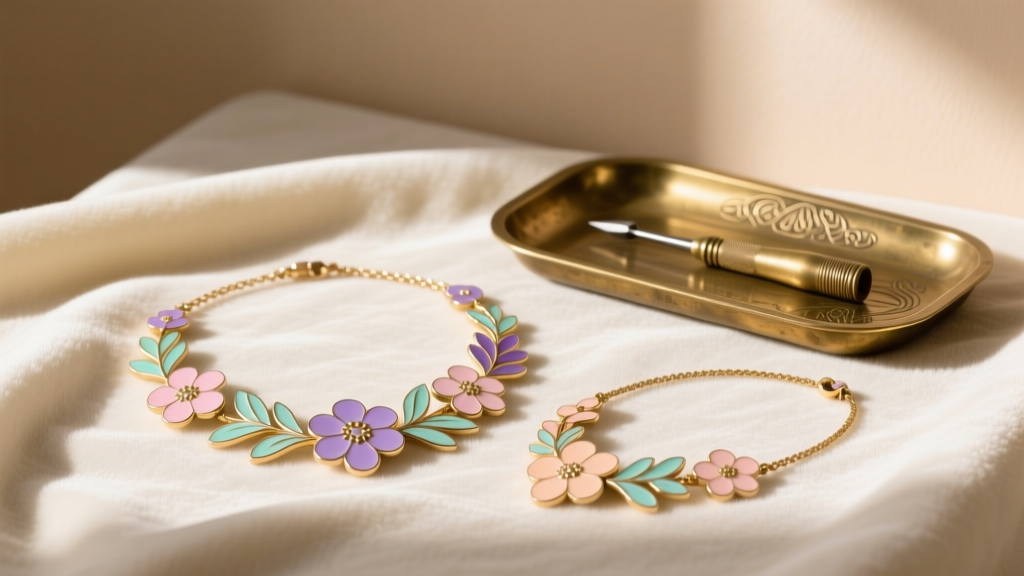 Similarly, avoid chemical silver dips, which can strip the metallic oxides used to color the enamel.
Clean the piece using only a soft, untreated microfiber cloth and mild, phosphate-free soap if absolutely necessary. Store the necklace flat in a padded, acid-free archival box. Hanging vintage enamel pendants on standard jewelry trees can cause the bail to warp over time or result in the pendant swinging into other pieces, causing catastrophic glass chipping. By understanding the metallurgy, history, and fragility of these wearable botanical gardens, you can confidently acquire a piece that will endure for generations.


