Authenticating a Vintage Italian Silver Necklace: Metal Guide
Learn how to authenticate a vintage Italian silver necklace by analyzing hallmarks, alloy grades (800 vs 925), patina, and material properties.

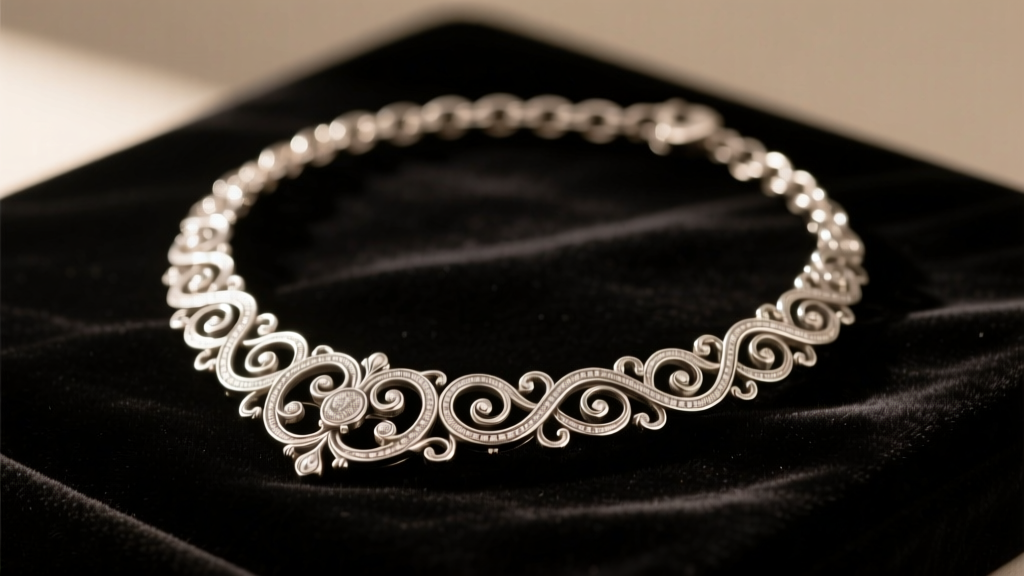
The secondary market for estate jewelry has seen a massive resurgence, and at the center of this revival is the vintage Italian silver necklace. Renowned for exceptional craftsmanship, intricate filigree, and bold mid-century modernist designs, Italian silver remains highly coveted. However, as we navigate the 2026 vintage jewelry market, the surge in demand has led to an increase in sophisticated counterfeits and misrepresented alloys. To truly appreciate and accurately value these pieces, collectors and enthusiasts must look beyond the aesthetic and understand the underlying metallurgy, hallmarking laws, and material properties that define authentic Italian silver.
The Metallurgy of Italian Silver: 800 vs. 925
Unlike the United States and the United Kingdom, where 925 sterling silver has been the undisputed standard for centuries, Italy has a long, complex history with alternative silver alloys. When evaluating a vintage Italian silver necklace, you will most frequently encounter two distinct purity grades: 800 and 925.
Continental 800 Silver
Historically, Italian silversmiths favored 800 silver (80% pure silver, 20% copper or other base metals). This was not a compromise on quality, but a deliberate metallurgical choice. The higher copper content provides significant structural integrity, allowing artisans to execute the incredibly fine, lace-like filigree and repoussé work that Italian regions like Vicenza and Arezzo are famous for. Pure silver is too malleable to hold these intricate shapes without bending or warping under its own weight.
925 Sterling Silver
While 925 sterling (92.5% silver, 7.5% copper) was used in Italy, it became much more prevalent in the latter half of the 20th century, primarily driven by export demands to the American and British markets. According to the Gemological Institute of America (GIA), sterling silver offers a brighter, whiter luster but is inherently softer, making it less ideal for the rigid, architectural mesh chains popular in 1970s Italian design.
| Property | 800 Continental Silver | 925 Sterling Silver |
|---|---|---|
| Silver Purity | 80.0% | 92.5% |
| Alloy Metals | 20% Copper/Zinc | 7.5% Copper |
| Tensile Strength | High (Excellent for filigree) | Moderate (Better for casting) |
| Tarnish Rate | Faster (due to higher copper) | Slower |
| Visual Luster | Slightly warmer, deeper tone | Bright, stark white |
Decoding the Losanga and Italian Hallmarks
Authenticating a vintage Italian silver necklace requires a jeweler's loupe (minimum 10x magnification) and a working knowledge of Italian assay laws. The hallmarking system in Italy is highly regulated, most notably codified in Law 464 of 1968 and later updated by Legislative Decree 251/99.
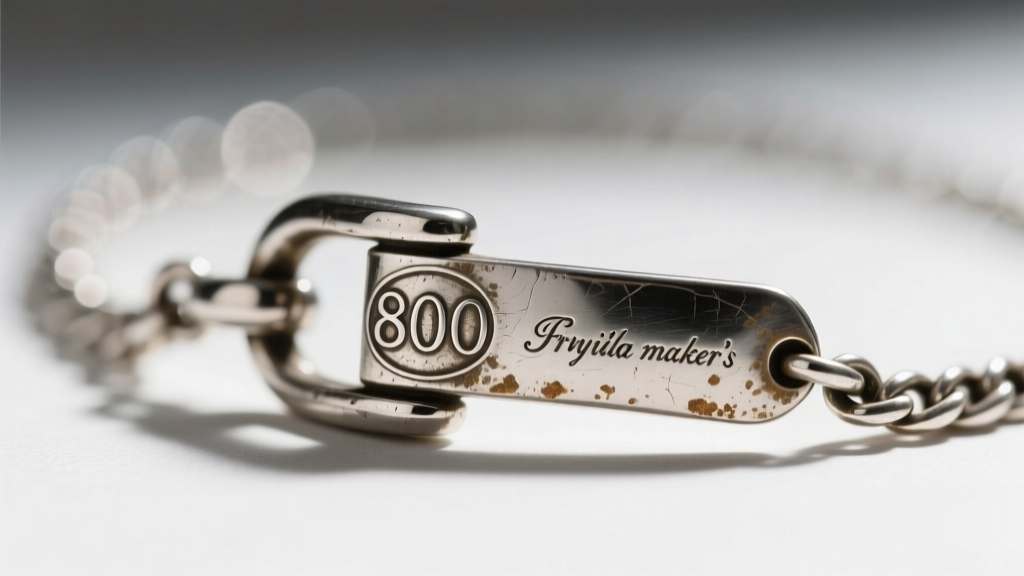
You should look for three distinct stamps on the clasp or end rings:
- The Purity Mark: Stamped as '800' or '925'. In older pieces, this may be accompanied by a profile of a woman (the 'testa di donna') used prior to 1968, or a star symbol in later decades.
- The Maker's Mark (Losanga): This is a rhombus-shaped stamp containing a number and a two-letter provincial code. For example, '123 VI' indicates the 123rd registered silversmith in Vicenza, a historic hub for gold and silver chain manufacturing.
- The Star of Italy: Introduced in 1968, a small star often precedes the maker's number, signifying that the piece was registered and exported legally.
Be highly suspicious of pieces that simply read 'Italy' or 'Silver' without the specific numerical purity or the Losanga maker's mark, as the Federal Trade Commission (FTC) Jewelry Guides strictly require accurate purity disclosures for precious metals sold in international markets.
Material Properties: Patina, Tarnish, and Wear
The way a vintage Italian silver necklace ages is a direct reflection of its alloy composition. Tarnish on silver is primarily silver sulfide, but the high copper content in 800 silver introduces another compound: cuprite (copper oxide). This results in a distinct, multi-layered patina that is highly prized by serious collectors.
The Anatomy of Vintage Tarnish
When an 800 silver necklace is left unpolished for decades, the outermost layer develops a deep, iridescent purple-black hue. Beneath this lies a layer of reddish-brown cuprite. This natural oxidation protects the underlying metal from further degradation. In the 2026 collector's market, a heavy, undisturbed antique patina on a mid-century Italian piece can actually increase its valuation by 15% to 20%, as it proves the piece has not been aggressively restored or dipped in harsh chemical strippers.
Common Failure Modes in Vintage Chains
Because vintage necklaces are subjected to decades of mechanical stress, understanding material failure points is crucial for buyers:
- Box Clasp Spring Fatigue: The internal steel or silver springs inside vintage tongue-and-groove box clasps often lose their tension or snap due to metal fatigue. Always test the 'click' mechanism.
- Rope Chain Unraveling: Italian rope chains are machine-woven. If a single link in a vintage 800 silver rope chain fractures, the torsion tension can cause the entire chain to rapidly unravel. Inspect every inch for micro-fractures.
- Solder Joint Degradation: Vintage Italian silversmiths often used lower-temperature silver solders. Over time, exposure to lotions, perfumes, and skin acids can cause these solder joints to become brittle and fail at the jump rings.
Non-Destructive Authentication in 2026
Never use destructive acid tests on a vintage Italian silver necklace. Nitric acid will permanently scar the patina and destroy the delicate maker's marks on the clasp. Instead, rely on advanced, non-destructive methodologies.
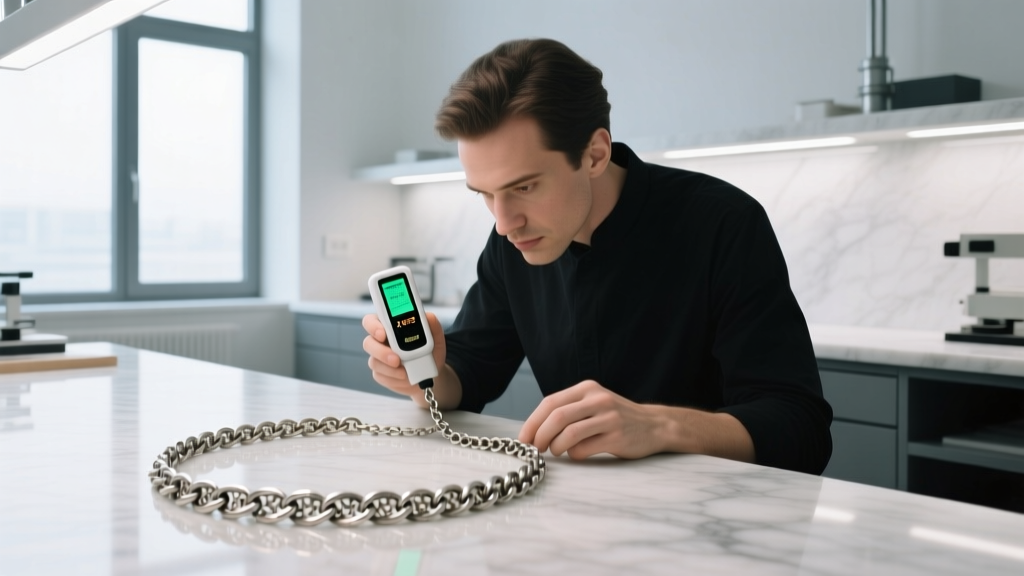
X-Ray Fluorescence (XRF) Spectrometry
XRF is the gold standard for authenticating vintage alloys. A handheld XRF analyzer fires X-rays into the metal, causing the atoms to emit secondary fluorescent X-rays. This allows the gemologist to see the exact elemental breakdown—confirming not just the 80% silver content, but also identifying the specific trace elements (like zinc or nickel) that can pinpoint the exact decade and region of Italian manufacture.
The Magnet and Ice Tests
While not definitive proof of purity, these field tests are excellent first-line defenses against counterfeits. Silver is diamagnetic; it will not stick to a rare-earth neodymium magnet. Furthermore, silver possesses the highest thermal conductivity of any common metal. If you place an ice cube on a thick vintage Italian silver link, it should begin to melt almost instantaneously, far faster than it would on a stainless steel or silver-plated brass replica.
Expert Preservation Tip: If you must clean a vintage Italian 800 silver necklace, avoid commercial silver dips. Instead, use a mild solution of distilled water and a few drops of phosphate-free dish soap, gently agitating with a soft baby toothbrush. This removes decades of skin oils and sebum without stripping the historic cuprite patina from the crevices of the filigree.
Ultimately, acquiring a vintage Italian silver necklace is an exercise in historical archaeology. By understanding the metallurgical reasons behind the 800 alloy, mastering the visual language of the Losanga hallmark, and respecting the natural oxidation of the metal, you can confidently navigate the market and secure authentic, museum-quality pieces that will endure for generations.