Authenticating a Vintage Tiger Eye Necklace: Material Properties & Fakes
Discover how to authenticate a vintage tiger eye necklace by analyzing chatoyancy, Mohs hardness, and material properties to spot modern fakes.

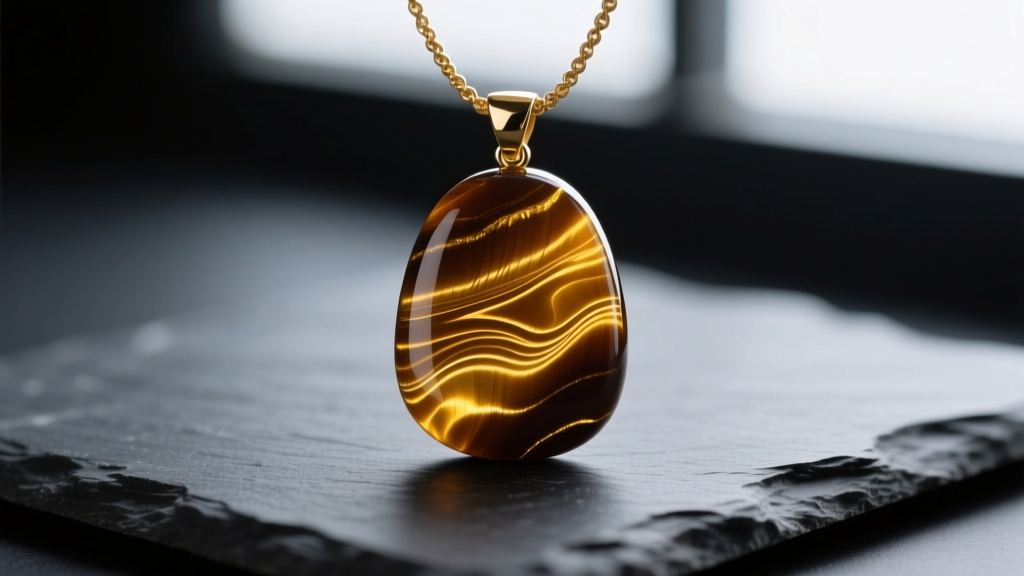
Few gemstones capture the imagination quite like tiger's eye, with its mesmerizing, shifting bands of golden light. However, sourcing a genuine vintage tiger eye necklace requires more than just a good eye for aesthetics; it demands a deep understanding of mineralogy, lapidary history, and material physics. As of 2026, the secondary jewelry market is saturated with highly convincing synthetic imitations, dyed agates, and fiber-optic glass masquerading as mid-century vintage pieces. To build a collection that holds both historical and material value, buyers must look beyond the surface and evaluate the intrinsic properties of the stone and its structural setting.
The Mineralogy of Tiger's Eye: Quartz vs. Asbestos Pseudomorphs
To authenticate a vintage piece, one must first understand how genuine tiger's eye forms. According to the Mindat Mineralogy Database, tiger's eye is a pseudomorph—a mineral that has replaced another while retaining the original's external form. Specifically, it is a macrocrystalline quartz (SiO2) replacement of crocidolite, a fibrous blue amphibole asbestos.
During the geological replacement process, iron oxides (primarily limonite and goethite) infiltrate the fibrous structure, transforming the stone from its original blue state (hawk's eye) into the rich golden-brown hues characteristic of tiger's eye. This fibrous internal architecture is the absolute prerequisite for the stone's optical properties. When evaluating a suspected vintage pendant, gemologists look for the natural, slightly irregular distribution of these iron oxide pockets. Genuine vintage stones often display subtle color zoning and minor mineral inclusions, whereas perfectly uniform coloration is an immediate red flag for modern dye treatments or synthetic manufacturing.
Decoding Chatoyancy: The Optical Physics of the 'Cat's Eye'
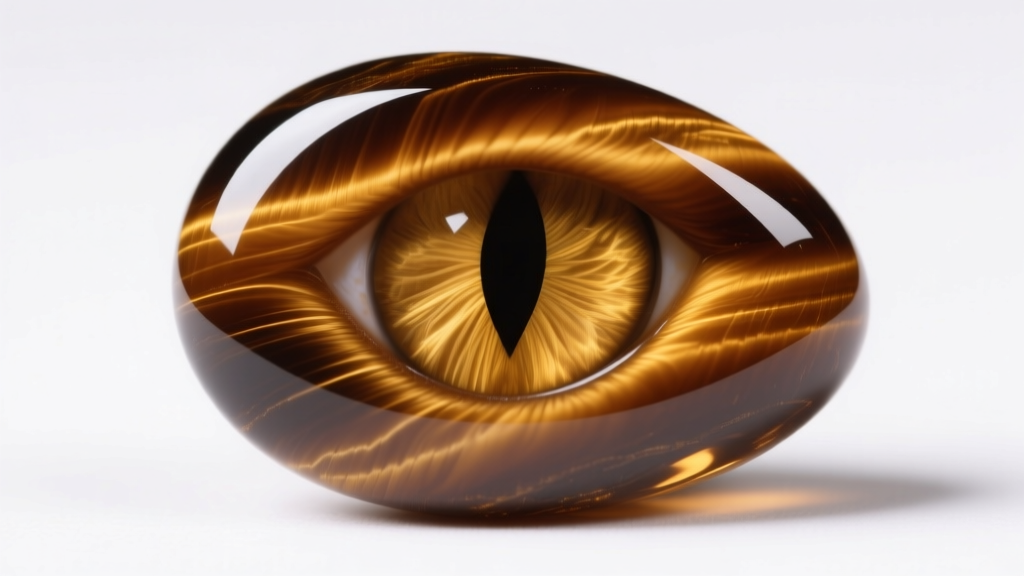
The defining characteristic of a true vintage tiger eye necklace is its chatoyancy (from the French 'oeil de chat', meaning cat's eye). This optical phenomenon is not a surface reflection but a subsurface light scattering effect. When light strikes the parallel, microscopic asbestos-replaced quartz fibers, it reflects back in a concentrated, luminous band that appears to glide across the surface of the cabochon as the viewing angle changes.
Genuine chatoyancy is dynamic and highly directional. The 'eye' should be sharp, yet it will exhibit natural imperfections, slight waviness, and varying intensity depending on the density of the fibrous inclusions. In contrast, modern fiber-optic glass imitations produce an unnaturally perfect, razor-sharp, and completely static line of light that lacks the organic depth and secondary golden flashes found in natural quartz pseudomorphs. Furthermore, the Gemological Institute of America (GIA) notes that natural tiger's eye possesses a refractive index (RI) of 1.54 to 1.55, which gives it a distinct, deep vitreous luster that glass (RI 1.50) simply cannot replicate.
Material Comparison: Genuine Vintage vs. Modern Imitations
When assessing a vintage tiger eye necklace, distinguishing between natural quartz, dyed agate, and glass is critical. Below is a comparative breakdown of the physical properties you should expect when testing or appraising these materials.
| Material | Mohs Hardness | Specific Gravity (SG) | Refractive Index (RI) | Visual & Structural Traits |
|---|---|---|---|---|
| Genuine Tiger's Eye | 7.0 | 2.64 - 2.71 | 1.54 - 1.55 | Dynamic chatoyancy, fibrous internal structure, natural color zoning. |
| Dyed Agate (Common Fake) | 6.5 - 7.0 | 2.60 - 2.65 | 1.53 - 1.54 | Lacks true chatoyancy; shows concentric banding; dye concentrates in fractures. |
| Fiber-Optic Glass | 5.5 - 6.0 | 2.40 - 2.60 | 1.45 - 1.52 | Perfectly uniform 'eye', lower density, feels warmer to the touch than quartz. |
| Chatoyant Resin/Plastic | 2.0 - 3.0 | 1.10 - 1.30 | 1.49 - 1.58 | Extremely lightweight, easily scratched by a copper coin, lacks thermal mass. |
The Thermal Conductivity Test
Because vintage pieces were historically cut from dense, high-quality quartz, they possess significant thermal mass. When pressed against the skin or the inside of the wrist, genuine tiger's eye will feel distinctly cool and take several seconds to warm to body temperature. Glass and resin imitations will feel neutral or warm almost immediately upon contact.
Chain Pairings: Metallurgy and Tarnish Resistance for Heavy Pendants
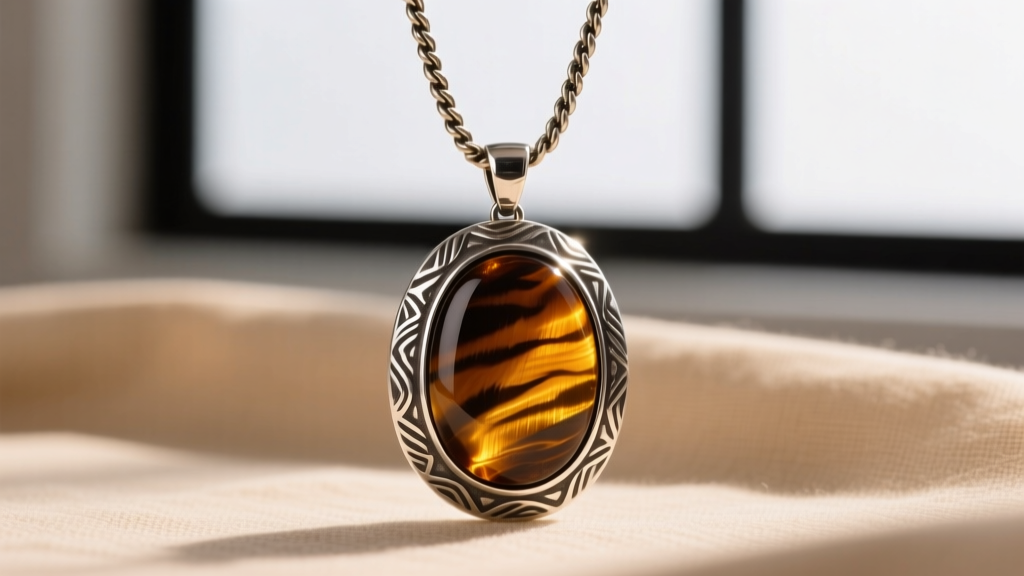
A common failure point in vintage tiger eye necklaces is the chain and setting hardware. Genuine tiger's eye has a relatively high specific gravity (up to 2.71), meaning a substantial 25mm vintage cabochon pendant, complete with a metal bezel, can easily exceed 35 grams. This concentrated kinetic weight places immense shear stress on the chain's jump rings and links.
- Chain Gauge & Style: Avoid delicate cable or box chains under 2.0mm. For heavy vintage pendants, opt for a 2.5mm to 3.0mm Wheat, Rope, or Figaro chain. These interlocking styles distribute weight laterally, preventing the links from stretching or snapping under pendulum-like movement.
- Jump Ring Integrity: Always inspect the jump ring connecting the pendant bail to the chain. On genuine vintage pieces, this ring should be soldered closed. An open, unsoldered jump ring will eventually pull apart under the stone's weight.
- Metallurgical Pairings: Tiger's eye's warm, earthy tones are historically paired with oxidized sterling silver or 14k gold-filled brass. If choosing silver, look for modern Argentium silver replacements for vintage chains, as the addition of germanium drastically reduces tarnish and increases the metal's tensile strength compared to traditional 925 sterling.
Restoration and Care: Preventing Micro-Fractures
While quartz itself is highly durable (Mohs 7), the limonite and goethite inclusions that give tiger's eye its color have different hardness levels and structural integrities. This discrepancy creates internal planes of weakness. Many vintage tiger eye necklaces from the 1970s and 80s were cut with thick, flat backs and steep domes, making them susceptible to chipping if struck against hard surfaces.
Safe Cleaning Protocols
Never use ultrasonic or steam cleaners on a vintage tiger eye necklace. The high-frequency vibrations of an ultrasonic bath can exploit the microscopic boundaries between the quartz and the iron oxide inclusions, causing internal micro-fractures that cloud the stone's chatoyancy and compromise its structural integrity.
Expert Lapidary Tip: To safely clean a vintage tiger's eye pendant, use a soft, untreated microfiber cloth and a mild, phosphate-free dish soap diluted in lukewarm water. Gently scrub the back of the cabochon with a soft-bristled baby toothbrush to remove decades of accumulated skin oils and cosmetics, which can dull the stone's vitreous luster and trap moisture against the metal setting. Dry immediately to prevent water spots on the metal hardware.
By prioritizing material science over superficial aesthetics, collectors can confidently navigate the vintage market. Understanding the precise optical physics of chatoyancy, the lapidary realities of pseudomorphic quartz, and the mechanical requirements of heavy stone settings ensures that your vintage tiger eye necklace remains both a stunning wearable artifact and a structurally sound investment.


