What Is the Clasp of a Necklace Called? A Buyer's Guide
Wondering what the clasp of a necklace is called? Discover types, security ratings, and how to choose the best necklace clasp in our buyer's guide.

The Anatomy of a Necklace: What Is the Clasp Called?
If you have ever found yourself at a jewelry counter or searching online for replacement parts, you might have asked: what is the clasp of a necklace called? In the jewelry industry, the entire fastening mechanism is simply referred to as the clasp or finding. However, a clasp is rarely a single piece of metal. It is an engineered system comprised of three distinct components:
- The Fastener: The primary mechanical locking device (e.g., the lobster claw or spring ring itself).
- The Catch Plate (or Eye): The loop or receptacle that the fastener hooks into.
- The Jump Ring: The small circular wire ring that connects the clasp components to the actual chain or strand of the necklace.
Understanding this terminology is the first step in evaluating the quality, security, and longevity of your fine jewelry. A necklace is only as secure as its weakest finding, and according to the GIA Gem Encyclopedia, clasp failure is the number one reason for lost pendants and broken chains.
The 6 Most Common Necklace Clasp Types (And When to Use Them)
Not all clasps are created equal. The right choice depends on the weight of your chain, the value of your pendant, and your manual dexterity. Here is a deep dive into the mechanics of the most common necklace fasteners.
1. The Spring Ring
The spring ring is a circular clasp with a small lever that retracts an internal spring. While ubiquitous on affordable and lightweight chains, they have a critical flaw: the internal spring is almost always made of carbon steel, not gold or silver. Over time, exposure to sweat, humidity, or chlorine can cause the internal steel to rust or lose tension, leading to sudden failure. They are best reserved for lightweight chains under 15 grams.
2. The Lobster Claw
Named for its resemblance to a lobster's pincer, this clasp uses a heavier, more robust spring mechanism. Lobster claws offer superior leverage and security compared to spring rings. When buying, look for cast lobster claws rather than stamped ones. Stamped clasps are hollow and can easily crush if snagged on clothing, whereas solid cast clasps withstand significant lateral pressure.
3. The Box Clasp (Tongue and Groove)
Standard on tennis necklaces and heavy multi-strand pieces, the box clasp features a V-shaped metal 'tongue' that compresses and clicks into a rectangular 'box.' 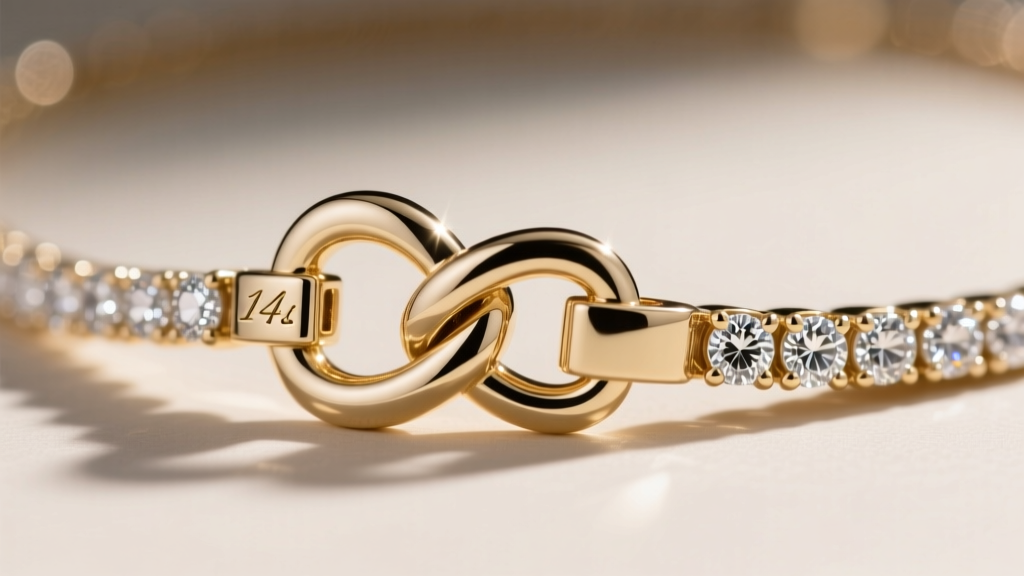 Because the metal tongue can bend and lose its friction fit over time, high-quality box clasps always include a figure-eight safety latch—a secondary wire loop that snaps over a button on the outside of the box to prevent catastrophic failure if the tongue slips.
4. The Toggle Clasp
A toggle consists of a T-shaped bar that inserts through a large O-ring. It relies entirely on the weight and tension of the necklace to stay closed. The golden rule of toggle security is the 1:3 ratio: the T-bar must be at least one-third wider than the inner diameter of the O-ring. If the chain is too light or the necklace is too long, the lack of tension will cause the bar to slip out.
5. The Fishhook (Pearl Clasp)
Designed specifically for delicate pearl strands, the fishhook clasp involves a thin, curved hook that slides into an ornate, oval-shaped box and catches on an internal pin. It is highly secure against pulling but requires excellent manual dexterity and good eyesight to fasten behind the neck.
6. Magnetic Clasps
Modern neodymium magnetic clasps offer incredible ease of use, especially for those with arthritis. However, they are vulnerable to lateral sliding forces. A strong tug will not pull a good magnetic clasp apart, but a twisting motion will slide the magnets off one another. They should only be used on lightweight chains and never with heavy pendants.
Security vs. Aesthetics: A Clasp Comparison Matrix
Use this matrix to determine which clasp type aligns with your specific jewelry needs, balancing physical security with visual discretion.
| Clasp Type | Security Level | Best Application | Common Failure Mode |
|---|---|---|---|
| Spring Ring | Low | Chains under 15g | Internal steel spring rusts or loses tension |
| Lobster Claw | High | Everyday wear, pendants up to 40g | Stamped hollow body crushes under lateral stress |
| Box (with Safety) | Very High | Tennis necklaces, heavy multi-strands | V-tongue bends and loses friction fit |
| Toggle | Medium | Chunky chains, statement pieces | Bar slips through ring due to low chain tension |
| Fishhook | High | Knotted pearl or gemstone bead strands | Internal pin wears down or bends outward |
| Magnetic | Medium-Low | Lightweight chains, accessibility needs | Twisting motion causes lateral magnet separation |
Material Grades and Durability: What to Look For
The metal alloy used to manufacture the clasp directly dictates its lifespan. According to metallurgical standards referenced by Jewelers of America, the hardness of the metal is paramount for moving parts.
Expert Insight: Avoid 18k or 22k gold for spring rings and lobster claws. High-karat gold is too soft and lacks the 'memory' required to keep a spring mechanism tight. 14k gold or platinum is vastly superior for mechanical clasps due to their higher Vickers hardness ratings.
Furthermore, pay close attention to the jump ring connecting the clasp to your chain. Jump rings are measured in gauge (thickness) and millimeters (diameter). A standard medium-weight chain requires an 18-gauge (1.0mm) jump ring, while delicate chains use 20-gauge (0.8mm). Crucially, the jump ring on the clasp end must be soldered (the seam fused shut with heat and filler metal). An unsoldered jump ring will eventually pull apart under the swinging weight of a pendant.
How to Inspect a Clasp Before Buying
Whether you are buying vintage or new, perform this three-point physical inspection before handing over your credit card:

- The Snap Test: Open and close the lobster or spring ring five times. It should produce a crisp, audible 'snap.' If the action feels mushy or the lever doesn't return flush against the body, the internal spring is already fatigued.
- The Seam Check: Use a jeweler's loupe (or your smartphone camera on macro mode) to look at the jump ring. If you see a hairline vertical slit, it is unsoldered. Demand a soldered ring for any piece holding significant monetary or sentimental value.
- The Safety Latch Tension: On a box clasp, push the figure-eight safety wire down over the button. It should require deliberate pressure to snap into place. If it rests loosely, the wire has been stretched and will not save your necklace if the primary tongue fails.
Upgrading and Repairing: When to Replace Your Clasp
If you own a beautiful chain but struggle with a tiny, failing spring ring, upgrading the clasp is one of the most cost-effective jewelry modifications you can make. A bench jeweler can typically solder on a new, solid-cast 14k gold lobster claw and a soldered jump ring for between $45 and $85, depending on the metal color and local labor rates.
For heirloom pieces or heavy diamond tennis necklaces, replacing a worn box clasp is a more involved process. A custom-fabricated platinum box clasp with a dual safety latch can cost between $250 and $450, but it guarantees the structural integrity of a piece worth thousands. Always ask your jeweler to laser-weld the new clasp to the chain if the links are too delicate for traditional torch soldering, preventing heat damage to nearby gemstones.
Ultimately, knowing what the clasp of a necklace is called—and how it functions—transforms you from a passive shopper into an informed buyer. By prioritizing mechanical integrity, correct metal hardness, and soldered connections, you ensure your jewelry stays exactly where it belongs: around your neck.


