What Is a Safety Pin Necklace? 2026 Buying Guide
Discover what a safety pin necklace is, from punk DIY roots to luxury designs. Learn about metal gauges, clasp security, and pricing in our 2026 guide.

The Origins and Definition: What Is a Safety Pin Necklace?
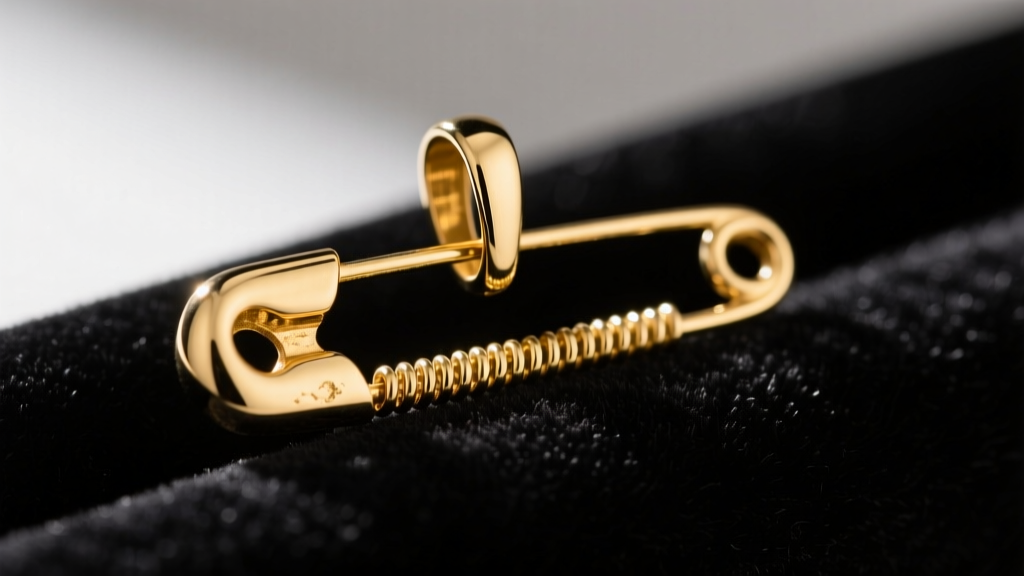
If you have ever browsed alternative jewelry shops or high-end runway collections, you might have asked yourself: what is a safety pin necklace, and how does it differ from simply stringing a hardware store fastener on a chain? At its core, a safety pin necklace is any pendant or chain motif that replicates the iconic coiled-spring fastener. However, in modern jewelry design, the execution of this motif is vastly more complex than upcycled hardware.
Historically, the safety pin was adopted as a rebellious fashion staple during the 1970s London punk movement. Designers like Vivienne Westwood and Malcolm McLaren utilized literal safety pins to deconstruct garments and create confrontational, anti-establishment jewelry. According to the V&A Museum's historical jewelry archives, this era cemented the safety pin as a permanent icon of subculture. Today, the safety pin necklace has evolved into two distinct categories: functional articulated pieces (where the pin actually opens and closes) and solid-cast decorative pendants (where the pin is frozen in a closed or slightly ajar position for aesthetic purposes).
Material Grades and Wire Gauges: What to Look For
When evaluating a functional safety pin necklace, the wire gauge (thickness) and metal grade are the most critical factors determining its lifespan. Standard office safety pins are typically stamped from 20-gauge or 22-gauge steel wire. In the American Wire Gauge (AWG) system, a 20-gauge wire measures just 0.81mm in diameter. While sufficient for holding fabric, a 20-gauge wire will easily bend, warp, or snap when subjected to the lateral torque and weight of a jewelry chain.
For a durable, functional safety pin pendant, you must look for a minimum of 18-gauge (1.02mm) wire, with 16-gauge (1.29mm) or 14-gauge (1.63mm) being the gold standard for heavy chains. Furthermore, the metal's tensile strength dictates how well the hinge will maintain its 'spring-back' memory over time.
| Metal Grade | Ideal Wire Gauge | Tensile Strength | Best Use Case |
|---|---|---|---|
| 316L Surgical Steel | 18g - 14g (1.0mm - 1.6mm) | Very High | Functional clasps, punk aesthetics, daily wear |
| 925 Sterling Silver | 16g or thicker | Moderate | Cast non-functional pendants, light chains |
| 14k Yellow/White Gold | 18g (often with steel core) | High | Luxury functional pieces, heirloom jewelry |
| 18k Gold | N/A (Usually solid cast) | Low (Soft) | Decorative pendants, high-end fashion |
As noted in GIA's comprehensive guide on gold alloys, pure gold and high-karat alloys like 18k lack the structural rigidity required for functional springs. Therefore, high-end luxury brands often engineer functional 14k gold safety pins with a hidden stainless steel or titanium core wire to ensure the hinge retains its tension, while the exterior is cast or sleeved in precious metal.
Anatomy of the Clasp: Hinge Tension and Cap Security
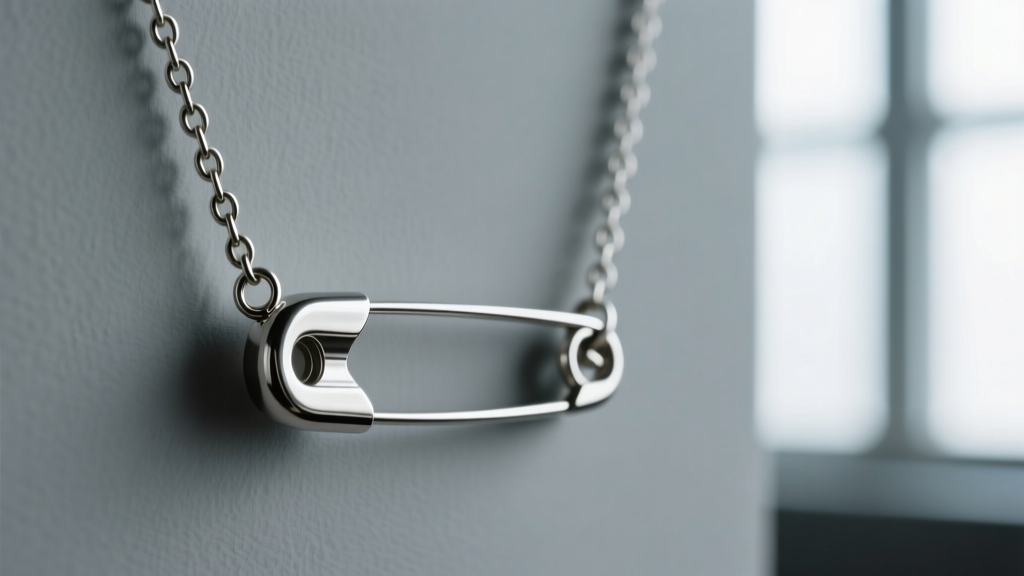
To truly understand what a safety pin necklace is from a mechanical perspective, you must examine its anatomy. A functional pin relies on three interacting components: the coil (hinge), the body (straight wire), and the cap (hood). When buying, inspect these areas for specific manufacturing quality.
Common Failure Modes in Mass-Produced Pins
- Cap Stretching: The hood that covers the sharp point is often formed from sheet metal. In cheaper mass-produced necklaces, this cap is thin. Repeated opening and closing will stretch the metal, causing the cap to lose its friction grip on the pin's point. Once stretched, the pin will swing open unexpectedly, risking loss of the necklace.
- Coil Fatigue: The 3-to-4 loops at the base of the pin act as a torsion spring. If the wire is too thin or the metal is poorly annealed, the coil will experience metal fatigue, resulting in a 'lazy' pin that sags open and lacks the snap-back tension required to seat securely in the cap.
- Point Blunting: The sharp end of the pin naturally dulls over time from scraping against the inside of the metal cap. While this doesn't affect a necklace worn strictly on a chain, it ruins the piece if you intend to use the pin to pierce fabric or lapels.
When shopping, perform the 'snap test.' Open the pin to a 45-degree angle and release it. It should snap audibly and firmly back into the cap without requiring you to manually push it down. If it drifts closed slowly, the coil tension is inadequate.
Chain Pairings and Layering Techniques
The visual weight of a safety pin pendant dictates the chain it should be paired with. Because the safety pin is an inherently industrial and linear motif, it pairs best with chains that offer geometric contrast or complementary utilitarian vibes.
- Box Chains: The smooth, square links of a box chain are highly recommended for functional safety pin pendants. Unlike cable or rope chains, box chains lack exposed loops that can accidentally catch on the pin's point if the cap fails.
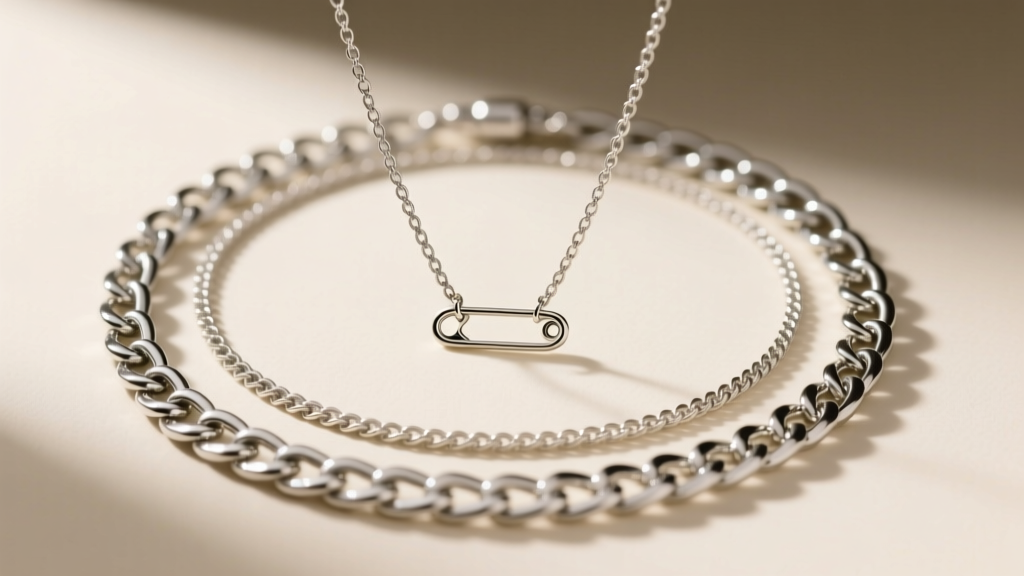
- Curb Chains: For a heavier, streetwear-inspired look, pair a thick 14-gauge steel safety pin with a 5mm to 8mm curb chain. The flat, interlocking links of the curb chain mirror the industrial aesthetic of the pin.
- Layering: Safety pin pendants are excellent anchor pieces for layered necklace stacks. Wear a 14-inch choker chain with a tiny, 10mm solid-cast silver safety pin, and layer it beneath a 20-inch matinee-length chain featuring a heavier padlock or crucifix pendant. The varying lengths prevent the metal clasps from tangling.
Pricing Tiers and Brand Examples
Understanding the market tiers will help you identify whether a piece is priced fairly based on its materials and engineering.
- Tier 1: Upcycled & Mass Market ($15 - $45): These are literal hardware store safety pins strung on basic chains, or thin, mass-produced alloy pendants. They are prone to cap stretching and coil fatigue within a few months of daily wear. Best for temporary festival wear or costume styling.
- Tier 2: Indie Silversmiths & Steel Brands ($50 - $180): This tier includes brands specializing in 316L surgical steel or heavy-gauge sterling silver. The pins are often cast as solid, non-functional decorative pieces, or engineered with thick 16-gauge wire for functional use. This is the sweet spot for durability and everyday alternative fashion.
- Tier 3: Luxury Designer & Solid Gold ($400 - $3,000+): High-end jewelers and luxury fashion houses offer safety pin motifs cast in solid 14k or 18k gold, often accented with pavé diamonds on the cap or body. These are almost exclusively non-functional decorative pendants, prioritizing precious metal weight and gemstone quality over mechanical utility.
Final Verdict: How to Choose Your Pin
So, what is a safety pin necklace ultimately? It is a versatile, historically rich motif that bridges the gap between rebellious subculture and high-end luxury. When making your purchase, prioritize the wire gauge and the mechanical integrity of the cap if you are buying a functional piece. If you are opting for a solid-cast decorative pendant, focus on the metal purity and the quality of the bail attachment. By paying attention to these structural details, you can ensure your safety pin necklace remains a secure and striking staple in your jewelry collection for years to come.


