A Technical Fit Guide for the Woman Wearing Cross Necklace Pendants
Discover the technical fit, metallurgy, and styling metrics for the modern woman wearing cross necklace pendants. Master chain gauges and bail types.


The Anatomy of a Perfectly Fitted Cross Pendant
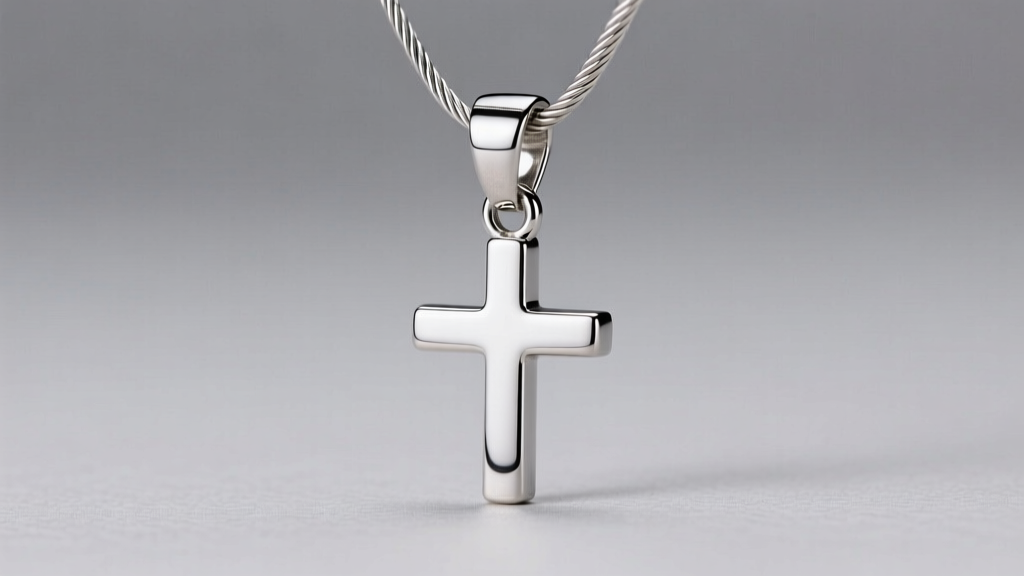
The aesthetic impact of a woman wearing cross necklace pendants relies heavily on proportional harmony and structural integrity. Unlike simple geometric pendants, the cross features intersecting axes that demand precise center-of-gravity management. A traditional Latin cross maintains a vertical-to-horizontal aspect ratio of roughly 3:2 or 4:3. When selecting a piece, the thickness (or depth) of the metal is just as critical as the face dimensions. For everyday wear, a minimum thickness of 1.5mm is required to prevent warping, while luxury pieces often utilize a 2.5mm to 3.5mm depth to allow for light-catching bevels and engraving.
When observing a woman wearing cross necklace layers, the most common failure point is the bail—the loop that connects the pendant to the chain. Understanding bail mechanics is essential for ensuring the cross hangs perfectly plumb against the sternum.
Bail Mechanics and Chain Compatibility
The bail dictates both the visual flow and the mechanical wear of the necklace. There are three primary bail types used in cross pendants:
- Standard Loop Bail: A simple soldered ring at the top. Best for lightweight crosses (under 3 grams) and compatible with almost all chain types up to 2.0mm in gauge.
- Tube Bail: A horizontal cylinder that the chain threads through. This provides a seamless look but restricts chain choice. A standard 3mm tube bail requires a chain with a maximum width of 2.2mm to prevent friction damage.
- Hidden Bail: Attached to the back of the cross, allowing the front design to remain uninterrupted. This raises the pendant's center of gravity, which can cause flipping on chains thinner than 1.5mm.
Metallurgical Breakdown: Choosing the Right Alloy
The longevity of a cross necklace depends entirely on its metallurgical composition. According to the Gemological Institute of America (GIA), the alloy mix in gold jewelry drastically alters its Vickers hardness (HV) and tensile strength. A softer metal will suffer from bail friction, eventually wearing through the loop and resulting in a lost pendant.
| Metal Alloy | Vickers Hardness (HV) | Tarnish Resistance | Avg. Price Range (18" Chain + Pendant) |
|---|---|---|---|
| 316L Stainless Steel | 150 - 200 HV | Excellent | $40 - $120 |
| 14k Yellow/White Gold | 130 - 160 HV | High | $350 - $800 |
| 18k Yellow Gold | 115 - 130 HV | High | $600 - $1,500 |
| Platinum 950 | 110 - 135 HV | Superior | $1,200 - $3,500+ |
While 18k gold offers a richer, warmer hue, its lower hardness makes it susceptible to scratching and bail wear over decades of use. 14k gold remains the optimal choice for daily-wear religious jewelry due to its superior structural resilience. Platinum 950, despite having a similar HV rating to 18k gold, behaves differently under stress; rather than losing material when scratched, platinum displaces, making it the most secure choice for heirloom-quality diamond-set crosses.
Neckline Geometry and Chain Length Metrics
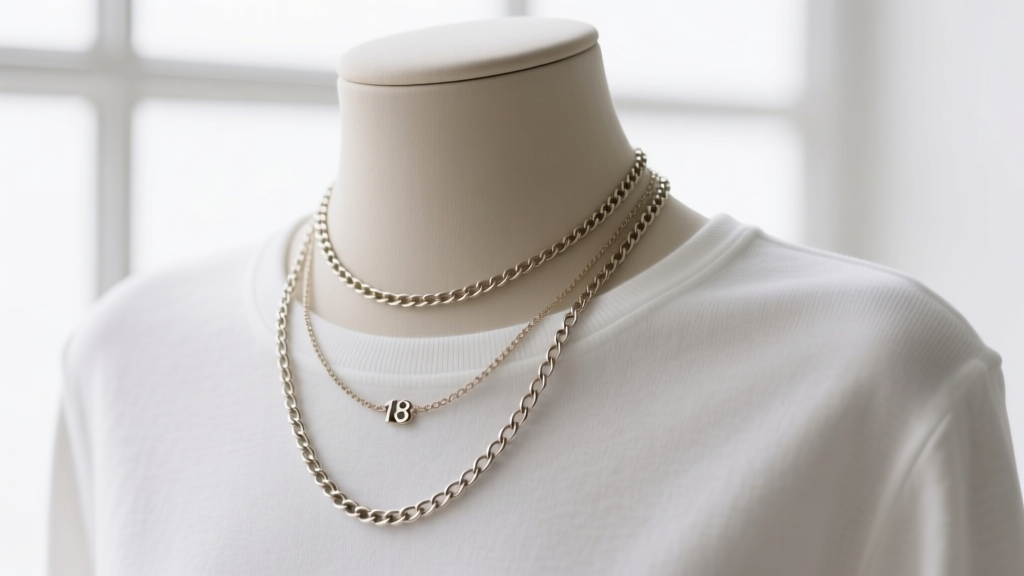
The visual success of a woman wearing cross necklace jewelry is heavily dictated by the chain length relative to her neckline. Chain length is not a matter of mere preference; it is a geometric calculation based on the clavicle and sternum landmarks.
- 16-Inch (Choker/Collar): Sits tightly on the base of the neck. This length is generally unsuitable for cross pendants unless the cross is micro-sized (under 10mm), as larger pendants will choke the wearer and catch on collarbones.
- 18-Inch (Princess): The universal standard. It drops exactly to the collarbone hollow. This length perfectly frames the face and sits optimally over crew necks, scoop necks, and V-necks.
- 20 to 22-Inch (Matinee): Falls on the upper sternum. Ideal for high-neck blouses, turtlenecks, or business attire where the pendant needs to rest visibly below a buttoned collar.
- 24 to 30-Inch (Opera/Rope): Rests on the mid-chest or solar plexus. Typically reserved for layering or wearing over heavy winter garments and dresses.
Troubleshooting Common Wear Issues
Even the finest jewelry suffers from mechanical wear. Identifying and correcting these issues ensures the piece remains secure and visually appealing.
The Center of Gravity Fix (Pendant Flipping)
The most frequent complaint regarding cross pendants is that they continuously flip upside down or sideways. This occurs when the pendant's center of gravity sits above the chain's natural drape point, or when the bail hole is too large, allowing the metal to slide laterally. To fix this, a jeweler can install a small, transparent silicone o-ring inside the bail to create friction against the chain. Alternatively, switching from a lightweight box chain to a slightly heavier rolo or curb chain provides enough downward tension to keep the cross anchored plumb.
Chain Tangling and Hair Snagging
Chain selection dictates maintenance. Herringbone and snake chains, while beautiful and fluid, act like microscopic combs that catch and break hair. For a hassle-free experience, opt for a cable, curb, or Figaro chain. These links lie flat and have smooth, rounded exterior profiles that glide past hair strands without snagging.
Hallmark Verification and FTC Compliance
When investing in precious metals, verifying the hallmark is non-negotiable. The Federal Trade Commission (FTC) Jewelry Guides mandate that any item stamped with a quality mark (e.g., 14k, 18k, 950 Plat) must also bear the registered trademark of the manufacturer. If a cross necklace features a '14k' stamp but lacks a maker's mark, its metallurgical purity is legally unverified and highly suspect. Always use a 10x jeweler's loupe to inspect the inside of the bail or the back of the cross arm for both the purity stamp and the manufacturer's hallmark to guarantee you are receiving the exact alloy you paid for.


