The Woman With Necklace: Anatomy of Proportion and Fit
Explore the technical anatomy of the woman with necklace styling. Learn precise gauge metrics, drape coefficients, and anatomical fit tolerances.


The Engineering of the Cervical Canvas
When high-end stylists and art directors conceptualize the quintessential "woman with necklace" portrait, the resulting image is rarely an accident of styling. It is a calculated exercise in anatomical geometry, metallurgical drape, and visual weight distribution. In 2026, as hyper-personalized jewelry design merges with 3D-scanned body mapping, understanding the technical thresholds of necklace fit has moved from subjective art to applied science. A necklace does not merely sit on the skin; it interacts with the skeletal landmarks of the cervical spine and the sternum. To achieve a flawless drape, one must understand the precise tolerances required for different chain architectures and pendant drops.
The Suprasternal Zero-Point
The foundation of all necklace proportion begins at the suprasternal notch (also known as the jugular notch). This concave depression between the clavicles serves as the primary zero-point for measuring pendant drop. On an average female frame (approximately 5'4" with a standard torso ratio), a classic 18-inch chain is engineered to terminate exactly 1.5 to 2.0 inches below this landmark. Deviations in torso length or cervical spine curvature require custom millimeter adjustments. If a pendant rests directly inside the suprasternal notch, it creates a visual "sinking" effect, disrupting the neckline's architecture. Conversely, terminating more than 3 inches below the notch on a standard chain pushes the jewelry into the bust apex, fundamentally altering the visual center of gravity.
Choker Tolerances and Lymphatic Clearance
The modern choker has evolved from rigid Victorian collars to fluid, tension-based bands. However, fitting a choker requires strict adherence to physiological tolerances. The average female neck circumference ranges from 305mm to 355mm. When sizing a rigid metal collar, a strict +5mm tolerance over the exact skin measurement is required to accommodate the sternocleidomastoid muscle during rotation.

For flexible chains or velvet bands, the tolerance must increase to +15mm or +25mm. This additional clearance is not merely for comfort; it is a medical necessity to prevent the compression of the superficial cervical lymph nodes and the external jugular vein. A common failure in commercial choker sizing is the omission of the "swelling factor"—the natural 3% to 5% increase in neck circumference that occurs throughout the day due to fluid retention and ambient temperature shifts. Master jewelers account for this by integrating micro-adjustable silicone-lined slide clasps rather than fixed jump rings.
Chain Architecture and Drape Coefficients
The way a chain conforms to the clavicle is dictated by its gauge, link geometry, and tensile yield. The "drape coefficient" is a theoretical scale from 1 to 10, where 10 represents a highly fluid chain that mimics fabric, and 1 represents a rigid, tubular structure that stands away from the skin. Selecting the wrong architecture for a specific neckline is the primary cause of poor fit in editorial styling.
| Chain Architecture | Gauge (mm) | Tensile Yield (lbs) | Drape Coefficient |
|---|---|---|---|
| Cable (Standard) | 0.8 - 1.0 | 4.5 - 6.0 | 9 (Highly Fluid) |
| Box (Italian) | 1.2 - 1.5 | 11.0 - 14.5 | 6 (Structured) |
| Rope (Diamond Cut) | 2.0 - 3.0 | 28.0 - 45.0 | 3 (Rigid) |
| Snake (Flat) | 1.5 - 2.5 | 8.0 - 12.0 | 2 (Semi-Rigid Tubular) |
For deep V-necks and plunge silhouettes, a fluid Cable or Wheat chain (Coefficient 8-10) is mandatory. These chains possess high articulation, allowing them to fall in a perfect geometric 'V' that mirrors the garment. Conversely, Boat necks and Bateau necklines require structured Box or Snake chains (Coefficient 2-6) that rest horizontally across the collarbone without buckling or twisting. According to manufacturing standards outlined by the Gemological Institute of America (GIA), the structural integrity of these chains relies heavily on the precision of the laser-welded link closures, which must withstand repetitive micro-flexing without metal fatigue.
Pendant Drop and the Golden Ratio
The relationship between the width of a pendant and the length of the chain is not arbitrary; it is governed by principles of visual proportion akin to the Golden Ratio (1.618). When styling a woman with necklace pendants, the width of the pendant should ideally be 1/6th to 1/8th of the total visible chain circumference.
- Micro-Pendants (3mm - 8mm): Require delicate 0.8mm chains. If placed on a heavier chain, the pendant's bail will slide freely, causing it to constantly flip upside down due to a lack of friction.
- Statement Pendants (25mm - 40mm): Demand a minimum 1.5mm Box or Rope chain. The bail must feature a hidden silicone insert to grip the chain, preventing the pendant from migrating off-center.
- Architectural Drops (50mm+): Require counter-weighting. The mass of the pendant will pull the chain downward, causing the back of the neck to experience severe friction. A secondary counter-weight element at the nape of the neck is often engineered into high-end bespoke pieces to distribute the load.
Metallurgy, Mass, and Clasp Migration
The specific gravity of the chosen metal directly impacts how the necklace behaves in motion. 18k yellow gold (75% Au, alloyed with copper and silver) has a specific gravity of approximately 15.6, making it nearly twice as dense as 316L surgical stainless steel (SG 8.0). This density provides a luxurious, weighted drape that resists tangling. However, it also exacerbates the most common mechanical failure in necklace wear: clasp migration.
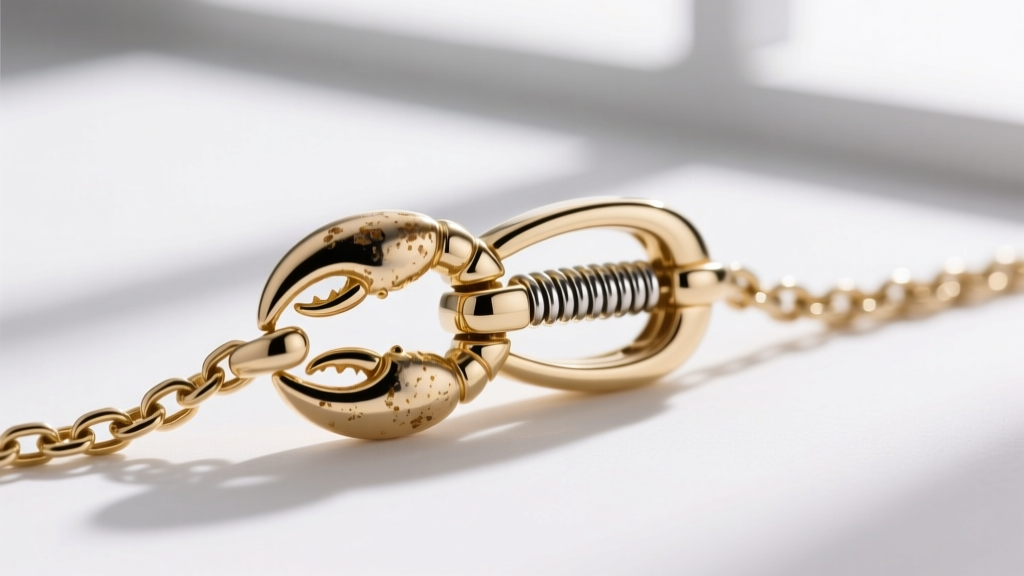
Clasp migration occurs when the center of gravity shifts, causing the clasp to slide from the nape of the neck to the front. This happens when the mass of the clasp and its adjoining jump rings exceeds 15% of the total chain mass. To combat this, precision jewelers utilize counter-balanced clasps or integrate a fixed, decorative "tag" at the exact midpoint of the chain's posterior arc. Furthermore, the World Gold Council notes that the alloy composition of white gold, which requires rhodium plating, can lead to microscopic surface friction changes over time, altering how smoothly the chain glides against itself and accelerating the migration effect if not properly maintained.
Troubleshooting Fit Failures
Even with precise measurements, environmental and anatomical variables can compromise the fit. Here is a technical troubleshooting framework for common issues:
The "Flipping" Bail: If a pendant continuously flips to show its back, the bail's inner diameter is too large for the chain gauge. Solution: Have a jeweler solder a micro-jump ring inside the bail to reduce the clearance to less than 0.5mm.
Another frequent issue is the "kinking" of Snake chains. Because Snake chains are constructed from tightly interlocking smooth bands rather than individual links, they possess a structural memory. If stored coiled or bent past a 45-degree angle, the internal tension bands can permanently deform. To preserve the structural integrity of semi-rigid chains, they must be stored suspended vertically or laid perfectly flat in a velvet-lined tray, never dropped loosely into a jewelry box.
Conclusion
The perfect necklace fit is a masterclass in applied physics and anatomical awareness. By respecting the zero-point of the suprasternal notch, calculating precise millimeter tolerances for chokers, and matching the drape coefficient of the chain to the garment's silhouette, stylists and collectors can elevate their jewelry from mere accessories to structural enhancements of the human form. In the modern era of jewelry design, true luxury lies in the invisible engineering that allows a piece to sit flawlessly against the skin.


