The Ultimate Wood Bead Necklace Guide: Hardwood vs Softwood Traits
Compare sandalwood, ebony, and olive wood for your next wood bead necklace. Explore Janka hardness, porosity, and stringing needs.

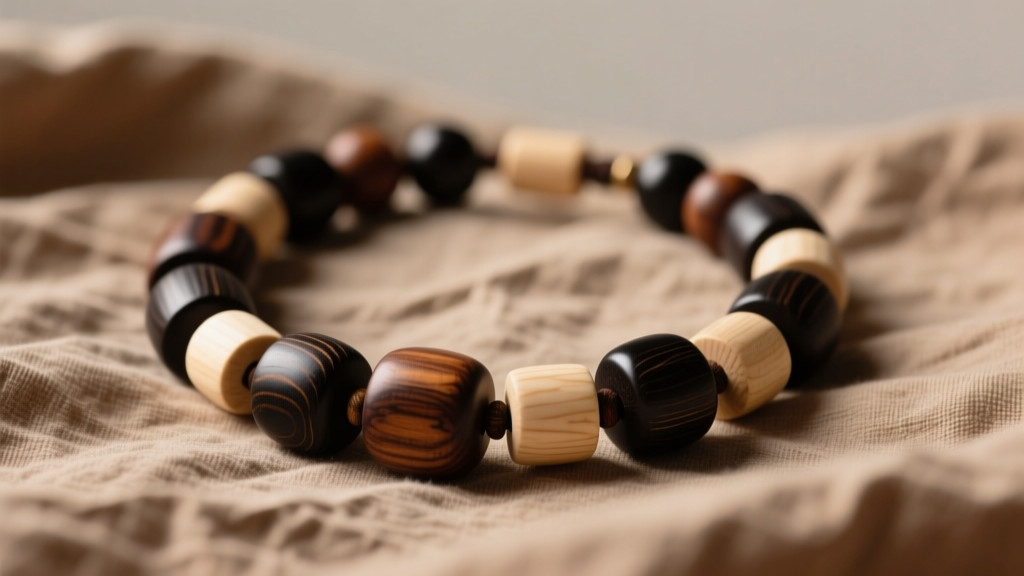
The Anatomy of a Wood Bead Necklace
When selecting or designing a wood bead necklace, the organic warmth of timber offers a stark, grounding contrast to cold metals and faceted gemstones. However, wood is a hygroscopic and anisotropic material. This means it actively absorbs ambient moisture and expands at different rates depending on the grain direction. For jewelry makers and collectors, treating a wood bead necklace as a simple string of shapes is a recipe for cracked beads, degraded finishes, and snapped cords. To build or buy a piece that lasts decades, you must understand the specific material properties of the timber involved, from its cellular density to its natural oil content.
Unlike metal alloys that are engineered for uniform stress tolerance, every wood species possesses a unique biological fingerprint. The distinction between hardwoods (angiosperms) and softwoods (gymnosperms) is botanical, but in jewelry making, it translates directly to durability, weight, and how the beads interact with human skin oils and environmental humidity. In this comprehensive material comparison, we break down the exact metrics that dictate the performance of wooden beads in daily-wear necklaces.
Janka Hardness Scale: Which Woods Survive Daily Wear?
The Janka hardness test measures the force required to embed a 0.444-inch steel ball halfway into a piece of wood. For a wood bead necklace, this rating dictates how well the beads will resist denting from accidental impacts against desks, doorframes, or other jewelry. While a delicate 8mm sandalwood bead might suffice for occasional wear, a heavy, swinging statement necklace requires timber with a high Janka rating to prevent the bead holes from elongating and the surfaces from pitting.
According to The Wood Database, the Janka scale reveals massive disparities between common jewelry woods. Softwoods like Pine (approx. 380 lbf) are virtually useless for high-end bead necklaces due to their extreme susceptibility to scratching and moisture warping. Conversely, dense tropical hardwoods offer near-stone-like durability.
| Wood Species | Janka Hardness (lbf) | Specific Gravity | Necklace Application |
|---|---|---|---|
| African Ebony | 3,220 | 1.10 - 1.30 | High-wear pendants, focal beads, spacer beads |
| Olive Wood | 2,710 | 0.85 - 0.99 | Chunky statement beads, carved pendants |
| Honduran Rosewood | 2,200 | 0.95 - 1.05 | Uniform 6mm-8mm strand necklaces |
| Maple (Hard/Sugar) | 1,450 | 0.63 - 0.75 | Lightweight, dyed, or painted bead strands |
| Sandalwood | 1,220 | 0.75 - 0.85 | Mala beads, aromatherapy necklaces |
Notice that African Ebony and Olive Wood possess a specific gravity near or above 1.0, meaning they will sink in water. When designing a multi-strand wood bead necklace using these heavy hardwoods, the overall weight of the piece can easily exceed 150 grams, requiring reinforced clasps and thicker stringing materials to prevent structural failure at the clasp loop.
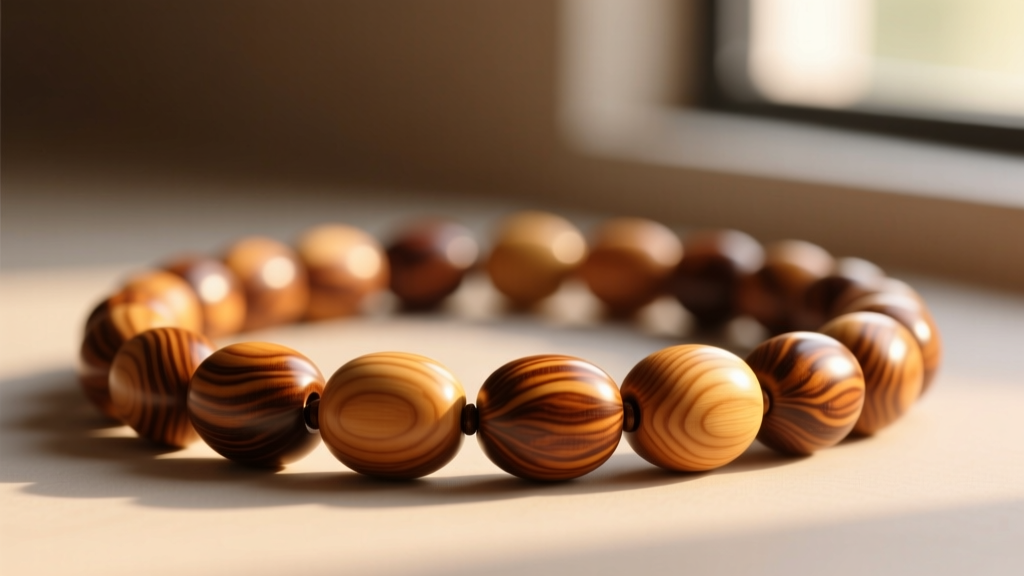
Porosity, Grain, and Sealing Your Beads
The cellular structure of wood determines its porosity, which directly impacts how a wood bead necklace reacts to human sweat, cosmetics, and humidity fluctuations. Woods are generally categorized into open-grain (ring-porous) and closed-grain (diffuse-porous) species.
Open-Grain vs. Closed-Grain Timber
Open-grain woods like Oak and Ash have large, visible pores that can trap dead skin cells, lotion, and dirt, leading to a dark, muddy appearance over time. These woods require heavy grain-fillers before polishing. Closed-grain woods like Maple, Ebony, and Olive Wood have tightly packed cellular structures. They polish to a glass-like finish using only friction and natural waxes, making them vastly superior for beads that rest directly against the collarbone and neck.
Finishing Framework: Oil vs. Wax vs. Polyurethane
Leaving a wood bead necklace unfinished is a common mistake that leads to rapid degradation. Uric acid and salts in human sweat will permanently stain light woods like Maple and Birch within weeks. To protect the timber while maintaining its organic tactile feel, jewelers rely on specific finish types:
- Pure Tung Oil: Penetrates deeply and polymerizes into a hard, water-resistant plastic matrix. Requires 4-5 coats with 24-hour curing times between applications. Ideal for Sandalwood and Rosewood.
- Carnauba Wax: A hard, plant-based wax applied via friction buffing. It provides a brilliant, satin sheen but offers minimal water resistance. Best reserved for low-wear, decorative pendants.
- Cyanoacrylate (CA) Finish: Often used by pen turners, a thin CA glue finish creates an impervious, high-gloss acrylic shell over the bead. While incredibly durable, it gives the wood a synthetic, plastic-like feel that defeats the purpose of choosing natural timber.
Stringing Mechanics: Matching Cord to Wood Density
The bead hole diameter and the stringing material must be engineered to support the specific gravity of the chosen wood. Standard wooden beads typically feature 1.0mm to 1.5mm drilled holes, though European large-hole beads can accommodate up to 3.0mm. Using cheap elastic cords for heavy hardwood beads is a critical failure point; the sharp inner edges of dense wood beads will shear through elastomer threads under the stress of gravity and movement.
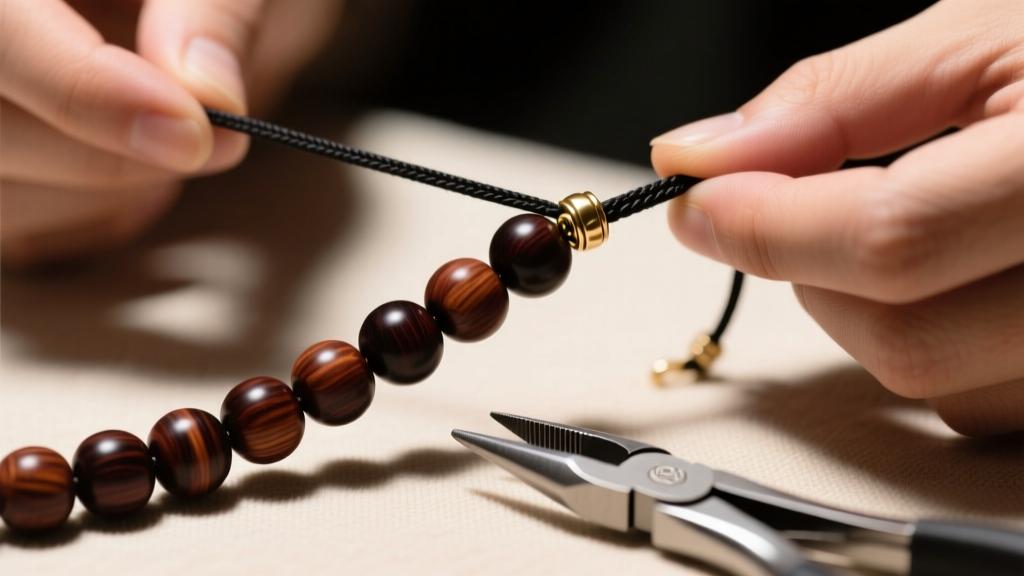
Optimal Stringing Materials by Wood Type
For dense hardwoods like Ebony and Olive, a 1.0mm to 1.5mm waxed cotton cord or nylon micro-cord (like C-Lon) is mandatory. The wax coating fills the microscopic gaps in the cotton fibers, preventing fraying caused by the friction of the bead holes. When terminating the necklace, avoid standard metal crimp beads. The pressure required to crush a metal crimp onto a thick 1.5mm cord often compromises the cord's structural integrity. Instead, utilize macramé sliding knots, wire guardians with heavy-duty jump rings, or specialized cord ends secured with two-part epoxy resin.
For lighter woods like Sandalwood or Pine, a 0.8mm un-waxed silk or nylon thread can be used, allowing for traditional knotting techniques between each bead. Knotting prevents the beads from grinding against one another, which is especially important for softer woods that can develop flat, worn spots where the beads collide.
Sourcing, Sustainability, and CITES Regulations
The jewelry industry's demand for exotic hardwoods has led to severe ecological depletion. When sourcing materials for a wood bead necklace, ethical provenance is not just a marketing buzzword; it is a legal necessity. Many highly prized jewelry woods, particularly within the Dalbergia genus (Rosewoods) and certain Sandalwood species, are strictly regulated under CITES (Convention on International Trade in Endangered Species) Appendix II.
Purchasing undocumented Rosewood or African Blackwood beads can result in customs seizures and hefty fines. Responsible jewelers and consumers should demand documentation from suppliers or opt for woods certified by the Forest Stewardship Council (FSC). Excellent, sustainable alternatives to restricted woods include:
- Verawood (Lignum Vitae substitute): Offers a similar olive-green hue and extreme density to endangered true Lignum Vitae.
- Wenge: Provides striking dark brown and black striping, serving as a highly durable, ethically accessible alternative to Ebony.
- Reclaimed Urban Timber: Woods salvaged from fallen city trees (like Black Walnut or Cherry) offer unique, localized grain patterns with zero deforestation impact.
Care and Maintenance Troubleshooting
Even the most meticulously finished wood bead necklace requires specific environmental care. Wood expands across the grain (tangentially and radially) but barely at all longitudinally. If a necklace is left in a highly humid environment (like a bathroom), the beads will swell. If subsequently exposed to dry, heated indoor air, they will shrink rapidly, leading to radial checking (cracks emanating from the center hole outward).
Reviving Dried-Out Timber
If your wooden beads begin to look chalky or develop micro-fissures, do not use water or commercial jewelry dips. Instead, apply a micro-crystalline wax or a light coat of mineral oil using a soft microfiber cloth. Allow the oil to penetrate for 15 minutes, then buff vigorously to generate friction heat, which helps seal the pores. Store your wood bead necklaces flat in a climate-controlled environment, ideally inside a cotton pouch that allows the wood to breathe while buffering rapid humidity shifts.
Expert Insight: Never wear an unfinished or lightly waxed wood bead necklace while applying perfume or hairspray. The alcohol and aerosol propellants will instantly strip natural oils from the wood, leaving irreversible gray, desiccated patches on the bead surface.
By respecting the biological realities of timber—matching the Janka hardness to the wear environment, sealing the grain against acidic sweat, and utilizing heavy-duty stringing mechanics—you elevate the wood bead necklace from a fragile craft project to a resilient, heirloom-grade piece of wearable art.


