Expert Guide to 18g Nose Piercing Jewelry: Sizing & Metals
Master the technical specs of 18g nose piercing jewelry. Explore gauge dimensions, implant-grade metals, and anatomical fit for nostril piercings.

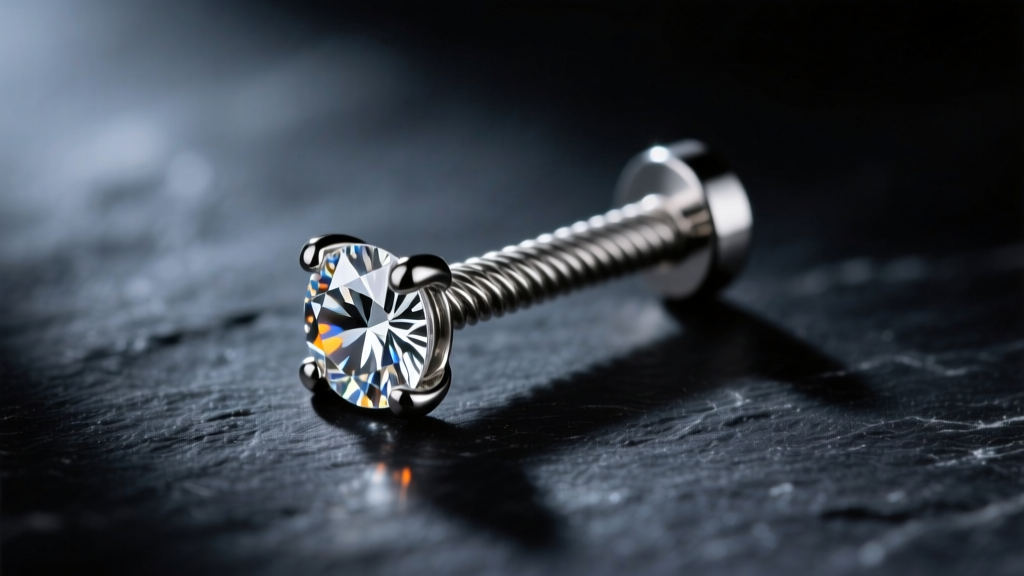
The Exact Dimensions and Tolerances of 18g Wire
When sourcing high-quality 18g nose piercing jewelry, understanding the precise metallurgical and dimensional tolerances is critical for both piercer and client. In the American Wire Gauge (AWG) system, 18 gauge translates to exactly 1.024 millimeters in diameter. However, in the global body jewelry market, this is universally rounded to 1.0mm. This 1.0mm thickness represents the absolute threshold for safe, long-term wear in dynamic facial tissue.
Going thinner than 18g (such as 20g or 0.81mm) introduces severe biomechanical risks. The primary failure mode of sub-18g jewelry is the "cheese-cutter effect," where the high pressure-per-square-millimeter exerted by a thin wire slices through the fistula during accidental snags. Conversely, 18g provides a sufficient surface area to distribute kinetic force, minimizing tissue rejection while maintaining a delicate, minimalist aesthetic that thicker 16g (1.29mm) or 14g (1.6mm) wires cannot achieve.
Metallurgy and Tensile Strength at 1.0mm
At a mere 1.02mm thickness, the tensile strength and yield point of the chosen metal dictate the jewelry's longevity. Not all implant-grade metals perform equally when machined down to 18g.
Implant-Grade Titanium (ASTM F136)
Titanium alloy Ti6Al4V ELI (ASTM F136) is the undisputed standard for 18g nose piercing jewelry. Its high strength-to-weight ratio means an 18g titanium post will resist bending and warping under moderate stress. Furthermore, titanium's lack of nickel ensures that the microscopic surface porosity of an 18g wire will not trigger contact dermatitis during the highly sensitive epithelialization phase of healing.
14k vs. 18k Gold Alloys
When clients request gold, the karatage drastically alters the structural integrity of an 18g wire. Pure 24k gold is far too malleable; an 18g 24k wire would deform under the weight of a gemstone setting. Therefore, reputable manufacturers use 14k or 18k gold. 14k gold contains 58.3% gold and 41.7% alloy metals (like copper, silver, and zinc), giving it a higher Vickers hardness rating than 18k gold. For 18g threadless pins that require a tension bend, 14k gold holds the bend angle significantly better than the softer 18k variants, according to guidelines published by the Association of Professional Piercers (APP).
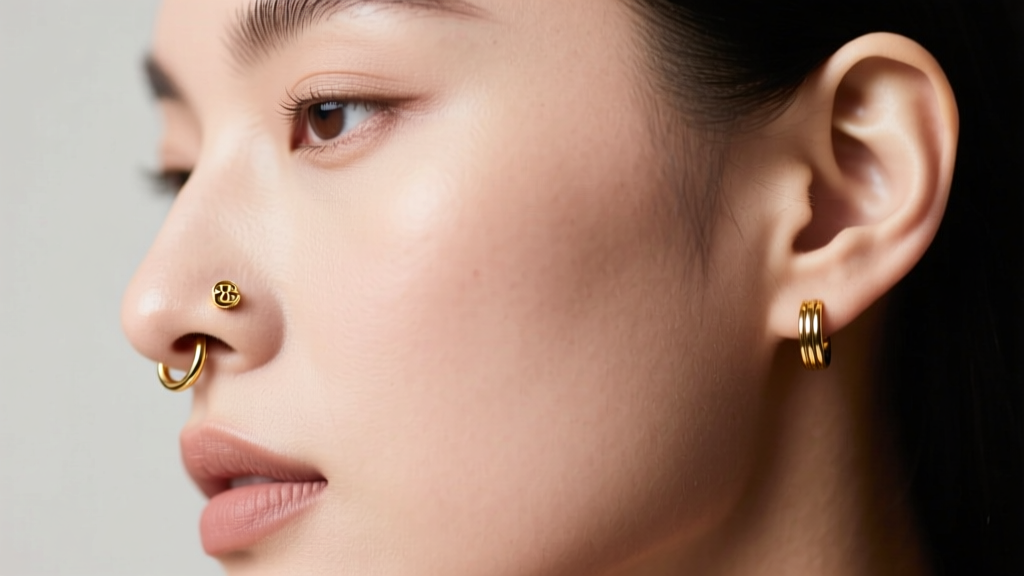
Anatomical Suitability: Nostril vs. Septum Placement
The application of 18g nose piercing jewelry is strictly governed by tissue density and fistula depth. While 18g is the gold standard for nostril piercings, it is generally contraindicated for septum piercings.
- Nostril Piercings: The nasal ala (nostril wing) consists of thin fibrofatty tissue and cartilage, typically ranging from 1.5mm to 3.0mm in thickness. An 18g (1.0mm) wire leaves adequate tissue margins on either side of the jewelry channel, promoting rapid vascularization and reducing the risk of hypertrophic scarring.
- Septum Piercings: The "sweet spot" of the septum (the columella) is a thicker, highly vascular membrane. Piercing this area at 18g creates an unstable fistula. The constant rotational force of a septum clicker or captive bead ring on a 1.0mm wire will cause chronic irritation, leading to migration. Professional piercers almost exclusively use 16g or 14g for septums to ensure structural stability.
- High Nostril / Bridge: For high nostril placements, the tissue is often denser and closer to the underlying bone. 18g remains acceptable, but the jewelry must be custom-fitted to avoid pressure necrosis against the nasal bone.
Threading Mechanics and End-Attachment Engineering
The method by which the decorative end attaches to the 18g post is a marvel of micro-engineering. At 1.0mm, traditional threading methods face severe physical limitations.
The Problem with External Threading
External threading on an 18g post requires cutting grooves directly into the 1.0mm wire. This removes material, reducing the core diameter of the post to roughly 0.7mm at the threaded section. This creates a critical structural weak point prone to snapping inside the fistula. Furthermore, the sharp threads act like a micro-file, tearing the delicate epithelial lining of the healing fistula upon insertion.
Internal Threading vs. Threadless (Push-Pin)
Internal threading (where the screw is on the gemstone end and the post is tapped with a hole) preserves the outer smooth surface of the wire. However, tapping a hole into a 1.0mm titanium rod leaves very little wall thickness. Consequently, the industry has heavily pivoted toward threadless (push-pin) systems for 18g nose piercing jewelry.
Threadless jewelry relies on the tensile memory of the metal. The 18g pin is bent at a precise 10 to 15-degree angle before being inserted into the hollow receiving tube. The friction and spring-tension of the metal attempting to return to its straight form create a lock that is often stronger than 18g internal threading, without compromising the structural integrity of the post.
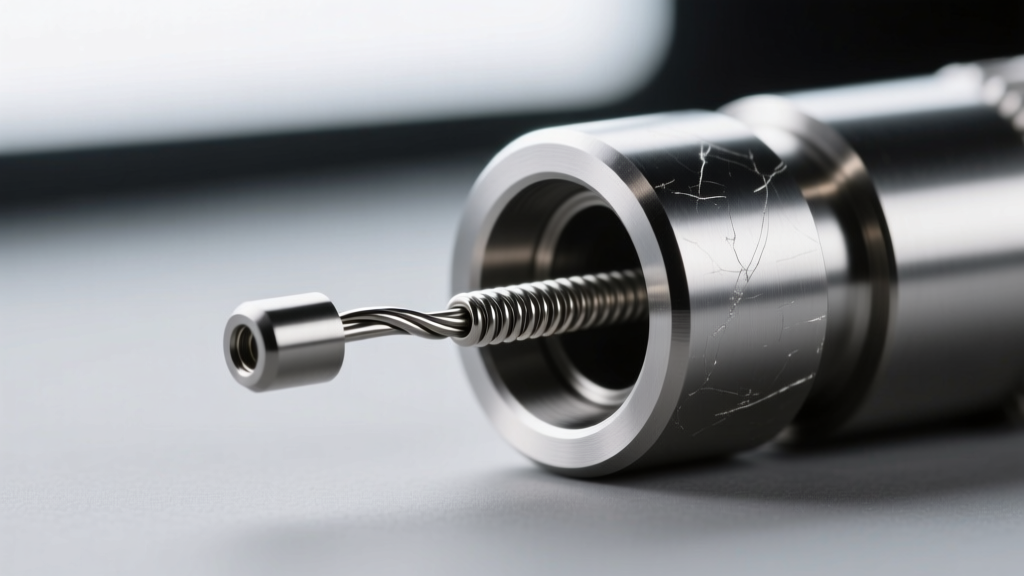
Custom Bending: Fishtail Blanks and Hoop Dynamics
For clients transitioning from a stud to a hoop, or those with unique nasal vestibule depths, off-the-shelf 18g nose screws or L-bends rarely provide a perfect fit. This is where the technical skill of the piercer intersects with the material properties of 18g wire.
Professional studios stock 18g "fishtail blanks"—straight, extra-long wires made of implant-grade titanium or niobium. Using specialized ring-opening pliers and mandrels, the piercer measures the client's exact fistula depth and nasal contour, then custom-bends the 18g wire into a screw, L-shape, or bone profile. This custom fabrication ensures the jewelry follows the exact topography of the client's inner nostril, eliminating the "flip" that causes chronic irritation bumps.
"A properly fitted 18g custom-bent screw should sit flush against the mucosal lining without applying upward pressure. If the wire is pushing against the tissue, the constant micro-trauma will stall the healing process indefinitely." — Advanced Piercing Biomechanics Guidelines.
Troubleshooting Migration and Rejection
While 18g is safe for nostrils, improper aftercare or poor jewelry geometry can still trigger the body's immune response to reject the foreign object. Migration is characterized by the fistula slowly moving toward the surface of the skin, thinning the tissue barrier until the jewelry falls out.
| Failure Mode | Primary Cause in 18g Jewelry | Technical Solution |
|---|---|---|
| Cheese-Cutter Migration | Snagging on towels/clothing with lightweight 18g rings | Switch to a flat-backed 18g threadless labret stud during sleep |
| Pressure Necrosis | Hoop diameter too small (e.g., 6mm on a thick nostril) | Upsize to an 8mm or 9mm 18g hoop to allow for swelling and natural curvature |
| Galvanic Corrosion | Mixing 18g titanium posts with cheap, unverified alloy ends | Ensure all components are ASTM F136 titanium or solid 14k/18k gold |
Sourcing and Quality Verification
When purchasing 18g nose piercing jewelry, visual inspection is insufficient to verify material safety. Reputable manufacturers provide mill certificates proving their titanium meets ASTM F136 standards. Brands like Industrial Strength, Anatometal, and BVLA are industry benchmarks, utilizing CNC machining to ensure their 18g posts have perfectly smooth, mirror-polished surfaces free of microscopic burrs that could harbor bacteria. Always verify that the jewelry you select is specifically designated for initial piercings if your fistula is not fully matured, as outlined by the APP aftercare and jewelry guidelines.
Ultimately, 18g nose piercing jewelry represents the perfect intersection of delicate aesthetics and biomechanical safety for nostril placements. By prioritizing implant-grade metals, threadless engineering, and custom anatomical fitting, you ensure a piercing that remains stable, healthy, and visually flawless for a lifetime.


