Using Round Nose Pliers Jewelry Making Tools on Nose Hoops
Learn how to safely reshape warped nose hoops and L-bends using round nose pliers jewelry making tools without scratching or breaking your metal.

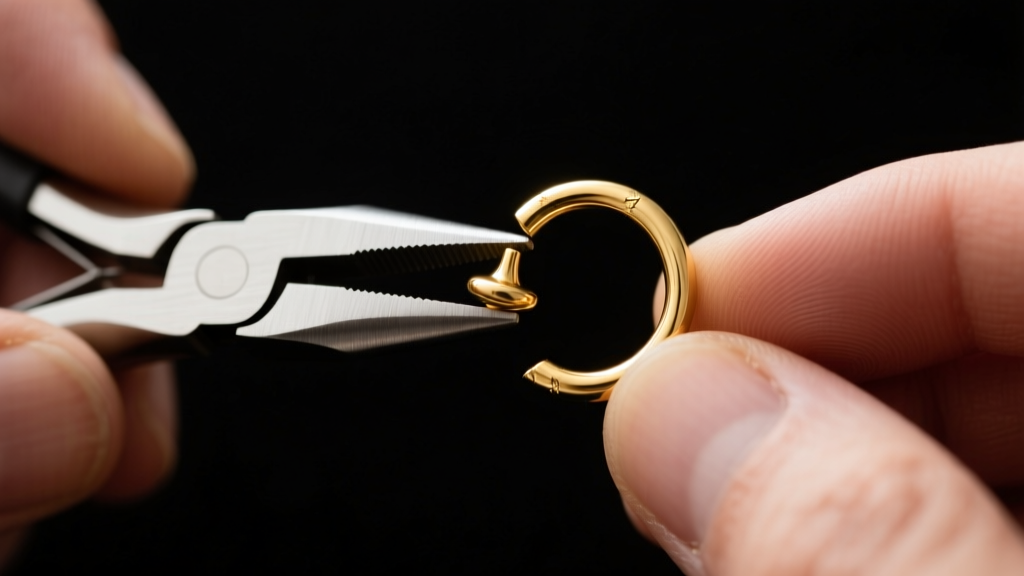
Snagging your nose ring on a sweater, waking up with a crushed hoop, or accidentally stepping on your favorite nostril stud are universal rites of passage for the pierced community. When a delicate 20-gauge or 18-gauge nose hoop warps out of shape, the immediate instinct is to reach for the household toolbox. However, using standard hardware pliers with serrated teeth is a guaranteed way to scratch gold plating, gouge implant-grade titanium, and create sharp burrs that will tear your piercing channel. For safe, at-home adjustments, utilizing dedicated round nose pliers jewelry making tools is the absolute gold standard for troubleshooting and repairing warped body jewelry.
In this comprehensive troubleshooting guide, we will explore the metallurgy of nose jewelry, how to select the correct tapered pliers, and step-by-step techniques for restoring your hoops, L-bends, and nose screws to their original factory specifications without compromising the structural integrity of the metal.
The Anatomy of Nose Jewelry Deformation
Before applying pressure to your jewelry, it is crucial to understand why it bent in the first place and how different materials react to stress. Nose jewelry typically ranges from 22-gauge (0.6mm) to 16-gauge (1.2mm) in thickness. Because these wire diameters are so fine, they are highly susceptible to torsional warping. A seamless hoop can easily become oval-shaped when lateral pressure is applied during sleep.
According to the Association of Professional Piercers (APP), the internal structure of the metal dictates how it can be repaired. If you attempt to bend a piece of jewelry back and forth to 'work out' a kink, you will trigger work-hardening. This metallurgical phenomenon causes the crystal lattice of the metal to lock up, making it incredibly brittle. If you work-harden a 20-gauge titanium hoop, it will eventually snap, leaving a sharp edge embedded in your nostril.
Metallurgy Matters: Titanium vs. Gold vs. Steel
Different metals require different troubleshooting approaches when using your pliers:
- Implant-Grade Titanium (ASTM F136): Titanium is exceptionally strong but has low malleability. It requires firm, deliberate, single-motion bends. Never wiggle titanium back and forth, or it will snap.
- 14k and 18k Solid Gold: Gold is highly malleable and forgiving, making it the easiest to reshape. However, it is also the softest. Even the slightest friction from steel pliers will leave permanent, ugly gouges in the surface.
- 316L Surgical Steel: Steel has a high 'spring-back' factor. When you bend it, it tends to resist the new shape and try to return to its original form. You must slightly over-bend steel to achieve the desired final curve.
Selecting the Right Round Nose Pliers
Not all pliers are created equal. When shopping for round nose pliers jewelry making sets, you must look for specific features to protect your body jewelry. Standard craft pliers often have microscopic ridges on the jaws that act like cheese graters on soft gold.
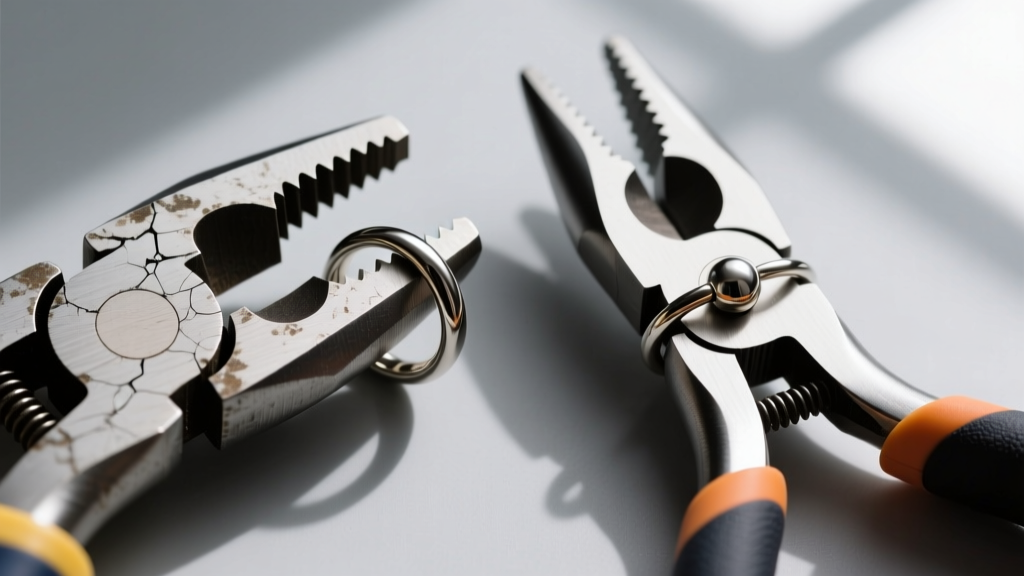
Nylon-Jaw vs. Bare Steel
The best troubleshooting tool for a pierced jewelry enthusiast is a pair of nylon-jaw round nose pliers. The nylon coating provides a smooth, non-marring surface that grips the wire securely without leaving tool marks. If you only own bare steel round nose pliers, you must create a barrier. Wrapping the jaws tightly in two layers of blue painter's tape or dipping the tips in liquid tool rubber (like Plasti Dip) will provide a temporary cushion that prevents scratching your 14k gold or anodized titanium pieces.
Understanding the Taper
Round nose pliers feature conical, tapered jaws. This means the diameter of the jaw changes from the base (usually around 5mm) to the tip (around 1mm). To reshape an 8mm inner diameter (ID) nose hoop, you must find the exact point on the plier's taper that measures 8mm. Using digital calipers to mark your pliers with a fine-tip permanent marker is a professional jeweler's trick that ensures perfect, symmetrical circles every time.
Step-by-Step Troubleshooting: Reshaping a Warped Nostril Hoop
If your seamless or segment ring has been crushed into an oval or teardrop shape, follow this framework to restore it:
- Assess the Damage: Lay the hoop flat on a white surface. Identify where the metal has folded or kinked. If there is a sharp, hard crease (rather than a smooth curve), the metal may be too compromised to save safely.
- Find Your Gauge on the Taper: Use your calipers to measure the wire thickness (e.g., 18g / 1.0mm). Place the wire into the jaws of the pliers at the corresponding thickness point to avoid crushing the wire.
- Apply Incremental Pressure: Do not try to bend the entire hoop at once. Work in small, 5-millimeter increments around the circle. Squeeze gently, rotate the hoop slightly, and squeeze again.
- Check the Seam: For segment rings, ensure the hinge and closure mechanism are not being twisted. Never apply torque directly to the hinge pin of a clicker, as this will permanently loosen the tension and ruin the 'click'.
Fixing Loose L-Bends and Nose Screws
L-shaped studs and corkscrew nose bones rely on precise geometry to stay anchored in the nostril without a backing. Over time, the friction of inserting and removing the jewelry can pull the 'L' outward, resulting in a shallow angle that causes the stud to fall out when you touch your face.
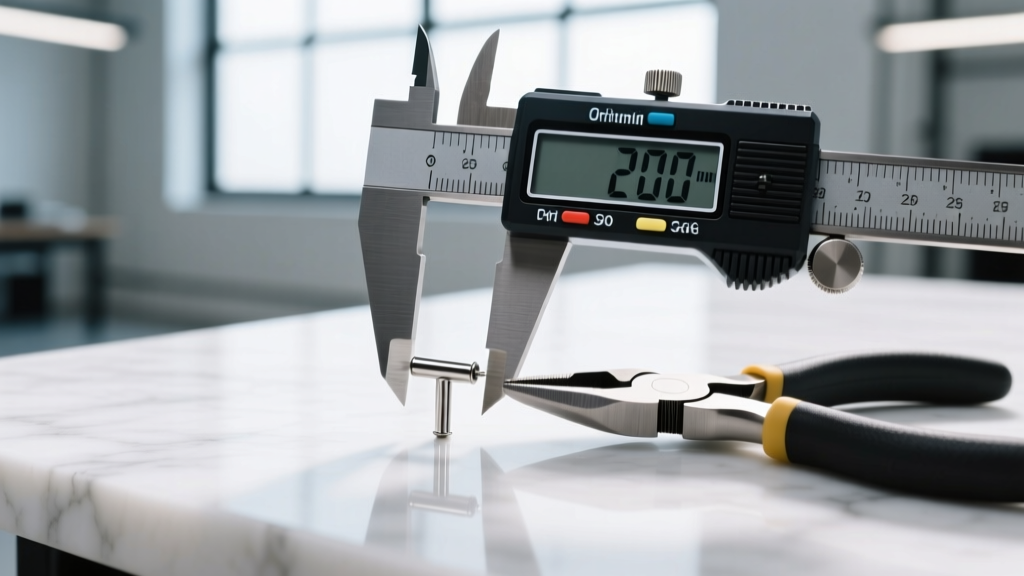
To troubleshoot a loose L-bend, grip the vertical post of the stud with your nylon-jaw pliers just below the bend. Using your thumb, apply gentle pressure to the horizontal tail, pushing it back toward a strict 90-degree angle. For nose screws, you can use the tapered barrel of the pliers as a mandrel. Wrap the corkscrew wire around the appropriately sized section of the jaw and gently squeeze to tighten the spiral, ensuring the coils sit flush against one another without overlapping.
Troubleshooting Matrix: Common Mistakes and Solutions
Even with the right tools, errors happen. Use this quick-reference table to diagnose and fix issues that arise during your repair process.
| Problem Encountered | Root Cause | Expert Solution |
|---|---|---|
| Deep scratches on gold | Using bare steel pliers or debris on the jaws | Switch to nylon-jaw pliers; clean jaws with isopropyl alcohol before use. |
| Titanium wire snapped | Work-hardening from bending back and forth | Titanium cannot be glued. Discard the jewelry and replace with a new piece. |
| Hoop remains oval-shaped | Bending the entire hoop at once instead of incrementally | Use the 'roll and squeeze' method in 2mm increments along the taper. |
| L-bend is too sharp/pinches | Bent past 90 degrees into an acute angle | Use the flat side of the plier jaw to gently push the angle back to 90 degrees. |
| Clicker hinge feels loose | Lateral torque applied to the hinge pin during bending | Isolate the hinge; never grip the ring on both sides of the hinge simultaneously. |
When to Abandon the Repair and See a Piercer
While mastering the use of round nose pliers jewelry making tools empowers you to maintain your collection, there is a limit to at-home troubleshooting. If your jewelry is made of gold-plated brass or silver, the base metals are highly prone to structural fatigue and can cause severe contact dermatitis if the plating cracks and exposes the underlying alloy to your healing fistula. Furthermore, if a seamless hoop has developed a sharp burr at the seam that catches on your skin, do not attempt to file it down yourself without proper jeweler's files and polishing compounds. In these cases, visit a reputable APP-certified piercer who can assess the damage with a loupe or safely order a replacement that meets ASTM implant standards.
By respecting the metallurgy of your body jewelry and investing in high-quality, non-marring tools, you can extend the lifespan of your favorite pieces, ensuring they remain safe, comfortable, and perfectly round for years to come. For more information on safe jewelry materials, consult resources like Rio Grande for professional jewelry supply standards and metallurgy guides.


