How to Clean Costume Jewelry Tarnish Without Ruining Plating
Learn how to clean costume jewelry tarnish safely. Expert guide on base metal chemistry, plating thickness, and safe ion-transfer cleaning methods.

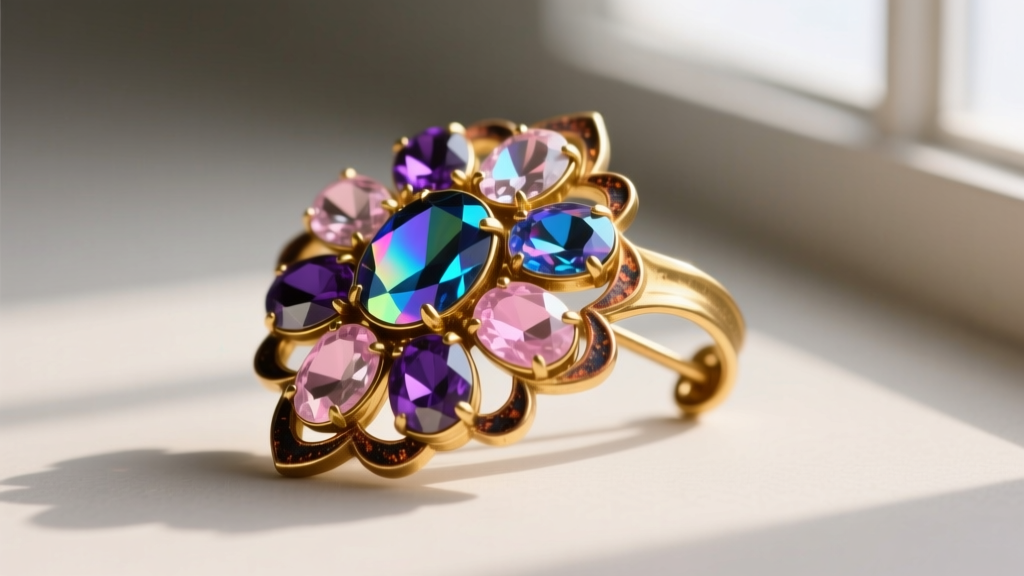
The Metallurgy of Costume Jewelry: Why It Tarnishes Differently
To understand how to clean costume jewelry tarnish, you must first understand its complex metallurgical structure. Unlike fine jewelry, which is cast from solid precious alloys, costume jewelry relies on a base metal substrate—typically brass (a copper-zinc alloy), pure copper, or Zamak (a zinc alloy containing aluminum, magnesium, and copper). This substrate is then coated with a microscopic layer of precious metal via electroplating.
The vulnerability of costume jewelry lies in the thickness of this plating. High-end vintage pieces may feature micron plating (1.0 to 3.0 microns thick), but the vast majority of modern and mid-century costume jewelry utilizes flash plating, which is often less than 0.5 microns thick. Because flash plating is inherently porous at a microscopic level, environmental sulfur and oxygen inevitably penetrate the precious metal layer and react with the copper or brass substrate beneath. This creates a dual-tarnish problem: silver sulfide (Ag2S) on the surface, and aggressive copper oxide (CuO) blooming from the pores beneath.
The Chemistry of Tarnish: Silver Sulfide vs. Copper Oxide
When addressing tarnish on plated metals, identifying the chemical composition of the discoloration is critical. If your silver-plated piece has turned uniformly black or yellow, you are dealing with silver sulfide. This occurs when hydrogen sulfide in the atmosphere reacts with the silver plating. Fortunately, this can be reversed without abrasion using electrochemical ion transfer.
However, if you see patchy, dark brown, green, or black spots, the plating has been breached, and the underlying copper or brass is oxidizing. Copper oxide and copper carbonate (verdigris) require a completely different chemical approach. Using standard silver polishes on exposed base metals will not only fail to remove the oxidation but will also strip the remaining flash plating due to the harsh thiourea compounds found in commercial dips.
The Ion-Transfer Method: Reversing Silver Sulfide Safely
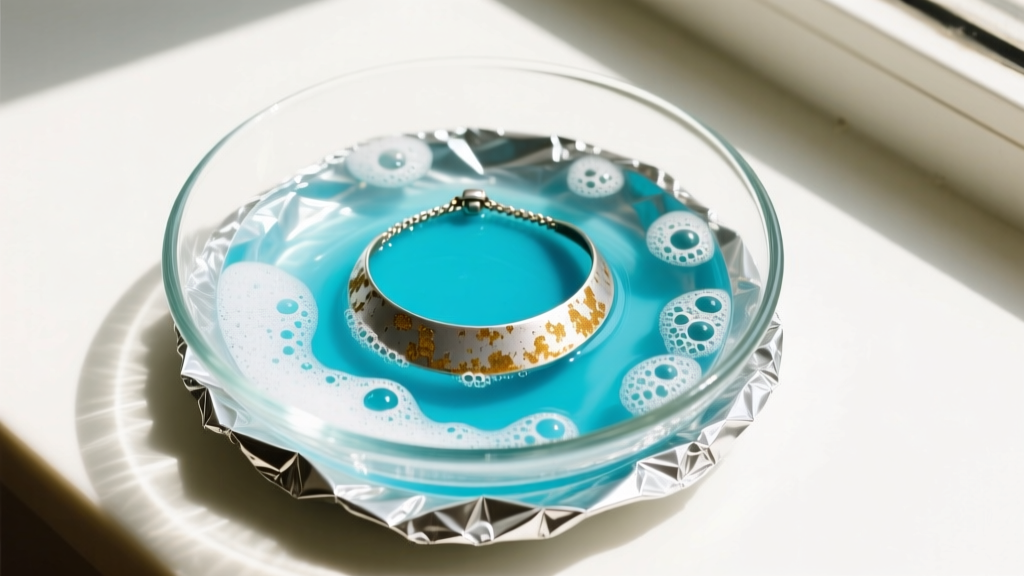
For silver-plated costume jewelry suffering from uniform silver sulfide tarnish, the safest and most technically sound method is the aluminum foil ion-transfer bath. This relies on the galvanic series: aluminum is more anodic (reactive) than silver. In an alkaline electrolyte solution, the aluminum sacrifices itself, pulling the sulfur atoms away from the silver and converting the silver sulfide back into pure silver.
Step-by-Step Technical Protocol
- Prepare the Electrolyte: Line a glass or plastic basin with heavy-duty aluminum foil, shiny side up. Add 1 tablespoon of sodium bicarbonate (baking soda) and 1 tablespoon of non-iodized salt per quart of water.
- Temperature Control: Pour boiling water into the basin to dissolve the salts. Allow the water to cool to exactly 160°F–180°F (71°C–82°C). Warning: Water exceeding 180°F will soften and dissolve the shellac or epoxy adhesives used to set vintage glass rhinestones, causing them to fall out or lose their reflective foil backing.
- The Reaction: Submerge the jewelry, ensuring it makes direct physical contact with the aluminum foil. You will immediately smell hydrogen sulfide (a rotten egg odor) as the sulfur transfers from the silver to the aluminum.
- Dwell Time: Leave the piece in the bath for exactly 3 to 5 minutes. Prolonged exposure to alkaline solutions can cause the underlying copper substrate to oxidize if the plating is porous.
- Neutralization: Remove the piece, rinse thoroughly in distilled water, and dry immediately with a microfiber cloth.
Chelation and Surfactants: Cleaning Exposed Base Metals
When the plating is entirely worn away and you are left with tarnished brass or copper, you must use mild chelating agents rather than abrasives. According to guidelines from the Smithsonian Museum Conservation Institute, mechanical polishing of historical base metals removes vital surface material and alters the artifact's integrity.
Instead, formulate a mild citric acid solution. Mix 1 part fresh lemon juice (which contains roughly 5-6% citric acid) with 3 parts distilled water and a single drop of a pH-neutral surfactant (like plain Castile soap). Apply this solution strictly to the exposed base metal areas using a cotton swab. The citric acid chelates the copper oxide, lifting it from the surface. Dwell time should not exceed 60 seconds. Neutralize immediately with a baking soda and water paste, then rinse with distilled water. This targeted approach prevents the acid from degrading adjacent intact plating.
The Destructive Cleaners: What to Avoid at All Costs
The internet is saturated with DIY jewelry cleaning hacks that are catastrophic for costume jewelry. Below is a technical breakdown of why common methods fail and destroy composite materials.
| Cleaning Method | Active Chemical / Mechanism | Impact on Flash Plating | Impact on Rhinestones & Enamel |
|---|---|---|---|
| Commercial Silver Dip | Thiourea & Hydrochloric Acid | Strips flash plating instantly; causes irreversible pitting on copper substrate. | Acid eats the metallic foil backing on glass stones, turning them clear or gray. |
| Ultrasonic Cleaners | High-Frequency Cavitation | Can cause micro-flaking on fatigued or peeling plating. | Shatters foil-backed rhinestones and cracks cold-painted enamel details. |
| Baking Soda Paste | Mechanical Abrasion (Mohs 2.5) | Scratches soft gold and silver flash plating, creating micro-grooves that accelerate future tarnishing. | Dulls the faceted surface of acrylic and glass stones. |
| Toothpaste | Hydrated Silica & Fluoride | Highly abrasive; strips micron plating within seconds of friction. | Leaves an opaque, unremovable film in the crevices of cast metal settings. |
Post-Cleaning Preservation: Micro-Crystalline Wax Sealing
Once you have successfully learned how to clean costume jewelry tarnish and restored the piece, the immediate priority is preventing re-oxidation. Because flash plating is porous, the piece will begin tarnishing again within days if exposed to ambient humidity and sulfur.
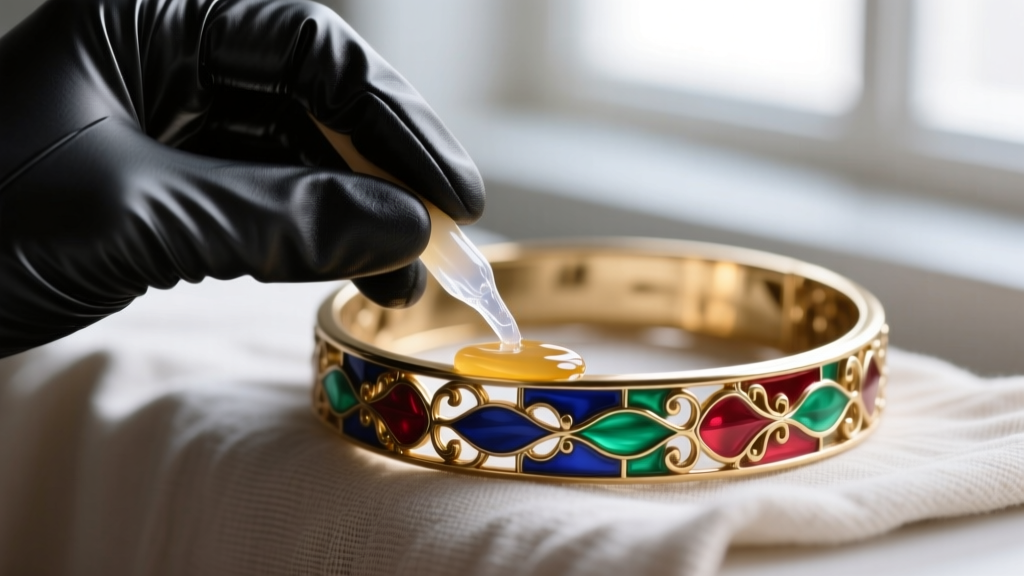
Conservation experts at the Gemological Institute of America (GIA) and various museum archives recommend sealing cleaned base metals and plated jewelry with a microcrystalline wax. Renaissance Wax, originally developed by the British Museum, is the industry standard. Unlike organic waxes (like beeswax or carnauba), which contain acidic fatty acids that can promote corrosion over time, microcrystalline wax is highly refined, chemically stable, and has a neutral pH.
Application Protocol
- Ensure the jewelry is 100% dry and free of any residual oils or moisture.
- Using a clean, lint-free cotton cloth, apply a microscopic amount of Renaissance Wax to the metal surfaces.
- Allow the wax to dry for 10 to 15 minutes until it forms a slight haze.
- Gently buff the piece with a fresh microfiber cloth to achieve a soft luster.
This creates an invisible, oxygen-impermeable barrier that will protect the flash plating and base metals from environmental pollutants for years, significantly reducing the need for future chemical interventions. Store the sealed pieces in an airtight container with activated charcoal or anti-tarnish silica gel packets to absorb any residual atmospheric sulfur.
Expert Note: Never apply wax to the faceted surfaces of rhinestones or pearls. The wax will fill the microscopic junctions between the stone and the setting, creating a cloudy appearance that is incredibly difficult to remove without solvents that may damage the jewelry's adhesives.
By respecting the chemical boundaries of flash plating and utilizing targeted, non-abrasive conservation techniques, you can preserve the historical and aesthetic integrity of your costume jewelry collection for decades.