At Home Jewelry Cleaner Cost Analysis: DIY vs Store-Bought
We break down the true cost and effectiveness of every at home jewelry cleaner, comparing DIY pantry solutions to commercial liquids and ultrasonics.

The True Cost of Sparkle: Why Your Cleaning Method Matters
Maintaining the brilliance of your jewelry collection is a non-negotiable aspect of ownership, but the financial and physical costs of doing so are rarely scrutinized. When evaluating an at home jewelry cleaner, most consumers default to whatever is most convenient or heavily marketed. However, a deeper budget and value assessment reveals stark differences in cost-per-clean, chemical safety, and long-term wear on precious metals and gemstones. From the chemistry of electrochemical reduction to the physics of ultrasonic cavitation, understanding what you are actually paying for—whether in dollars or microscopic structural damage—is critical for any serious collector or everyday wearer.
In this comprehensive cost-benefit analysis, we dissect the three primary categories of at home jewelry cleaning: commercial chemical dips, DIY pantry-based reactions, and entry-level ultrasonic machines. We will evaluate exact pricing, chemical compositions, and specific failure modes to help you maximize your jewelry care budget in 2026 without compromising the integrity of your pieces.
Commercial Liquid Cleaners: Convenience vs. Chemical Cost
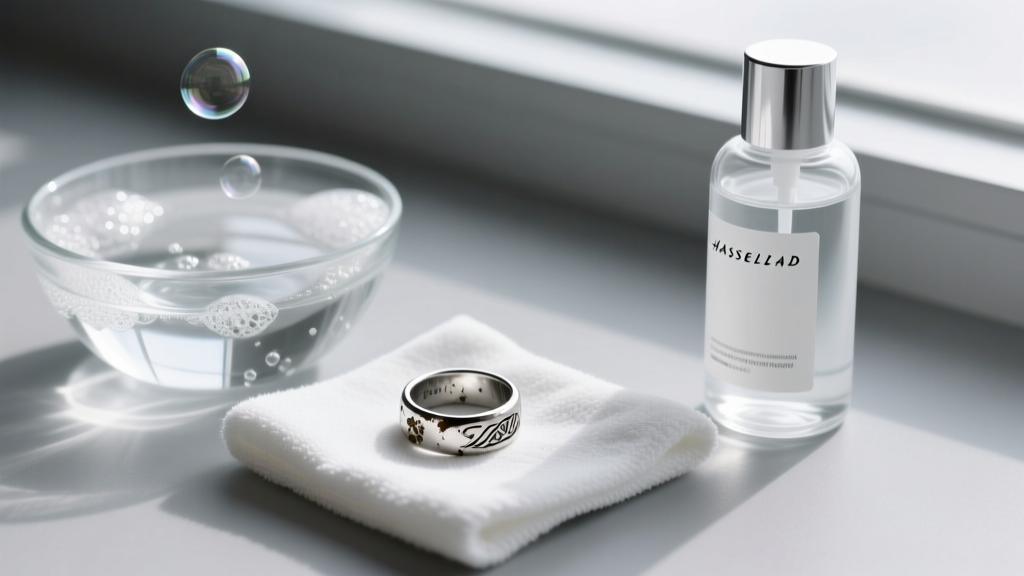
Commercial liquid cleaners, such as those produced by Connoisseurs or Hagerty, dominate the retail space. They promise instant results with minimal effort, but their value proposition requires a closer look at their chemical makeup and long-term costs.
Price Breakdown & Chemical Composition
A standard 6-ounce bottle of a premium commercial silver or gold cleaner typically retails between $7.00 and $12.00. Assuming you use one ounce per cleaning session (including the dipping basket and rinsing), the cost per clean hovers around $1.15 to $2.00. While this seems negligible, it compounds significantly for avid collectors.
More importantly, you are paying for a specific chemical cocktail. Most commercial silver dips rely on thiourea, a highly effective but toxic reducing agent that strips silver sulfide (tarnish) instantly. Gold cleaners, conversely, often utilize mild ammonia and non-ionic surfactants to break down sebum and cosmetic oils.
Expert Warning: While ammonia is excellent for degreasing diamonds, it is highly corrosive to copper alloys. Repeated use of ammonia-based commercial cleaners on 14k or 18k rose gold will gradually strip the copper, altering the metal's color and structural integrity over time.
Furthermore, commercial dips are notorious for stripping the intentional oxidation (antiquing) from designer silver pieces, such as those by David Yurman or Tiffany & Co., effectively ruining the piece's aesthetic value in seconds.
DIY Pantry Solutions: The Budget Champion or a Risky Gamble?
The appeal of DIY solutions lies in their near-zero upfront cost and the use of non-toxic, household ingredients. However, 'natural' does not always mean 'safe' for every gemstone or metal alloy.
The Baking Soda & Aluminum Foil Method (Electrochemical)
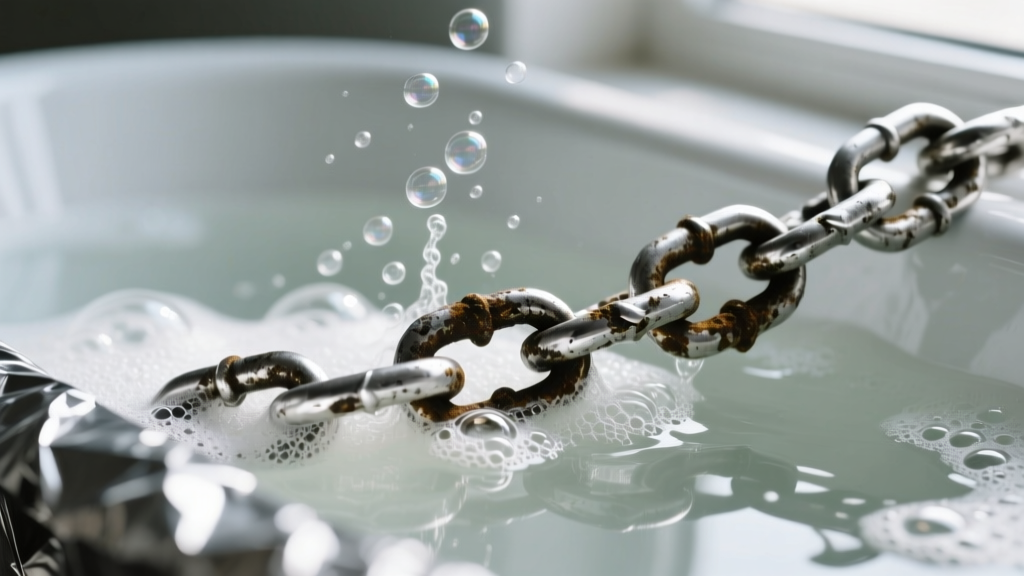
This is the undisputed champion for heavy silver tarnish removal. By lining a glass bowl with aluminum foil, adding boiling water, a tablespoon of baking soda (sodium bicarbonate), and a pinch of salt, you create an electrolytic bath. The silver sulfide tarnish is chemically reduced, transferring the sulfur from the silver to the aluminum.
- Upfront Cost: $0.00 (assuming pantry staples).
- Cost Per Clean: Less than $0.03.
- Value Assessment: Unbeatable for solid sterling silver flatware and chains.
- The Fatal Flaw: This highly alkaline, high-heat environment is catastrophic for porous or soft gemstones. According to the Gemological Institute of America (GIA), heat and harsh chemicals can dissolve the nacre on pearls, fracture opals, and permanently cloud turquoise and lapis lazuli.
Dish Soap & Seltzer (Surfactant Action)
For everyday gold, platinum, and diamond maintenance, a few drops of mild, phosphate-free dish soap (like Dawn) mixed with carbonated seltzer water is the safest, most cost-effective method. The mild surfactants encapsulate oils, while the carbonation provides gentle mechanical agitation. The cost per clean is virtually zero, and it carries a near-zero risk of damaging even the most delicate gemstones, provided you use a soft baby toothbrush and avoid aggressive scrubbing on paved settings.
Entry-Level Ultrasonic Cleaners: The High-Upfront Investment
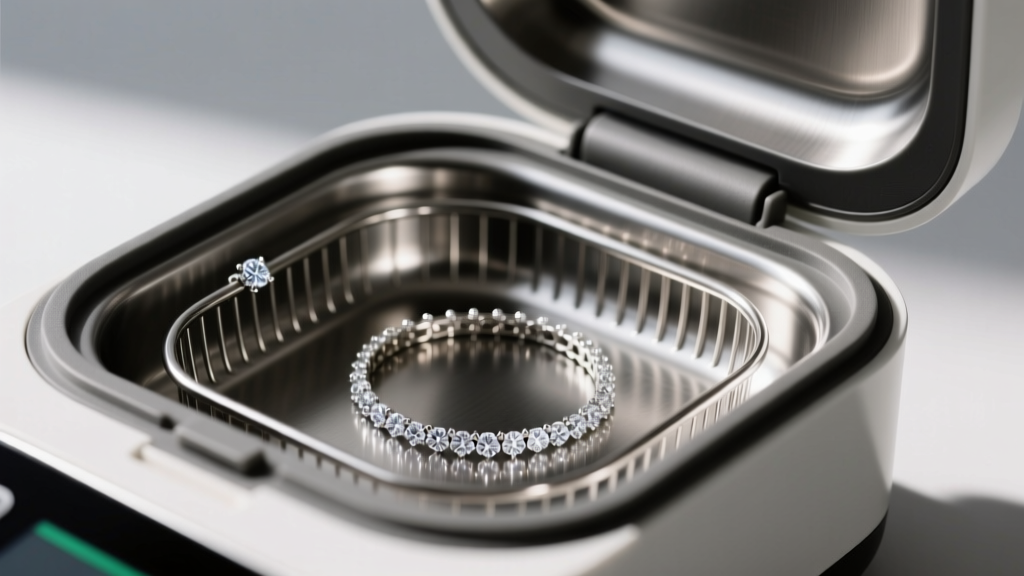
Ultrasonic cleaners represent a paradigm shift from chemical cleaning to physical cleaning. Brands like Magnasonic and iSonic offer entry-level, consumer-grade machines in the $35 to $55 range. These devices use high-frequency sound waves (typically 42,000 Hz) to create microscopic vacuum bubbles in a water-and-dish-soap solution. When these bubbles collapse against the jewelry—a process known as cavitation—they blast away microscopic dirt and grime from under prongs and inside intricate filigree.
Calculating the ROI of Ultrasonic Cleaning
If you amortize a $45 ultrasonic cleaner over 100 uses, the cost per clean drops to $0.45, not including the pennies spent on dish soap. For individuals who wear diamond engagement rings or intricate platinum settings daily, the machine pays for itself in less than two months compared to commercial liquid dips.
However, the 'cost' of an ultrasonic cleaner must also be measured in potential catastrophic failure modes. The violent micro-jetting action of cavitation can easily shake loose stones if the prongs are already worn. More critically, the GIA explicitly warns against placing fracture-filled diamonds, emeralds (which are routinely oiled), or tanzanite in an ultrasonic bath. The vibrations can shatter these stones or strip their internal fillings, turning a $45 investment into a $5,000 mistake.
Value Comparison Matrix: Cost Per Clean & Safety Profiles
To visualize the budget and safety trade-offs, refer to the decision matrix below. This framework should dictate your purchasing behavior based on your specific jewelry portfolio.
| Cleaning Method | Upfront Cost | Cost Per Clean | Best Suited For | Primary Risk / Failure Mode |
|---|---|---|---|---|
| Commercial Silver Dip (Thiourea) | $8.00 - $12.00 | $1.50 | Heavy tarnish on solid silver chains | Strips intentional oxidation; toxic fumes |
| Commercial Gold Wash (Ammonia) | $7.00 - $10.00 | $1.25 | Plain gold bands, diamond solitaires | Corrodes copper in rose gold alloys |
| DIY Electrochemical Bath | $0.00 | < $0.03 | Sterling silver without soft stones | Destroys porous gems; heat damage |
| DIY Soap & Seltzer | $0.00 | < $0.05 | Everyday wear, all safe gemstones | Requires manual labor; less effective on deep grime |
| Consumer Ultrasonic (42kHz) | $35.00 - $55.00 | $0.45 | Diamonds, platinum, intricate metalwork | Shatters included/fractured stones; loosens prongs |
The Verdict: Maximizing Your Jewelry Care Budget
There is no single 'best' at home jewelry cleaner; there is only the right tool for the specific material and your budget constraints. If your collection consists primarily of modern diamond solitaires and plain platinum or yellow gold bands, a $45 entry-level ultrasonic cleaner offers the highest long-term value and superior cleaning efficacy, easily paying for itself within a year.
Conversely, if you own a diverse portfolio featuring rose gold, antique silver, or mixed-media pieces with semi-precious stones, the DIY dish soap and seltzer method remains the undisputed budget champion. It costs virtually nothing, eliminates the risk of chemical corrosion, and preserves the structural integrity of your jewelry. By abandoning expensive, harsh commercial chemical dips in favor of targeted, material-specific cleaning protocols, you not only save hundreds of dollars over a decade of ownership but also protect your jewelry from irreversible chemical and physical degradation.


