Selecting a polishing cloth for jewelry: A Technical Deep Dive
Discover the metallurgy and micro-abrasive tech behind the right polishing cloth for jewelry. Expert guide on rouge, tarnish removal, and safe metals.

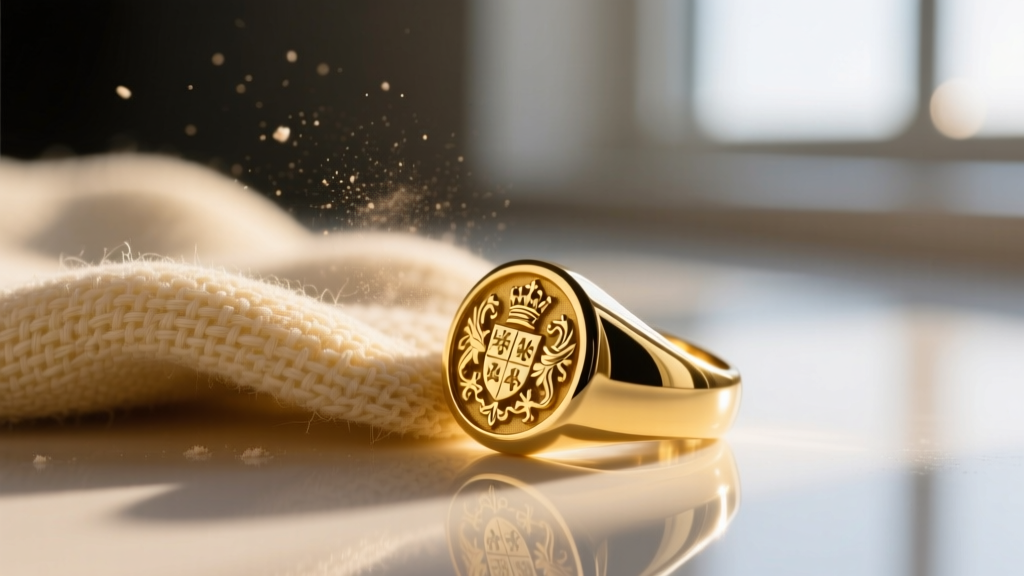
Most consumers treat jewelry maintenance as an afterthought, grabbing any generic microfiber rag to wipe down a ring or necklace. However, using the wrong polishing cloth for jewelry can inflict micron-level scratches, strip precious metal plating, and permanently dull soft gemstones. Professional jewelers do not rely on generic cleaning rags; they utilize engineered textiles embedded with specific micro-abrasives and chemical inhibitors. This expert guide deconstructs the metallurgical science, compound chemistry, and application protocols behind professional-grade jewelry polishing textiles.
The Anatomy of a Professional Polishing Cloth
To understand why a specialized polishing cloth for jewelry outperforms standard cleaning rags, we must examine the textile weave. Generic microfiber cloths are constructed from split synthetic fibers (typically a polyester-polyamide blend) designed to trap dust and oils via static charge. While excellent for removing fingerprints, microfiber lacks the structural "nap" required to hold and distribute polishing compounds.
Professional polishing textiles are predominantly woven from 100% cotton flannel. The flannel undergoes a mechanical "napping" process where fine metal brushes raise the loose fibers from the yarn, creating a dense, three-dimensional surface. This deep nap serves two critical functions:
- Compound Retention: The raised fibers trap and hold micro-abrasive compounds (rouge), ensuring an even distribution across the metal surface rather than clumping.
- Debris Capture: As the cloth abrades the metal, the deep nap pulls the removed metal oxides and tarnish away from the surface, preventing them from acting as secondary, uncontrolled abrasives that cause deep gouging.
Impregnated Compounds: Decoding Jewelers' Rouge
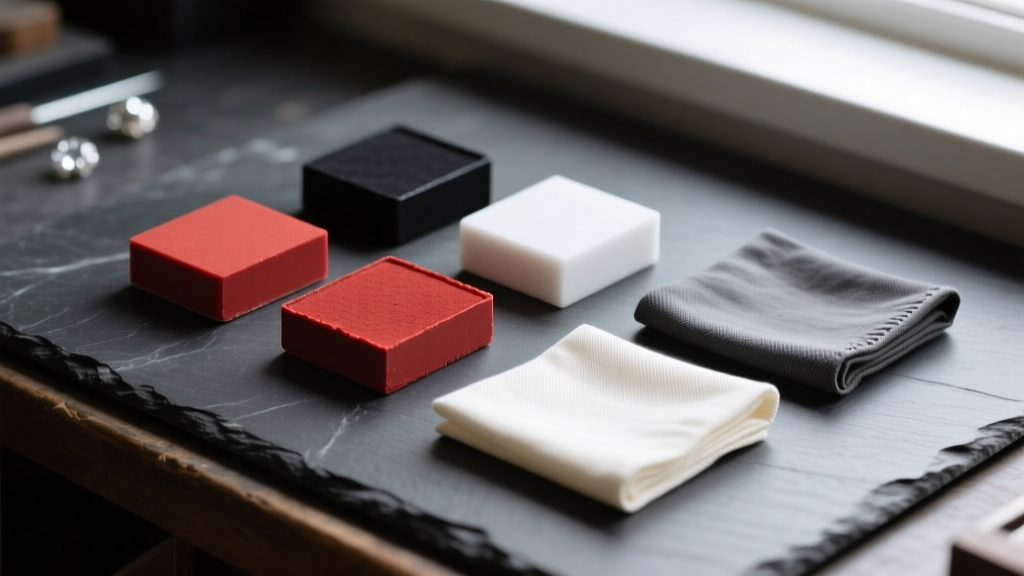
A dry cotton flannel cloth will remove light oils but will not polish metal. True polishing requires micro-abrasives. In professional bench work, these are known as "rouge," and they are impregnated directly into the cloth during manufacturing. The particle size and chemical composition of the rouge dictate its application.
Red Rouge (Jeweler's Rouge)
Composed of finely milled iron oxide ($Fe_2O_3$), red rouge is the industry standard for final polishing of precious metals. The particle size typically ranges between 0.5 and 1.0 microns. Because the particles are incredibly fine and round, they burnish the metal, creating a mirror finish without removing significant mass. It is the safest abrasive for high-karat gold (18k, 22k) and sterling silver.
White Rouge and Aluminum Oxide
White rouge utilizes aluminum oxide ($Al_2O_3$) with a slightly larger and more angular particle structure (1.0 to 2.0 microns). It cuts faster than red rouge and is frequently used for platinum and white gold alloys, which possess higher tensile strength and require a more aggressive initial cut to remove machining marks.
Black Rouge (Emery)
Black rouge contains emery (a naturally occurring mix of corundum and magnetite) or synthetic silicon carbide. With particle sizes often exceeding 5.0 microns, this is a heavy-cutting compound. A polishing cloth for jewelry impregnated with black rouge should never be used on finished pieces; it is strictly reserved for raw steel, titanium, or heavy scratch removal on raw castings prior to final finishing.
Silver Tarnish and Chemical Impregnation
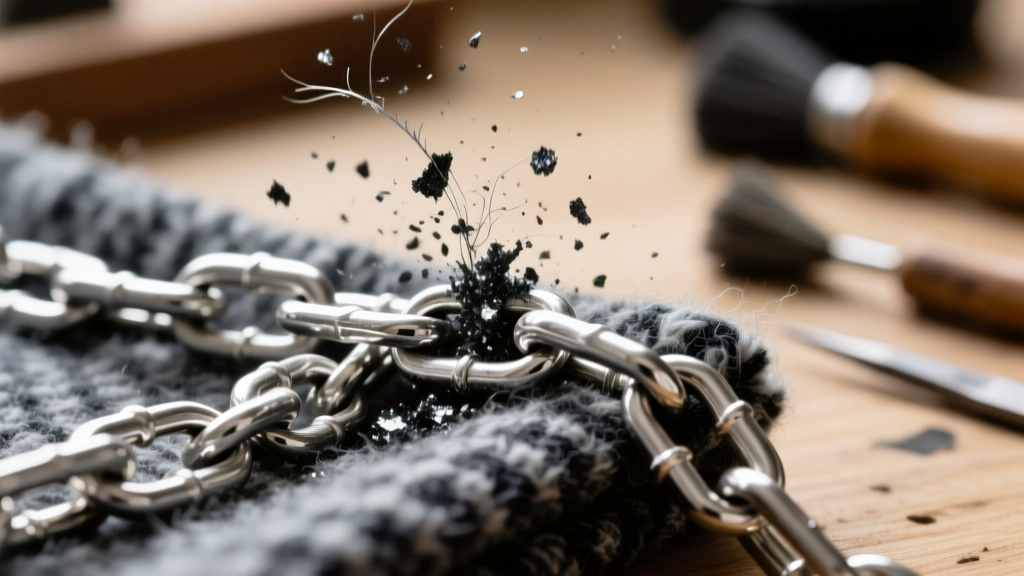
Silver tarnish is not dirt; it is a chemical corrosion layer. When sterling silver (92.5% Ag, 7.5% Cu) is exposed to hydrogen sulfide ($H_2S$) in the atmosphere, it forms silver sulfide ($Ag_2S$), the black layer seen on neglected jewelry. According to the Smithsonian Museum Conservation Institute, mechanical removal of this layer requires specialized chemical assistance to prevent excessive metal loss.
Anti-tarnish silver polishing cloths are impregnated with two distinct agents:
- Mild Micro-Abrasives: Usually calcium carbonate or silica, milled to under 2 microns, to gently fracture the brittle silver sulfide layer.
- Tarnish Inhibitors: Chemicals like benzotriazole (BTA) or zinc-based compounds. As the cloth wipes the silver, it leaves behind a microscopic, invisible monolayer of BTA that bonds to the copper alloy in the sterling silver, blocking sulfur molecules from reaching the metal surface.
Critical Rule: Never wash a chemically treated silver polishing cloth for jewelry. Water and detergent will strip the benzotriazole inhibitors and wash out the suspended micro-abrasives, rendering the cloth useless for tarnish prevention and turning it into a standard, ineffective rag.
Micron-Level Scratch Risks: What NOT to Polish
The most common mistake consumers make is assuming a polishing cloth for jewelry is universally safe for all materials. Micro-abrasives do not discriminate; they will abrade anything softer than their particle hardness on the Mohs scale.
The Rhodium Plating Hazard
White gold is naturally a pale, yellowish-gray alloy. To achieve a bright white finish, it is electroplated with rhodium, a platinum-group metal. This plating is exceptionally thin, typically ranging from 0.1 to 1.0 microns. Using an aggressive polishing cloth (or even rubbing too vigorously with a red rouge cloth) will strip the rhodium plating in seconds, exposing the dull yellowish alloy beneath. White gold should only be wiped with an untreated, ultra-soft microfiber cloth to remove oils.
Matte, Satin, and Sandblasted Finishes
Textured finishes are created by intentionally scratching the metal in a controlled pattern. Any abrasive polishing cloth will burnish these microscopic scratches, slowly turning a matte or satin finish into a high-gloss polish. Maintain textured finishes using only a soft brush and mild dish soap.
Porous and Soft Gemstones
The Gemological Institute of America (GIA) warns against using abrasive materials on organic and porous gems. Pearls (Mohs 2.5-4.5), turquoise (Mohs 5-6), opals, and malachite are easily scratched by the silica or aluminum oxide found in standard polishing cloths. Furthermore, the chemical tarnish inhibitors in silver cloths can permanently stain porous stones.
Cloth Type vs. Metal Compatibility Matrix
Use this technical matrix to select the correct textile for your specific jewelry inventory.
| Material / Finish | Recommended Cloth Type | Abrasive / Compound | Risk Level |
|---|---|---|---|
| Yellow Gold (14k, 18k) | Treated Flannel | Red Rouge (Iron Oxide) | Low |
| Sterling Silver | Anti-Tarnish Flannel | Calcium Carbonate + BTA | Low |
| Platinum | Treated Flannel | White Rouge (Aluminum Oxide) | Low |
| Rhodium-Plated White Gold | Untreated Microfiber | None (Dry or Damp) | High (Strips Plating) |
| Matte / Brushed Metals | Untreated Microfiber | None | High (Ruins Texture) |
| Pearls, Opals, Turquoise | Untreated Cotton Chamois | None | High (Scratches Stone) |
Lifecycle, Saturation Points, and Replacement
A pervasive myth in jewelry care is that a silver polishing cloth is "ruined" when it turns black. The black streaks are not a sign of cloth failure; they are the physical manifestation of the silver sulfide and oxidized copper being successfully removed from the jewelry. In fact, a slightly blackened cloth often polishes better than a brand-new one, as the embedded metal oxides can act as a secondary, ultra-fine polishing agent.
However, polishing cloths do have a definitive end-of-life. You must discard and replace your polishing cloth for jewelry under the following conditions:
- Compound Depletion: If the cloth no longer leaves a slight residue or fails to remove heavy tarnish after multiple passes, the micro-abrasives are exhausted.
- Silica Contamination: If the cloth is dropped on a hard floor or workbench, it will pick up microscopic silica (dust/sand). Silica ranks at a 7 on the Mohs scale—harder than gold, silver, and platinum. Using a contaminated cloth will inflict deep, irreversible scratches on precious metals.
- Fiber Matting: Over time, the napped fibers of the flannel compress and mat together. Once the cloth loses its three-dimensional loft, it can no longer trap debris, increasing the risk of friction burns on the metal surface.
Expert Sourcing and Brand Benchmarks
When sourcing professional-grade materials, avoid generic "jewelry cleaning kits" from mass-market retailers. Instead, look to established bench jewelers' suppliers like Rio Grande or specialized consumer brands that utilize true impregnation techniques. The Sunshine Cloth is a benchmark for micro-abrasive polishing, utilizing a proprietary non-toxic compound safe for most hard metals. For heavy silver tarnish, the Cape Cod Metal Polishing Cloth utilizes a liquid/vapor impregnation method that excels at breaking down heavy, neglected sulfide layers. Always store your treated cloths in their original resealable plastic sleeves to prevent the premature evaporation of chemical inhibitors and to protect the nap from environmental dust.


