Expert Sea Glass Jewelry Making: Wire Wrapping & Bezel Techniques
Master sea glass jewelry making with expert wire wrapping and bezel setting techniques. Learn wire gauges, drilling tips, and coastal metallurgy.

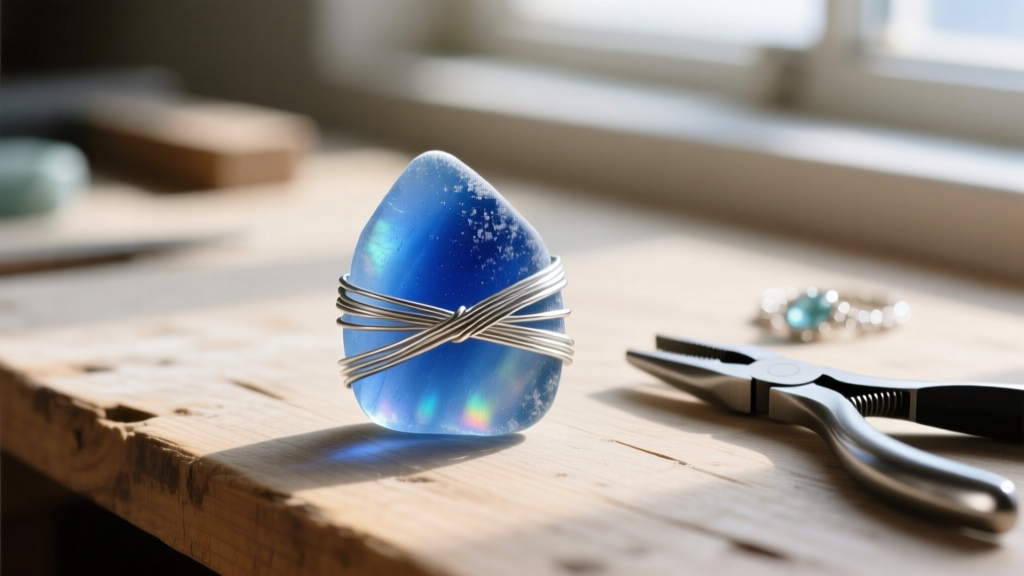
Sea glass jewelry making is a discipline that bridges lapidary science and metalsmithing. Unlike faceted gemstones, sea glass presents unique structural challenges: irregular geometries, fragile frosted surfaces, and varying thicknesses. To create heirloom-quality pieces that survive coastal environments, jewelers must move beyond basic craft-wire loops and employ advanced tension wrapping, precision drilling, and specialized metallurgy. This deep dive explores the technical specifications required to elevate your sea glass jewelry making from amateur crafting to professional design.
The Metallurgy of Coastal Jewelry
When designing jewelry intended for beachwear or coastal living, the ambient environment dictates your metal choices. Saltwater, high humidity, and sulfur in the air accelerate oxidation. Standard sterling silver (.925) contains 7.5% copper, which reacts rapidly with salt and sulfur, leading to severe tarnishing and eventual structural degradation in thin wire wraps.
For high-end sea glass jewelry making, Rio Grande and other master suppliers recommend Argentium silver or 14/20 gold-filled wire. Argentium (.935) replaces some copper with germanium, creating a transparent germanium dioxide layer that drastically slows tarnish. Gold-filled wire, consisting of a brass core mechanically bonded to a 14k gold exterior, offers the ultimate saltwater resistance without the solid-gold price tag.
| Metal Alloy | Composition | Coastal Durability | Workability & Notes | Approx. Cost/Oz |
|---|---|---|---|---|
| Argentium Silver | 93.5% Ag, Germanium | Excellent (Highly tarnish-resistant) | Soft, fuses without solder, requires dedicated tools to avoid contamination | $50 - $65 |
| 14/20 Gold-Filled | 5% 14k Gold, Brass Core | Superior (Will not tarnish in saltwater) | Cannot be cast or heavily filed; ideal for wire wrapping and cold connections | $35 - $45 |
| Sterling Silver | 92.5% Ag, 7.5% Cu | Poor (Tarnishes quickly near ocean) | Standard workhorse; requires frequent polishing or rhodium plating | $30 - $40 |
| Niobium | Pure Reactive Metal | Superior (Hypoallergenic, anodized) | Cannot be soldered; must be anodized for color; dead soft only | $15 - $25 |
Wire Gauges and Tensile Strength
The structural integrity of a wire-wrapped sea glass pendant relies entirely on selecting the correct gauge and temper. Wire gauge dictates thickness, while temper (dead soft, half-hard, full-hard) dictates tensile strength and memory.
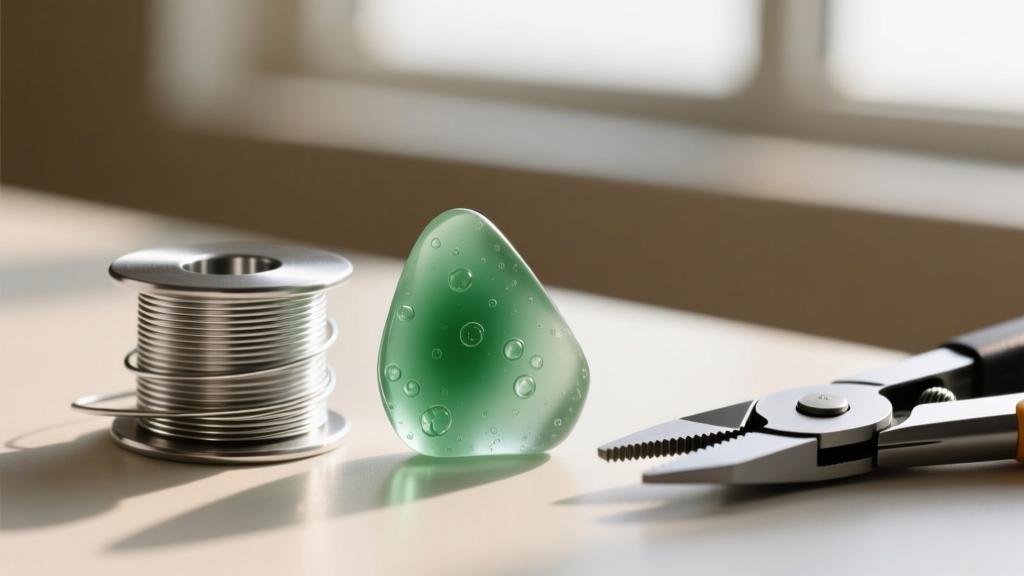
- 20-Gauge (0.81mm) Half-Hard: The foundational wire for structural frames and bail creation. Half-hard temper provides enough rigidity to hold the weight of heavy sea glass shards without warping, yet remains pliable enough for sharp 90-degree bends.
- 22-Gauge (0.64mm) Half-Hard: Ideal for securing prongs and creating tension locks over the edges of the glass. It bites into the natural pitting of the frost without snapping under pressure.
- 24-Gauge (0.51mm) to 26-Gauge (0.40mm) Dead-Soft: Reserved exclusively for decorative weaving and binding. Dead-soft wire lacks memory, allowing it to wrap tightly around the structural frame and conform to the glass's irregular topography.
Expert Tip: Never use full-hard wire for wrapping sea glass. The lack of malleability will cause the wire to spring back, failing to maintain the necessary tension against the glass, ultimately leading to the stone slipping out of the harness.
To Drill or Not to Drill? Thermal Shock and Silica Dust
Drilling sea glass allows for simple bead-stringing or minimal wire wrapping, but it introduces severe risks. Sea glass is essentially amorphous silica. Drilling generates intense localized friction, which can cause thermal shock, shattering the piece instantly. Furthermore, dry-drilling glass releases respirable crystalline silica dust, a known carcinogen.
According to safety guidelines highlighted by Lapidary Journal Jewelry Artist, wet-drilling is non-negotiable. You must use a variable-speed rotary tool (like a Foredom flex shaft) equipped with a 1.2mm to 1.5mm diamond-tipped core bit. Twist bits are for metal; diamond core bits are for glass and stone.
The Wet-Drilling Protocol
- Submerge the sea glass completely in a shallow bath of water inside a plastic container.
- Mark the drilling point with a wax pencil or a piece of masking tape to prevent the diamond bit from skating across the curved surface.
- Set the rotary tool to a low RPM (under 10,000). High speeds generate too much heat.
- Apply zero downward pressure. Let the diamond grit do the cutting. Use a gentle 'pecking' motion—drill for 3 seconds, lift the bit to allow water to flush the silica slurry from the hole, and repeat.
- Flip the glass halfway through to prevent 'blowout' or chipping on the exit side.
Advanced Tension Harness Wrapping
For jewelers who refuse to compromise the structural integrity of their finds by drilling, the tension harness wrap is the premier technique. This method relies on the mechanical lock of wire seated deeply into the natural 'C-shaped' pits of the sea glass frost.
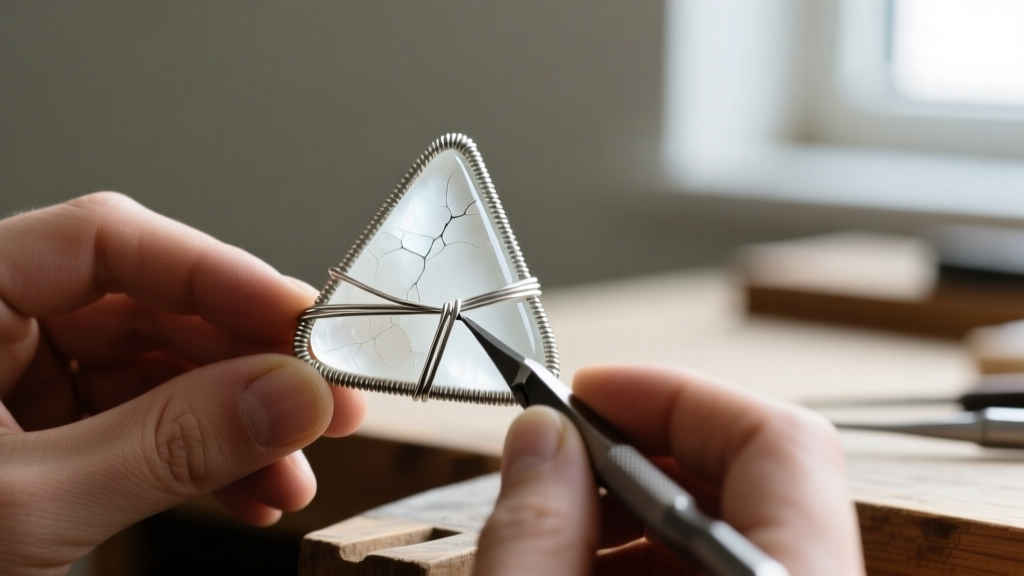
Executing the 3-Wire Lock
Start by cutting three 12-inch lengths of 22-gauge half-hard wire. Bundle them together and bind the center with a 6-inch piece of 26-gauge dead-soft wire. This creates your base plate. Separate the six protruding ends (three on top, three on bottom) and fan them out to match the contour of the glass.
Press the fanned wires firmly into the deepest grooves of the glass edge. Using chain-nose pliers, bend each wire sharply upward at a 90-degree angle exactly where the glass face begins to curve. This sharp bend creates a mechanical 'lip' that prevents the glass from sliding forward. Finally, use your 26-gauge weaving wire to bind the uprights together, creating a rigid cage. The tension is maintained not by squeezing the glass, but by the geometric lock of the 90-degree bends resting in the frost pits.
Bezel Setting for Tabbed Sea Glass
While wire wrapping is popular, bezel setting offers a cleaner, more modern aesthetic for flat, well-tumbled sea glass. However, because sea glass is rarely perfectly flat or uniformly thick, traditional bezel pushing often results in gaps or crushed glass.
To solve this, expert metalsmiths use a 'tabbed' bezel technique. Instead of using a continuous push, you cut 28-gauge fine silver bezel wire to the exact perimeter of the glass. Solder it to a backplate, then use a pair of flush cutters to snip small 'V' shaped notches into the bezel wall wherever the glass thickness varies. These notches act as relief points, allowing you to fold the silver over the glass smoothly without buckling the metal or applying uneven pressure to the silica.
Sealing and Preserving the Frost
The 'frost'—the microscopic pitting that gives sea glass its velvety glow—is highly susceptible to contamination from skin oils, lotions, and polishing compounds. Never tumble finished sea glass jewelry in a rotary tumbler with steel shot; the impact will bruise the glass and the steel will embed into the frost.
The Gemological Institute of America (GIA) notes that the surface texture of altered glass is permanent but fragile. Protecting it requires non-abrasive, chemically inert barriers.
To seal both the metal and the glass, apply a microcrystalline wax, such as Renaissance Wax. Unlike carnauba or beeswax, microcrystalline wax does not turn white in crevices and provides a hard, moisture-resistant barrier. Apply a microscopic amount with a soft microfiber cloth, let it haze for five minutes, and buff gently. This enhances the color saturation of the sea glass while protecting your Argentium or gold-filled wire from coastal humidity, ensuring your sea glass jewelry making results last for generations.


