How to Make Jewelry with Stones: Expert Wire & Bezel Guide
Master how to make jewelry with stones using expert wire wrapping and bezel techniques. Learn gauge selection and Mohs scale limits.

The Physics of Stone Setting: Mohs Scale Meets Metal Hardness
Learning how to make jewelry with stones without using a torch or solder requires a deep understanding of material physics. Cold connections—such as wire wrapping and fabricated bezels—rely entirely on mechanical tension and metal memory to secure a gemstone. Before bending a single piece of wire, you must evaluate the stone’s durability. The Gemological Institute of America (GIA) categorizes gemstone durability through three metrics: hardness (Mohs scale), toughness (resistance to breaking), and stability (resistance to chemicals or heat).
For wire artists, the Mohs scale dictates your tooling approach. Setting a faceted amethyst (Mohs 7) allows for aggressive prong pushing with steel tools. However, wrapping a fluorite cabochon (Mohs 4) or an opal (Mohs 5.5-6.5) requires extreme caution. If a steel chain-nose plier slips while tensioning a 20-gauge wire against a fluorite stone, the wire will instantly gouge the stone's surface. Furthermore, you must consult the Mindat Mineralogy Database to check for cleavage planes. Stones like moonstone and labradorite possess perfect cleavage, meaning point-load pressure from a misaligned wire prong can cause the stone to split cleanly along its crystal lattice, even if the stone's overall Mohs hardness is relatively high.
Wire Gauge and Temper: The Mechanics of Retention
The structural integrity of a wire-wrapped stone setting depends on selecting the correct American Wire Gauge (AWG) and temper. Wire temper refers to the metal's hardness and spring-back, achieved through the manufacturing process of drawing and annealing. According to the Rio Grande Wire Temper Guide, dead soft wire has been fully annealed, offering zero spring-back and making it ideal for weaving and tight wraps. Half-hard wire has been partially work-hardened, providing the structural memory needed to hold a prong against a stone's crown.

| Wire Gauge (AWG) | Diameter (mm) | Recommended Temper | Best Application |
|---|---|---|---|
| 28 | 0.32 | Dead Soft | Weaving, lashing, securing prongs, micro-macrame |
| 24 | 0.51 | Dead Soft | Binding, small jump rings, wrapping bails |
| 20 | 0.81 | Half-Hard | Main structural frames, bezel bases, heavy jump rings |
| 16 | 1.29 | Half-Hard | Heavy prongs for large faceted stones, bail cores |
Fabricating a Custom Wire Bezel for Cabochons
Cabochons (domed, unfaceted stones) are the most forgiving stones for beginners learning how to make jewelry with stones, as they lack sharp girdles and culets that can catch on wire. To create a secure, solderless bezel, you need a two-wire system: a heavy base wire and a fine weaving wire.
Step 1: Dead Soft vs. Half-Hard Base Wire
For a stone measuring 30x40mm, use 20-gauge half-hard sterling silver or copper for the base frame. The half-hard temper ensures that once the wire is shaped to the exact perimeter of the cabochon, it will not easily warp when you apply the wrapping tension. Measure the stone's perimeter using a flexible vinyl tape measure, add 15mm for the overlapping lock, and cut the base wire. Shape it around the stone using nylon-jaw pliers to prevent marring the metal.
Step 2: Tension Wrapping and Failure Modes
Use 28-gauge dead soft wire to bind the base frame to a secondary inner frame or to create a woven bezel wall. The most common failure mode in cabochon wrapping is "wire fatigue." Every time you bend wire, its crystal lattice deforms, increasing its hardness but decreasing its ductility. If you wrap the 28-gauge wire too tightly around a sharp 90-degree corner and then attempt to unspool it to fix a mistake, the wire will snap due to brittle fracture. Always weave with continuous, fluid tension, and never re-bend a weaving wire once it has been pulled taut.
Prong Settings for Faceted Stones Without Soldering
Setting faceted stones introduces complex geometry. A faceted stone consists of the table (top flat surface), the crown (angled top facets), the girdle (the widest outer edge), the pavilion (angled bottom facets), and the culet (the bottom point). To securely hold a faceted stone, your wire prongs must grip the girdle and fold over the crown at an exact angle.
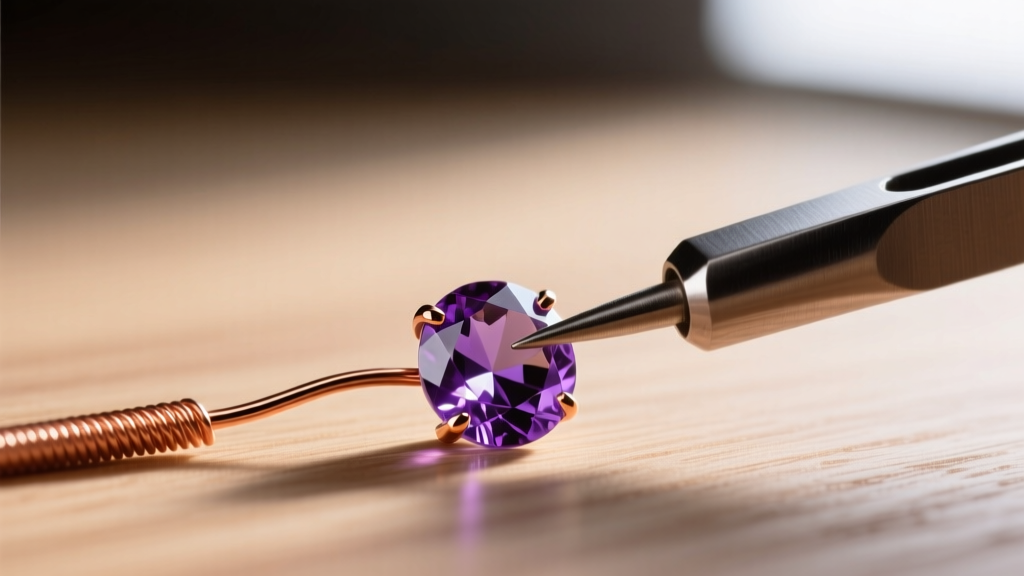
Expert Insight: Never use flat-nose pliers to push a prong over a faceted stone's crown. The flat steel surface will inevitably slip and scratch the table or crown facets. Instead, use a polished steel bezel pusher or a prong pusher with a slightly concave tip to cradle the wire as you fold it over the stone.
To construct a 4-prong solderless setting, start with a 16-gauge half-hard wire for the prongs. The thicker gauge provides the necessary leverage to hold a stone weighing over 5 carats. Create a cross-frame, place the stone in the center, and bend the 16-gauge wires up at a 90-degree angle against the pavilion. Using a bezel pusher, apply downward and inward pressure to fold the wire over the girdle and onto the crown. The spring-back of the half-hard wire will act as a mechanical clamp, applying continuous downward pressure on the stone to prevent rattling.
Sourcing and Tooling: What You Actually Need
Professional results require specialized tooling that protects both the metal and the stone. Investing in the right pliers will drastically reduce your scrap wire and chipped stone rates.
- Nylon-Jaw Pliers: Essential for straightening wire and shaping bezel frames without leaving tool marks on the metal.
- Flush Cutters: You need a high-quality pair with a flat back and a beveled cutting edge. This allows you to cut weaving wire perfectly flush against the base frame, eliminating sharp burrs that can snag clothing or scratch the stone.
- Chasing Hammer and Steel Bench Block: Used to flatten and work-harden specific sections of your wire frame (like the bail or the tips of prongs) without affecting the temper of the entire piece.
- OptiVISOR or Jeweler's Loupe (10x): Crucial for inspecting the girdle contact points to ensure no light leaks between the wire and the stone, which indicates a loose setting.
Troubleshooting Common Failure Modes
Even experienced jewelers encounter structural failures when figuring out how to make jewelry with stones using cold connections. Here is how to diagnose and fix the three most common issues:
1. The Stone Rattles: This occurs when the bezel wall or prongs are not applying enough downward pressure on the stone's girdle. If using a woven bezel, use a burnisher to gently push the top row of the weave inward and downward against the stone's crown. If using prongs, use a prong pusher to tighten the fold over the crown.
2. Wire Discoloration: Sterling silver and copper react with the oils on your hands and the sulfur in the air, causing rapid tarnishing, especially in the tight crevices of a wire weave. Always tumble your finished piece (without porous stones like turquoise or opals) in a rotary tumbler with stainless steel shot and a drop of dish soap. This burnishes the metal, hardens the wire slightly, and cleans out flux or finger oils.
3. Prong Slippage: If a prong constantly slips off the side of a faceted stone, the issue is likely the stone's cut, not your wire. Many commercially cut stones have uneven girdles or overly steep crowns. Use a fine-grit diamond file to carefully carve a microscopic "seat" or notch into the inside of the 16-gauge wire prong, allowing it to lock into the girdle's edge mechanically.


