Mastering the Orion Permanent Jewelry Welder: 2026 Tech Guide
Master the Orion permanent jewelry welder with our 2026 technical guide. Learn pulse arc settings, argon flow rates, and troubleshooting tips.

The Physics of Pulse Arc Welding in Permanent Jewelry
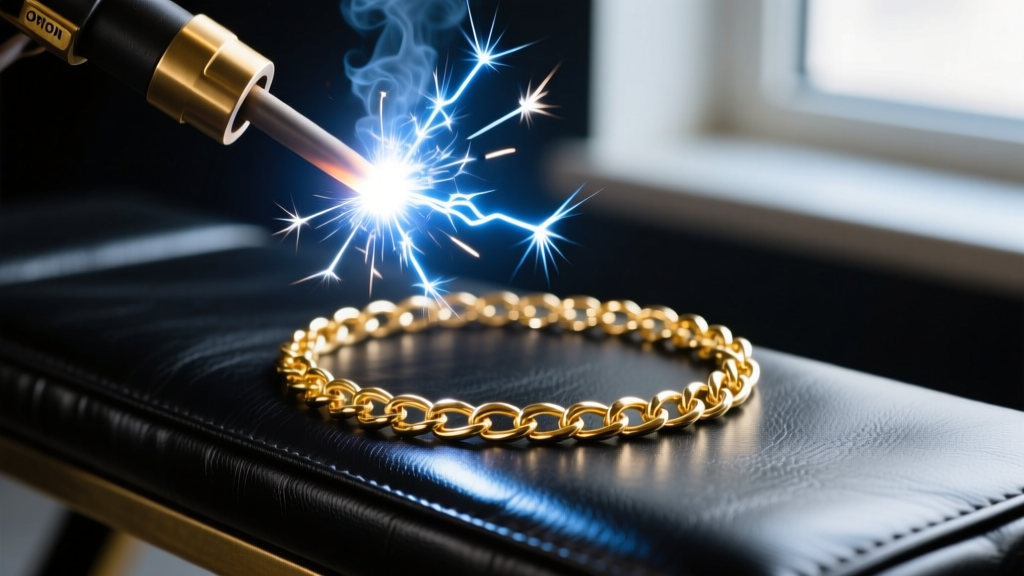
As the permanent jewelry sector continues its rapid expansion in 2026, the Orion mPulse has cemented itself as the industry benchmark for pulse arc welding. Unlike traditional torch soldering, which relies on capillary action and filler metals, pulse arc welding utilizes a high-energy capacitor discharge to melt the base metals directly together. This creates a homogenous weld joint without altering the karat purity or color of the chain.
The underlying physics involve charging a capacitor bank and releasing that energy in a fraction of a millisecond. When the tungsten electrode comes within 1 to 2 millimeters of the workpiece, the voltage ionizes the gap, creating a plasma arc. Because the discharge is so brief, the Heat Affected Zone (HAZ) remains incredibly small, preventing the annealing of the surrounding chain links—a critical factor when working with work-hardened cable chains.
Technical Specifications: Argon, Electrodes, and Energy
Achieving a flawless, oxidation-free weld requires strict adherence to atmospheric shielding and electrode metallurgy. The Orion permanent jewelry welder relies on three core technical pillars:
The Argon Envelope
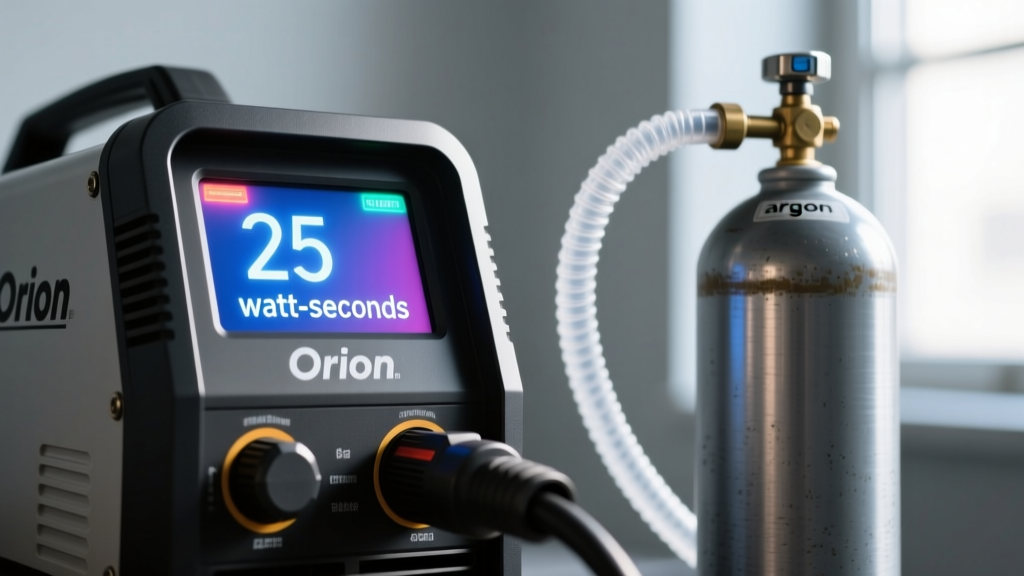
Atmospheric oxygen and nitrogen will instantly contaminate a molten gold or silver weld pool, causing severe porosity and embrittlement. You must use 99.99% pure argon gas. The flow rate should be meticulously regulated between 5 and 7 Cubic Feet per Hour (CFH). A flow rate that is too low will fail to displace the ambient air, while a flow rate that is too high will create turbulence, pulling oxygen into the shield envelope.
Electrode Metallurgy and Sharpening
For the low-current DC/pulse applications typical in permanent jewelry, a 2% Ceriated Tungsten electrode (identified by a grey tip) is vastly superior to pure or thoriated tungsten. Ceriated electrodes offer superior arc starting at low amperages and maintain a sharper point. The electrode must be sharpened longitudinally to a 45-degree angle using a dedicated diamond or boron nitride grinding wheel. A blunt or improperly ground electrode will cause the arc to wander, resulting in asymmetrical welds.
Material-Specific Welding Parameters
Dialing in the exact Watt-Seconds (Ws) is the most common hurdle for new permanent jewelry artists. The required energy is dictated by the thermal mass and thermal conductivity of the specific alloy and gauge. Below is a baseline calibration chart for standard permanent jewelry findings and chains sourced from suppliers like Stuller.
| Metal Alloy | Chain Gauge / Mass | Recommended Ws | Argon Flow | Technical Notes |
|---|---|---|---|---|
| 14k Yellow Gold | 1.2mm (approx. 16ga) | 20 - 25 Ws | 5 CFH | Standard cable chain. Pre-tension the jump ring flush against the link. |
| Sterling Silver | 1.0mm | 15 - 18 Ws | 6 CFH | Silver dissipates heat rapidly. Requires a sharp, fast pulse to avoid sinking. |
| Platinum 950 | 1.5mm | 35 - 45 Ws | 7 CFH | High melting point (1,768°C). Requires maximum capacitor discharge. |
| 18k Gold Filled | 1.1mm | 12 - 15 Ws | 5 CFH | Extremely low Ws required to prevent burning through the brass core. |
Step-by-Step Calibration for the Orion mPulse
To ensure structural integrity for permanent wear, follow this exact operational sequence:
- Surface Preparation: Clean the weld area with a pumice wheel or high-grit polishing paper, followed by an isopropyl alcohol wipe. Skin oils and polishing compounds will vaporize during the arc, causing micro-porosity.
- Flush Alignment: Use high-precision flush cutters to snip the chain link and jump ring. The two mating surfaces must be perfectly flush with zero gap. A gap wider than 0.2mm will cause the arc to bridge poorly, resulting in a weak, brittle joint.
- Argon Purge: Engage the foot pedal to initiate the argon flow for 1 full second before the arc fires. This pre-purge clears the immediate welding zone of ambient air.
- The Discharge: Bring the electrode to within 1.5mm of the joint. The Orion's auto-darkening lens will protect your eyes as the capacitor discharges. Hold the piece still for 2 seconds post-weld to allow the argon post-flow to shield the cooling metal.
Troubleshooting Common Pulse Arc Failures
Even with premium equipment from Rio Grande and Orion, metallurgical variables can cause defects. Here is how to diagnose and correct the most frequent failure modes.
Porosity and Oxidation
If your weld joint looks dull, grey, or pitted under magnification, you are experiencing atmospheric contamination. Correction: Increase your argon pre-purge time, check your hose fittings for micro-leaks using soapy water, and ensure your chain is chemically clean. Never weld in a room with an active HVAC vent blowing directly over your bench.
Chain Burn-Through and Melt-Back
If the delicate links adjacent to your weld joint are melting or deforming, your thermal mass calculation is off. Correction: Reduce the Watt-Seconds by 3-5 Ws. Additionally, ensure you are using copper tweezers or a copper heat-sink block behind the chain to draw excess thermal energy away from the HAZ.

Weak or Brittle Joints
If the weld snaps under light tension, the base metals did not achieve full fusion. This is usually caused by a gap between the jump ring and the chain link, or an overly blunt tungsten electrode. Correction: Re-sharpen your electrode longitudinally and use chain-nose pliers to mechanically force the jump ring flush against the link before firing the arc.
Orion Pulse Arc vs. Laser Welders: A 2026 Perspective
While laser welders offer pinpoint accuracy and a virtually non-existent HAZ, they remain a significant capital expenditure, often ranging from $6,000 to over $12,000. Lasers also require stringent safety protocols, including specialized eyewear and enclosed welding chambers. The Orion pulse arc welder, typically priced between $1,500 and $2,200, remains the most pragmatic choice for high-volume permanent jewelry studios. It offers 90% of the structural integrity of a laser weld for jump rings and chain links, with a vastly gentler learning curve and lower maintenance overhead. For artists focusing exclusively on chain-to-chain permanent attachments, mastering the pulse arc parameters outlined above will yield professional, heirloom-quality results every time.


