Farrington Jewelry Box Review: Is the Luxury Cost Worth It?
We analyze the Farrington jewelry box to determine if its premium price tag is justified by material quality, anti-tarnish features, and longevity.

The Hidden Economics of Premium Jewelry Storage
When evaluating high-end organizational tools, the upfront cost often obscures the long-term value proposition. The Farrington jewelry box sits firmly in the luxury tier of the storage market, with prices typically ranging from $450 to over $1,200 depending on the model and dimensions. For the average collector, dropping nearly a thousand dollars on a storage vessel might seem excessive when mid-tier alternatives are available for a fraction of the cost. However, as of 2026, the conversation around jewelry storage has shifted from mere aesthetics to active asset preservation.
Jewelry is highly susceptible to environmental degradation. Hydrogen sulfide in the air, moisture, and the off-gassing of cheap manufacturing materials can rapidly degrade precious metals and porous gemstones. This comprehensive value assessment breaks down the material science, structural integrity, and cost-per-year metrics of the Farrington line to determine if the investment is genuinely justified for serious collectors.
Material Breakdown: What You Are Actually Paying For
The chasm between a $60 mass-market organizer and a premium Farrington piece is not merely cosmetic; it is rooted in the chemical properties of the materials used. According to guidelines on jewelry care and preservation from the Gemological Institute of America (GIA), the micro-environment inside a jewelry box dictates the rate of tarnish and material fatigue.
Exterior Shell: Solid Hardwoods vs. MDF
Budget and mid-tier boxes almost universally rely on Medium-Density Fiberboard (MDF) or particleboard wrapped in polyurethane (PU) leather. MDF is essentially wood dust held together by synthetic resins. These resins frequently off-gas formaldehyde and sulfur compounds over time, creating a highly corrosive internal environment that accelerates silver sulfide formation (tarnish) on sterling silver and copper alloys.
In contrast, the Farrington jewelry box utilizes kiln-dried solid hardwoods, typically walnut or mahogany. Solid wood is chemically stable once properly cured. Furthermore, the exterior wrapping utilizes full-grain, vegetable-tanned leather. As noted by the Leather Working Group, vegetable tanning uses natural tannins from tree bark, avoiding the harsh chromium salts used in cheaper leather processing that can sometimes react with sensitive metals.
Interior Lining: The Anti-Tarnish Engine
The interior of a jewelry box is where the real preservation work happens. Standard boxes use polyester blends or cheap felt that trap ambient moisture against the metal. Farrington interiors are lined with ultra-suede and specialized anti-tarnish flannel.
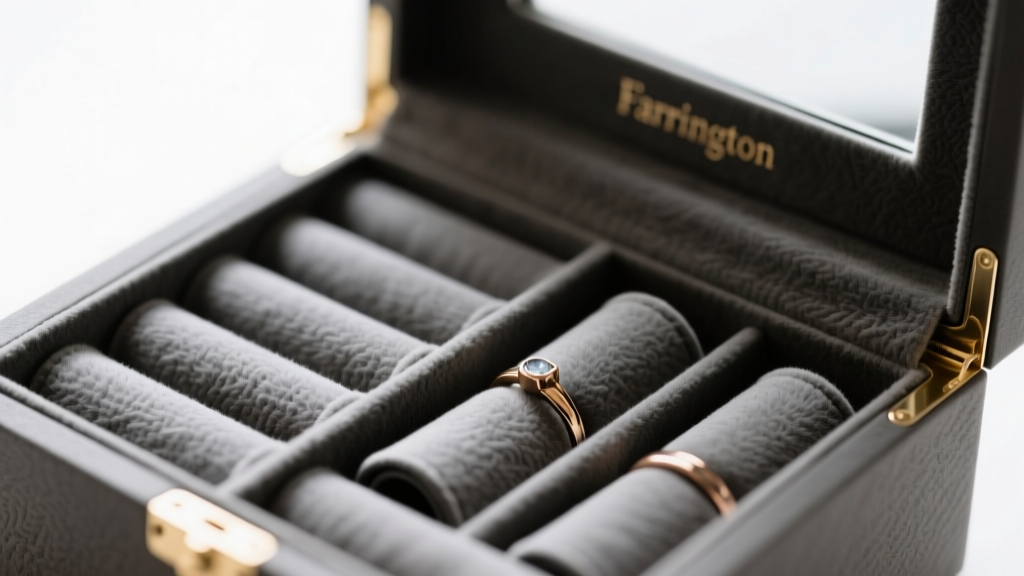
This flannel is often embedded with microscopic zinc or silver particles. These sacrificial metals act as a chemical intercept, reacting with airborne sulfur and moisture before those corrosive elements can reach your jewelry. This proactive neutralization means your sterling silver and white gold pieces remain pristine for months, eliminating the need for frequent, abrasive polishing that slowly wears away metal and rhodium plating.
Price-to-Value Matrix: Farrington vs. The Competition
To truly assess the value, we must compare the Farrington jewelry box against standard market tiers. The table below outlines the critical differences in construction that dictate both the lifespan of the box and the safety of the jewelry inside.
| Feature | Budget Tier ($30 - $80) | Mid-Tier ($150 - $300) | Farrington Luxury ($450+) |
|---|---|---|---|
| Core Shell | Cardboard / Thin Plastic | MDF / Particleboard | Kiln-Dried Solid Walnut |
| Exterior Wrap | PU (Fake) Leather | Bonded / Genuine Leather | Full-Grain Veg-Tan Leather |
| Interior Lining | Polyester Felt | Microfiber / Suede | Anti-Tarnish Flannel & Ultra-Suede |
| Hinge Hardware | Plastic or Zinc Alloy | Brass-Plated Steel | Solid Brass Piano / Quadrant Hinges |
| Adhesives Used | Acidic PVA Glues | Standard Wood Glues | pH-Neutral Archival Adhesives |
| Expected Lifespan | 1 - 3 Years | 5 - 10 Years | 30+ Years (Generational) |
Longevity and Failure Modes: Where Luxury Boxes Break Down
Understanding the failure modes of jewelry storage highlights why the Farrington engineering commands a premium. When a cheap box fails, it rarely just breaks; it actively damages the contents.
Adhesive Degradation and Off-Gassing
The most insidious failure mode in mid-tier boxes is adhesive breakdown. Acidic polyvinyl acetate (PVA) glues are commonly used to attach interior linings and exterior wraps. Over 3 to 5 years, these glues dry out, become brittle, and release acidic vapors. These vapors are catastrophic for porous gemstones like pearls, opals, and turquoise, causing them to craze or lose their luster. Farrington utilizes pH-neutral, archival-grade adhesives that remain stable for decades, ensuring the internal micro-climate remains chemically inert.
Hardware Sag and Hinge Pull-Out
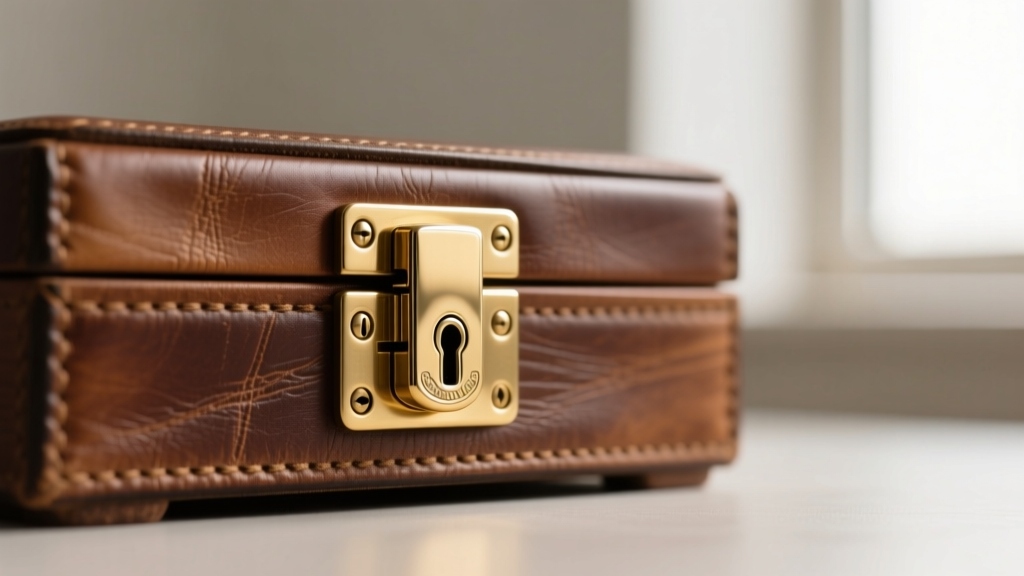
Heavy solid-wood lids require robust hardware. Budget boxes use small, zinc-alloy hinges screwed directly into MDF. Because MDF lacks a continuous wood grain, it has very poor screw-holding strength. Over time, the repetitive stress of opening and closing the lid strips the screw holes, causing the lid to sag, misalign, and eventually crush the contents. The Farrington jewelry box solves this by using solid brass piano hinges or heavy-duty quadrant stays, anchored deep into the solid wood substrate with brass wood screws, ensuring perfect alignment for a lifetime.
Lining Delamination
When humidity fluctuates, cheap linings absorb moisture, expand, and peel away from the rigid box walls, exposing the jewelry to the raw, off-gassing MDF underneath. The ultra-suede and flannel used in luxury boxes are tension-fitted and bonded with flexible, moisture-resistant adhesives that accommodate natural shifts in ambient humidity without bubbling or peeling.
The True Cost of Ownership: A 10-Year Projection
To evaluate the Farrington jewelry box purely on budget metrics, we must calculate the Total Cost of Ownership (TCO) over a decade, factoring in the hidden costs of jewelry maintenance caused by inferior storage.
The Hidden Maintenance Tax: Professional ultrasonic cleaning and rhodium replating for a white gold or silver collection can cost between $150 and $300 annually. If a mid-tier box fails to prevent tarnish and environmental damage, this maintenance tax quickly eclipses the initial savings of buying a cheaper box.
- Budget Box TCO (10 Years): $150 (replacing 3 boxes at $50 each) + $1,500 (annual professional polishing due to severe tarnish) = $1,650
- Mid-Tier Box TCO (10 Years): $250 (1 box) + $750 (bi-annual polishing due to moderate tarnish) = $1,000
- Farrington Box TCO (10 Years): $650 (1 box) + $0 (minimal at-home wiping required due to anti-tarnish lining) = $650
The Verdict: Who Should Invest in a Farrington Box?
The Farrington jewelry box is not a practical purchase for someone who owns a handful of inexpensive, replaceable fashion jewelry pieces. For everyday costume jewelry, a well-ventilated mid-tier acrylic organizer or a basic zip-lock anti-tarnish bag system is perfectly adequate.
However, if your collection includes heirloom pieces, high-karat gold, untreated sterling silver, or porous organic gems (pearls, coral, opals), the Farrington box transitions from a luxury indulgence to a necessary insurance policy. The combination of solid hardwood stability, full-grain vegetable-tanned leather, and chemically active anti-tarnish linings provides a level of asset protection that mass-market alternatives simply cannot engineer. When viewed through the lens of long-term preservation and the elimination of professional restoration costs, the premium price tag of a Farrington piece is not just justified—it is economically sound.


