Troubleshooting Your Glass Jewelry Display Box: Tarnish & Glare
Is your glass jewelry display box causing tarnish or glare? Learn expert troubleshooting tips to fix humidity traps, lining off-gassing, and lighting.

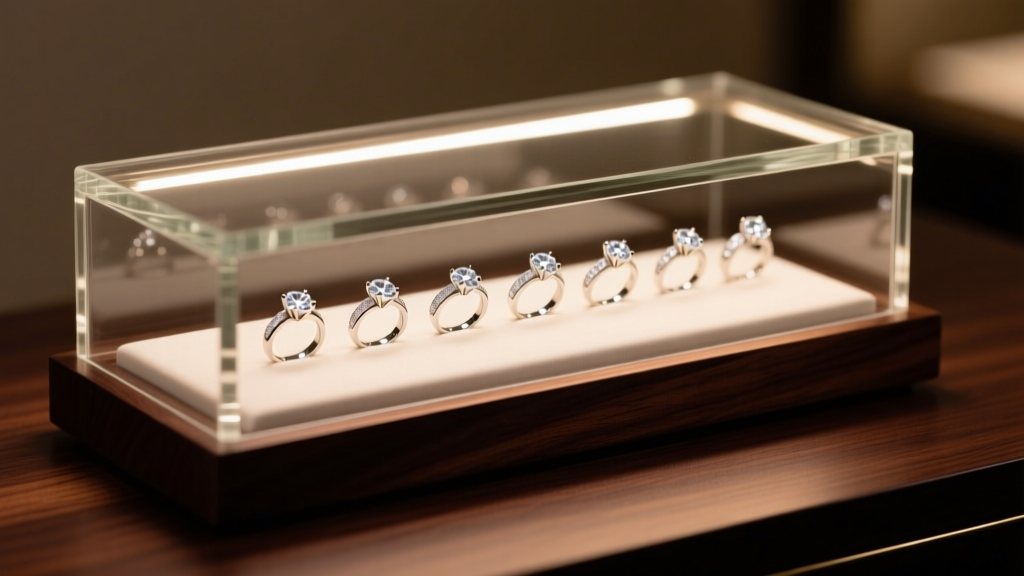
The Hidden Microclimate: Why Your Glass Box Causes Tarnish
A common misconception among collectors is that sealing jewelry inside a glass jewelry display box protects it from environmental damage. In reality, standard glass enclosures often create a trapped microclimate that accelerates tarnishing, particularly for sterling silver and copper alloys. When you close the lid in a room with 60% Relative Humidity (RH), you trap that moisture inside. According to the Smithsonian Museum Conservation Institute, silver tarnishes rapidly when RH exceeds 55% in the presence of airborne sulfur compounds.
The "greenhouse effect" of a glass box means that minor temperature fluctuations in your room cause condensation to form on the interior glass panels and the metal surfaces of your jewelry. To troubleshoot this, you must actively manage the interior climate rather than relying on the glass as a passive barrier.
Actionable Climate Control Solutions
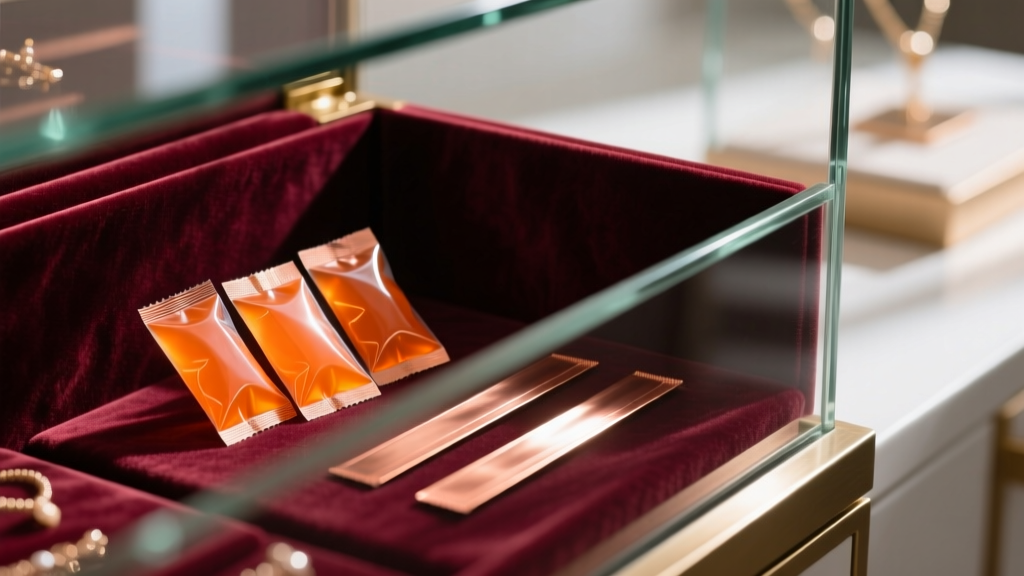
- Desiccant Selection: Avoid standard white silica gel packets, which are non-indicating and can over-dry organic gems like pearls or opals (causing crazing). Instead, use indicating silica gel (orange-to-green, cobalt-free). Place 10 grams of silica per cubic foot of display space to maintain an optimal 40-45% RH.
- Sulfur Scavengers: Integrate 3M Anti-Tarnish Strips into the display. These copper-based strips chemically bind with hydrogen sulfide gas before it reaches your silver. Replace them every 6 months, or when the copper coating turns completely black.
- Air Exchange: Open the glass jewelry display box for 15 minutes once a week in a climate-controlled room to allow stale, potentially off-gassed air to escape and reset the interior microclimate.
Lining Off-Gassing: When the Velvet is the Enemy
If your jewelry is tarnishing despite using anti-tarnish strips, the culprit is likely the interior lining. Many mass-produced glass display boxes use synthetic velvet or felt adhered with cheap rubber cements and hot-melt glues. These adhesives are notorious for off-gassing Volatile Organic Compounds (VOCs) and sulfur dioxide, which are trapped by the glass enclosure and forced directly into the pores of your metals.
The Sniff and Seal Test
Close the empty glass jewelry display box for 48 hours. Open it and immediately smell the interior. A distinct chemical, sour, or "new car" odor indicates active off-gassing. If present, the lining is actively damaging your collection.
Remediation Steps
You do not necessarily need to discard the box. You can isolate the jewelry from the toxic lining by creating a secondary barrier. Line the bottom and insert trays with Pacific Silvercloth or archival-grade, unbleached cotton flannel. If you are re-upholstering the box yourself, never use standard craft glues. Use archival PVA (Polyvinyl Acetate) adhesives or 3M Scotch-Weld, which are chemically stable and sulfur-free once fully cured. For high-end displays, consider replacing fabric entirely with Volara foam, a closed-cell polyethylene foam used in museum conservation that emits zero VOCs.
Solving the Glare and Lighting Dilemma
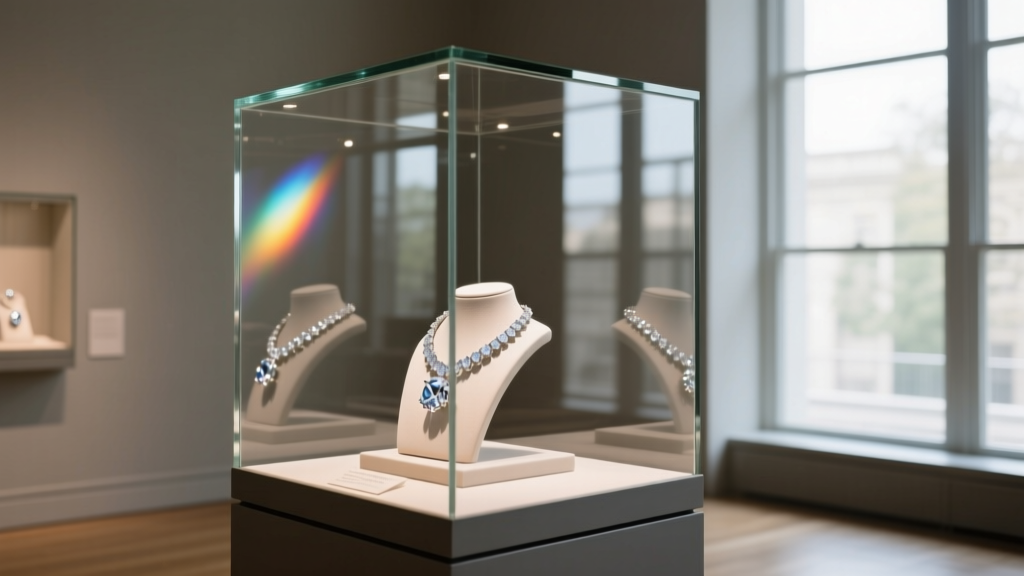
The primary purpose of a glass jewelry display box is visual appreciation, yet standard float glass reflects approximately 8% of ambient light per surface. This creates a double-reflection glare that obscures the scintillation of faceted gemstones and makes photography nearly impossible. Furthermore, improper lighting inside the case can cause thermal damage.
According to the Gemological Institute of America (GIA), prolonged exposure to heat from traditional halogen display bulbs can dry out the moisture content in opals, leading to irreversible cracking, and can melt the fracture-filling oils in emeralds. To troubleshoot glare and heat, you must upgrade both the glass medium and the illumination source.
Glass Upgrade Matrix
| Glass Type | Light Transmission | Reflection Rate | UV Protection | Best Use Case |
|---|---|---|---|---|
| Standard Float | ~90% | ~8% | None | Budget displays, low-light rooms |
| Tempered | ~90% | ~8% | None | High-traffic retail, safety priority |
| Museum (AR) | ~97% | <1% | Up to 99% | High-end gems, bright ambient light |
For serious collectors, retrofitting the lid with Museum-grade Anti-Reflective (AR) glass is the ultimate troubleshooting step. AR glass utilizes microscopic magnesium fluoride coatings that cancel out light waves, rendering the glass virtually invisible and allowing 97% light transmission.
Lighting Specifications
Replace any internal halogen or incandescent bulbs with LED strip lighting. You must select LEDs with a CRI (Color Rendering Index) of 95+ to accurately portray the true body color of rubies and sapphires. Set the color temperature to 3000K - 3500K (warm white) to enhance the fire of diamonds without casting a sterile, blueish clinical hue. Ensure the LED strips are mounted on aluminum heat-sink channels to draw thermal energy away from the glass enclosure.
Dust Infiltration and Hinge Alignment Fixes
Even a microscopic layer of dust can act as an abrasive when jewelry is moved, and over time, dust accumulation inside a glass jewelry display box ruins the aesthetic. Dust usually infiltrates through poorly aligned lid hinges or gaps in the frame joinery. Over time, the weight of a heavy glass lid causes standard brass butt hinges to sag, creating a millimeter-wide gap at the front seam.
Mechanical Troubleshooting
- Shim the Hinges: If the lid sits unevenly, loosen the hinge screws on the higher side and insert a 0.5mm brass shim behind the hinge leaf before retightening. This realigns the glass lid flush with the base.
- Apply PTFE Tape: For gaps along the wooden or metal frame where the glass rests, apply a thin strip of PTFE (Teflon) plumber's tape or specialized archival weatherstripping. PTFE is chemically inert, meaning it will not off-gas and damage your jewelry, while effectively sealing out microscopic dust particles.
- Clean the Tracks: If your box features a sliding glass drawer, use a dry, lint-free microfiber swab dipped in a tiny amount of isopropyl alcohol to clean the tracks. Never use silicone lubricants, as they attract dust and create a gritty paste that will eventually scratch the glass edges.
The Ultimate Troubleshooting Checklist
Use this rapid diagnostic checklist the next time you inspect your glass jewelry display box to ensure your collection remains pristine and visually stunning.
- Tarnish appearing on silver? Check RH levels, replace 3M anti-tarnish strips, and test the velvet lining for sulfur off-gassing.
- Gems look dull or yellow? Verify your internal LEDs are CRI 95+ and replace any bulbs with a color temperature above 4000K.
- Glare obscuring the view? Clean the exterior with an ammonia-free optical cleaner and consider upgrading the lid to Museum AR glass.
- Dust accumulating inside? Inspect hinge alignment, shim sagging butt hinges, and seal frame gaps with inert PTFE tape.
- Organic gems cracking? Remove aggressive desiccants that are dropping the interior RH below 35%, and ensure no heat-emitting halogen bulbs are in use.
By treating your glass jewelry display box not just as a passive container, but as an active, managed micro-environment, you can eliminate the root causes of tarnish, glare, and physical degradation, ensuring your collection remains as brilliant as the day it was acquired.


