Floor Jewelry Box Materials: Solid Wood vs MDF vs Metal
Compare solid wood, MDF, and metal floor jewelry boxes. Discover which material prevents tarnish, supports heavy collections, and lasts longest.

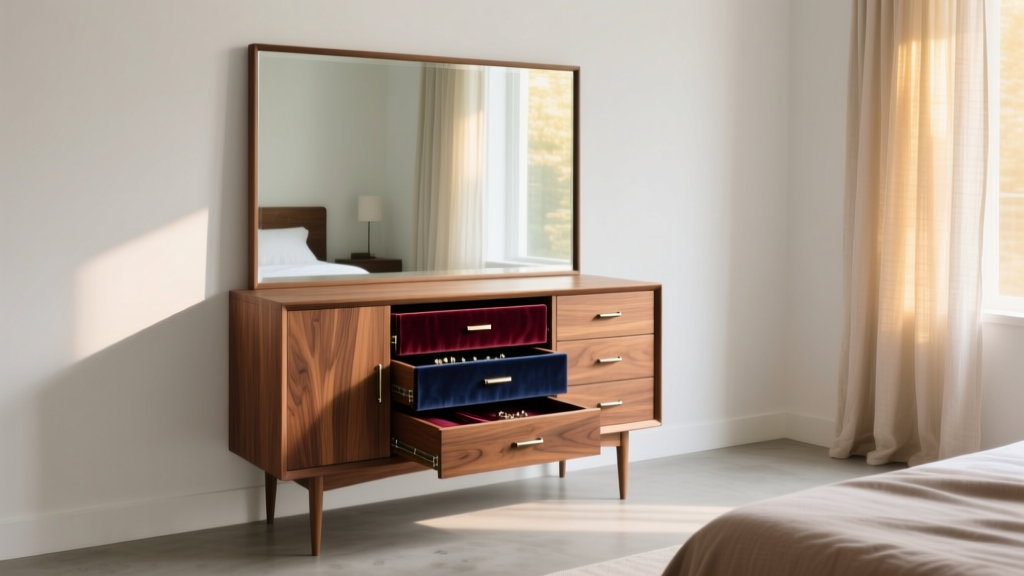
When investing in a floor jewelry box—often referred to as a standing jewelry armoire or cabinet—the exterior aesthetic is only half the battle. The structural material dictates the unit's lifespan, its ability to bear the substantial weight of a growing collection, and, crucially, its chemical interaction with your precious metals. A heavy silver necklace collection can easily exceed 40 pounds, placing immense shear stress on drawer joints and shelving brackets. Furthermore, the off-gassing properties of cheap composite woods can accelerate silver sulfide tarnishing, turning a storage solution into a destructive environment.
In this comprehensive material guide, we break down the structural and chemical properties of solid hardwood, engineered MDF, and powder-coated steel to help you choose the optimal floor jewelry box for your specific collection and climate.
The Structural Core: Why Material Dictates Longevity
A floor-standing jewelry cabinet is essentially a tall, narrow piece of furniture with a high center of gravity. When fully loaded with jewelry, the top-heavy weight distribution requires exceptional material rigidity to prevent bowing, racking (twisting), and tipping. The material you choose determines the type of joinery that can be used, which in turn defines the unit's structural ceiling.
Weight Capacity and Drawer Glide Wear
Heavy gemstone pieces, solid gold bangles, and layered silver chains accumulate weight rapidly. Drawer bottoms made from thin plywood or hardboard will sag under just 10 pounds of concentrated load. Furthermore, the friction generated by heavy drawers degrades cheap wooden runners within months, whereas metal ball-bearing glides require a rigid cabinet carcass to remain aligned. If the cabinet material flexes, the drawer tracks bind and fail.
Solid Hardwood: The Heirloom Standard
For serious collectors, solid hardwood remains the undisputed champion of floor jewelry boxes. Woods like North American Black Walnut, Hard Maple, and White Oak offer exceptional dimensional stability and structural integrity.
Janka Hardness and Joinery Potential
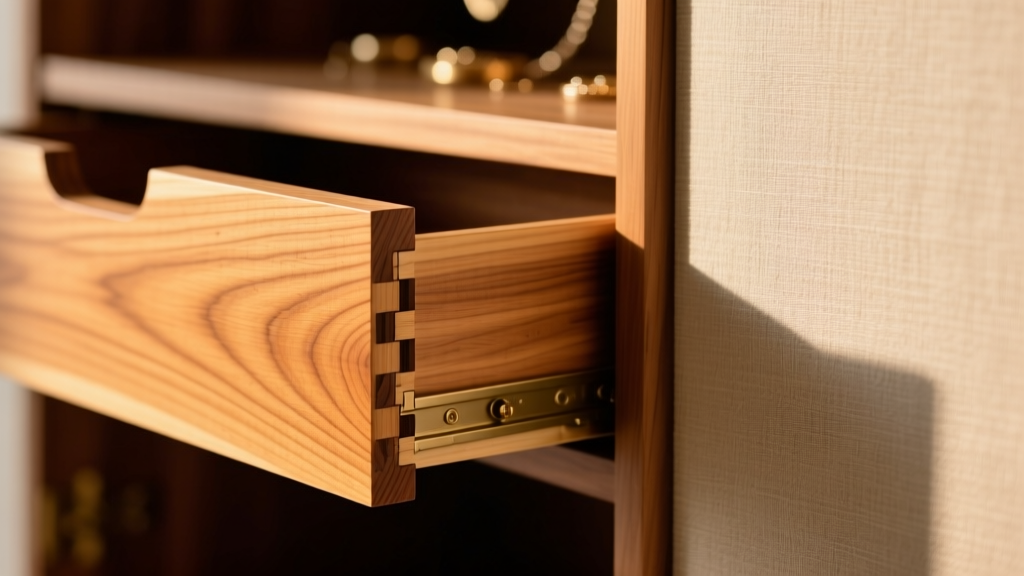
The Janka hardness test measures the resistance of wood to denting and wear. Hard Maple scores an impressive 1,450 lbf (pounds-force), while Black Walnut sits at a respectable 1,010 lbf. This density allows master craftsmen to cut precision dovetail or mortise-and-tenon joints directly into the drawer boxes. Unlike glued dowels, mechanical wood joinery absorbs the lateral stress of heavy drawers without failing.
Moisture Dynamics and Finishing
Solid wood is hygroscopic; it expands and contracts with ambient humidity. According to the USDA Forest Products Laboratory, proper kiln-drying and the application of a catalyzed lacquer or penetrating oil finish seal the wood, stabilizing its moisture content. This prevents the cabinet from warping in humid environments like coastal bedrooms, ensuring doors and drawers continue to open smoothly for decades. Expect to invest between $600 and $2,500 for a genuine solid hardwood floor armoire.
Engineered Wood (MDF & Particleboard): The Budget Trap
Medium-Density Fiberboard (MDF) and particleboard dominate the sub-$250 floor jewelry box market. While they offer a flawless, uniform surface for painted finishes and wood veneers, their internal physics and chemical makeup present significant risks to both the furniture and your jewelry.
Shear Strength and Screw Stripping
MDF is manufactured by breaking down hardwood or softwood residuals into wood fibers, combining them with wax and resin, and applying high heat and pressure. While MDF has high compressive strength, its shear strength and screw-holding capacity are notoriously poor. The heavy, repeated pulling of loaded drawers easily strips the screws holding the metal drawer glides to the MDF carcass. Once an MDF screw hole strips, it cannot be reliably repaired.
The Hidden Tarnish Culprit: Acid Off-Gassing
The most insidious flaw of cheap engineered wood is its chemical off-gassing. Many budget MDF boards are bound with urea-formaldehyde resins. As these resins degrade, they release acidic vapors. When trapped inside the enclosed space of a jewelry cabinet, these acids react with the copper alloys in sterling silver and the zinc in white gold, accelerating tarnish and corrosion. If you must buy an MDF floor jewelry box, ensure it is certified CARB Phase 2 compliant for low formaldehyde emissions, and line every drawer with anti-tarnish barriers.
Powder-Coated Steel & Aluminum: The Modern Fortress
Metal floor jewelry boxes have surged in popularity, offering a sleek, contemporary aesthetic paired with industrial-grade durability. However, not all metal cabinets are created equal; the gauge of the steel and the type of finish are critical differentiators.
Gauge Thickness and Structural Rigidity
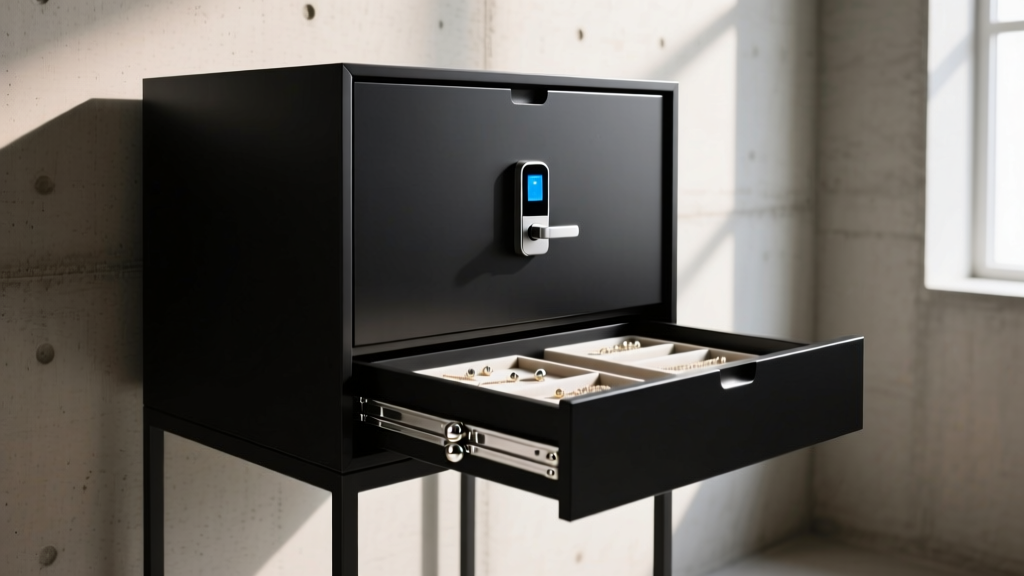
When evaluating a steel jewelry armoire, look for 18-gauge or 16-gauge cold-rolled steel (approximately 0.0478 to 0.0598 inches thick). Anything thinner (like 22-gauge) will dent easily and flex under weight, causing the integrated locks to misalign. High-quality metal cabinets utilize robotic TIG welding at the stress points, creating a monolithic frame that will never rack or twist, making it the safest option for earthquake-prone regions.
Powder Coating vs. Liquid Paint
The finish on a metal floor jewelry box is its primary defense against oxidation. Premium units use electrostatic powder coating, baked at 400°F to create a 1.5 to 2.0-mil thick thermoset polymer shell. This is vastly superior to cheap liquid spray paint, which chips upon impact and allows ambient moisture to reach the raw steel, causing rust blooms that can stain light-colored jewelry linings. A quality steel cabinet typically ranges from $300 to $800.
Material Comparison Matrix
| Material | Structural Strength | Tarnish / Off-Gassing Risk | Avg. Price Range | Estimated Lifespan |
|---|---|---|---|---|
| Solid Hardwood (Maple/Walnut) | Exceptional (High Janka) | Low (if properly sealed) | $600 - $2,500+ | 50+ Years |
| MDF / Particleboard | Poor (Low shear strength) | High (Formaldehyde acids) | $80 - $250 | 2 - 5 Years |
| 18-Gauge Powder-Coated Steel | Superior (No racking) | None (Inert surface) | $300 - $800 | 20+ Years |
Interior Linings: The Hidden Tarnish Culprits
The exterior shell is only half the equation; the interior lining directly touches your collection. The Smithsonian Museum Conservation Institute utilizes Oddy testing to evaluate materials for enclosed display cases, a standard that applies directly to high-end jewelry storage.
- Pacific Silvercloth: The gold standard for silver storage. This specialized flannel is embedded with microscopic silver particles that intercept and absorb hydrogen sulfide from the air before it reaches your jewelry.
- Polyurethane Foams: Often used for ring rolls and necklace busts. Cheap, untreated polyurethane can break down and release peroxides that cause severe pitting in copper and silver alloys.
- PVC and Synthetic Suedes: Avoid any lining that smells strongly of chemicals or plasticizers. Polyvinyl chloride (PVC) off-gasses hydrochloric acid over time, which will aggressively corrode karat gold and pearls.
Always opt for 100% untreated cotton velvet, acid-free flannel, or polyethylene-based foams for your drawer linings. If your floor jewelry box features questionable synthetic suede, line the drawers with archival-quality, acid-free tissue paper as a barrier.
Final Verdict: Matching Material to Your Collection
Choosing the right floor jewelry box requires aligning the material properties with your specific collection and environment. If you are storing heavy, high-value estate pieces and want a generational heirloom, solid hardwood with dovetail joinery is the only acceptable choice. For modern apartments, high-humidity environments, or collections prone to heavy daily rotation, an 18-gauge powder-coated steel cabinet offers unmatched rigidity and zero off-gassing risks. Avoid MDF entirely if you store unwrapped sterling silver or live in a humid climate, as the inevitable structural degradation and chemical off-gassing will cost you far more in ruined jewelry than you saved on the cabinet.


