Tall Jewelry Box Value Guide: Budget vs Premium 2026
Discover if a tall jewelry box is worth the investment. We compare budget vs. premium vertical organizers, analyzing materials, linings, and hardware.
The Vertical Storage Dilemma: Is a Tall Jewelry Box Worth It?
As micro-apartments and compact living spaces dominate urban real estate in 2026, vertical storage solutions have surged in popularity. A tall jewelry box—often styled as a jewelry armoire or tower—promises to maximize floor space while housing extensive collections. But when you strip away the aesthetic marketing, does the math actually justify the investment? The market is flooded with options ranging from $35 flat-pack towers to $400 solid-wood armoires. This value assessment breaks down the exact material grades, hardware mechanics, and anti-tarnish technologies to help you determine which tier truly offers the best return on investment for your specific collection.
The True Cost of Vertical Storage: Budget vs. Premium Tiers
When evaluating a tall jewelry box, the initial price tag is only a fraction of the total cost of ownership. Cheap materials degrade, tarnish precious metals, and fail mechanically, forcing premature replacements. Here is how the three primary market tiers break down in terms of raw value:
- Budget Tier ($35 - $65): Constructed from low-grade MDF (Medium-Density Fiberboard) or particle board. Exterior finishes are typically PVC vinyl wraps mimicking wood grain. Interiors feature untreated polyester flannel. Hardware consists of stamped zinc-alloy hinges and weak magnetic catches.
- Mid-Tier ($80 - $160): Often utilizes engineered bamboo or higher-density MDF with real wood veneers. Linings may include basic anti-tarnish treated flannel. Hardware upgrades to thicker steel hinges and reliable magnetic or mechanical latches.
- Premium Tier ($200 - $450+): Crafted from solid hardwoods (walnut, oak, or acacia) with dovetail or mortise-and-tenon joinery. Interiors are lined with premium Pacific Silvercloth or specialized microfiber. Hardware features solid extruded brass or stainless steel ball-bearing hinges.
Material Breakdown: Where Cheap Boxes Fail
The structural integrity of a tall jewelry box is paramount. Unlike wide, low-profile boxes, a tall unit acts as a lever; any weakness in the core material is magnified by gravity and door tension.
Core Framing: MDF vs. Solid Wood vs. Bamboo
Budget boxes rely heavily on MDF. While MDF is inexpensive and provides a smooth surface for veneers, it is highly susceptible to moisture. According to material science data cited by the Woodworkers Journal, MDF can swell and lose up to 30% of its structural integrity when exposed to high humidity environments (above 60% RH), which is common in bedrooms or bathrooms. Furthermore, the urea-formaldehyde resins used to bind MDF fibers can off-gas acidic compounds over time. These acidic vapors are trapped inside the closed drawers, actually accelerating the oxidation and tarnishing of copper alloys and sterling silver.
Conversely, premium solid hardwoods and cross-laminated bamboo offer dimensional stability. Bamboo, in particular, has a higher tensile strength than many hardwoods and resists warping, making it an exceptional mid-tier value proposition for tall, narrow towers that are prone to tipping or bowing.
Interior Linings: The Hidden Tarnish Trap
The interior lining is where budget boxes inflict the most financial damage on your collection. Silver tarnishes when it reacts with hydrogen sulfide in the ambient air, forming silver sulfide. The Gemological Institute of America (GIA) emphasizes that proper storage requires environments free of corrosive gases and excess moisture.
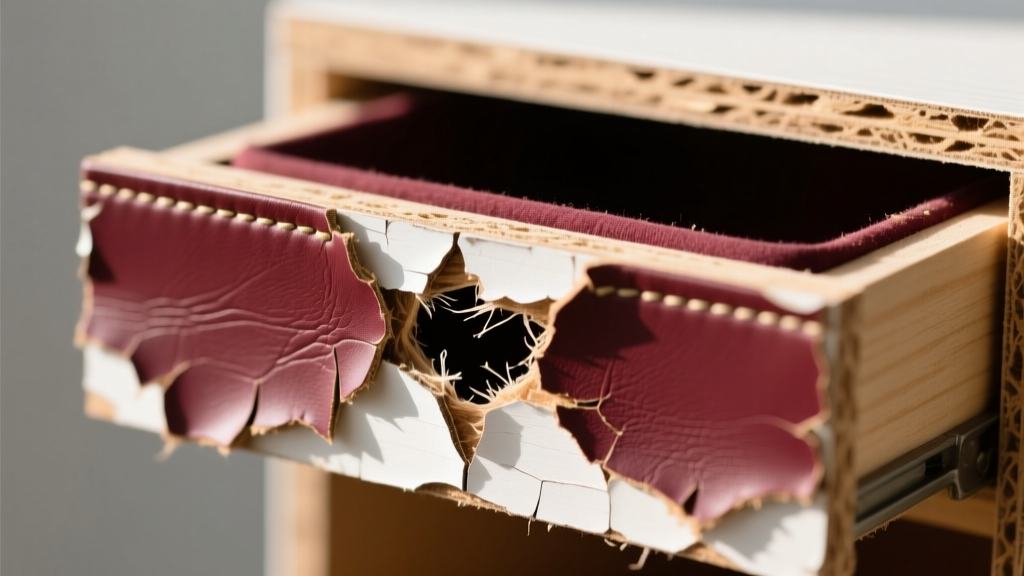
Budget boxes use standard polyester flannel. This synthetic material generates static electricity, which attracts dust and microscopic abrasive particles that scratch high-polish gold and platinum. More importantly, it offers zero chemical protection against tarnish. Premium boxes utilize treated cotton flannel (often branded as Pacific Silvercloth). This material is embedded with microscopic silver and zinc particles that act as a sacrificial anode. The embedded metals intercept and absorb hydrogen sulfide and moisture before they can reach your jewelry, effectively halting the tarnish process and saving you hours of polishing time.
Hardware and Hinges: The Mechanics of Longevity
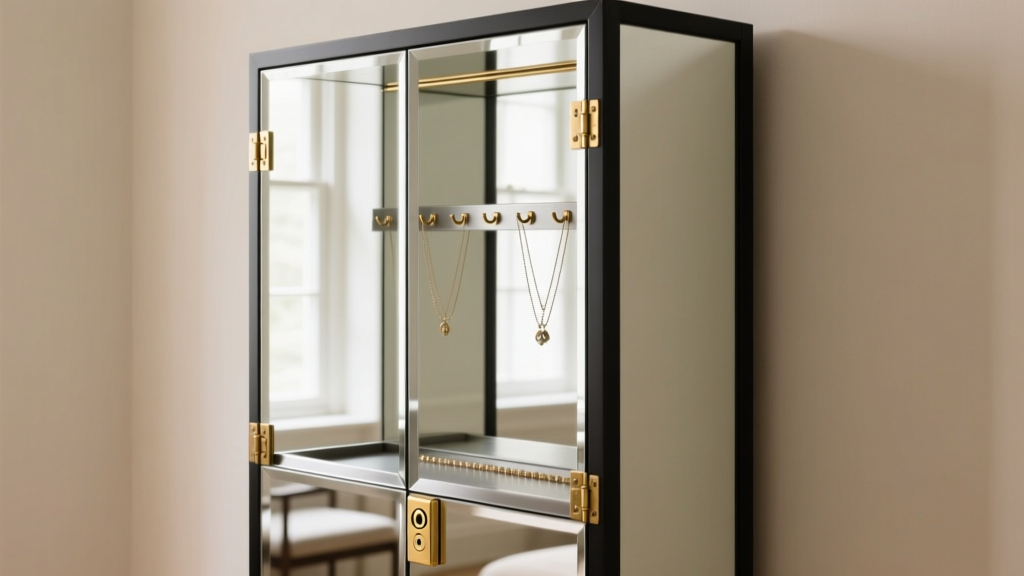
The most common failure mode for any tall jewelry box with a swing-out door or heavy drop-front drawer is hinge sag. A door that is 30 inches tall exerts significant lateral torque on the top hinge pivot point.
Budget manufacturers use 1.2mm to 1.5mm thick stamped zinc alloy hinges. Under the constant stress of a heavy, mirror-backed door, these soft metal hinges slowly yield and bend, causing the door to drag against the base of the unit. Once a stamped hinge warps, it cannot be repaired; the screw holes in the MDF strip out, rendering the door useless.
Troubleshooting Tip: If you already own a budget tall jewelry box and notice the main door sagging, remove the top hinge, fill the stripped MDF holes with wood glue and wooden toothpicks, let it cure for 24 hours, and reinstall the screws. For a permanent fix, replace the stamped hinges with 3mm thick steel butt hinges from a local hardware store.
Premium armoires solve this by using extruded brass or stainless steel hinges, often incorporating ball bearings to distribute the load evenly. Additionally, premium units utilize rare-earth neodymium magnetic catches (rated for 15+ lbs of pull force) to ensure doors seal tightly, preventing dust ingress and maintaining the anti-tarnish microclimate inside the box.
Space Efficiency & Cost-Per-Square-Inch Analysis
To truly assess value, we must look at spatial efficiency. A tall jewelry box is purchased primarily to save floor space. Below is a comparative analysis of the footprint versus usable storage volume across the three tiers, based on standard 2026 market models.
| Tier | Footprint (W x D) | Height | Approx. Volume | Avg Price | Cost per Cubic Inch |
|---|---|---|---|---|---|
| Budget MDF Tower | 12" x 8" | 36" | 3,456 cu in | $45 | $0.013 |
| Mid-Tier Bamboo Armoire | 15" x 10" | 40" | 6,000 cu in | $120 | $0.020 |
| Premium Solid Walnut | 18" x 12" | 42" | 9,072 cu in | $350 | $0.038 |
While the budget tier offers the lowest cost per cubic inch, the usable space is often compromised by poorly designed internal dividers that cannot accommodate modern, oversized statement pieces or long layered chain necklaces. Mid-tier bamboo models typically offer the best balance, providing adjustable shelving and dedicated deep drawers for chunky resin or gemstone pieces without the exorbitant cost of premium hardwoods.
Security and Dust Mitigation
An often-overlooked aspect of value assessment is security and environmental sealing. Tall jewelry boxes with large surface areas attract dust. Budget models feature significant gaps between drawers and the main frame due to poor manufacturing tolerances. This allows dust to infiltrate the drawers, embedding into the soft polyester lining and creating an abrasive environment for soft stones like opals and pearls.
Premium and high-end mid-tier boxes feature routed dust-proof lips on the drawer fronts and tight-tolerance rails. Furthermore, if your collection holds significant financial or sentimental value, the locking mechanisms matter. Budget boxes use cheap wafer locks that can be bypassed with a paperclip. Premium units integrate 3-digit or 4-digit mechanical combination locks or biometric fingerprint scanners, adding a layer of security that justifies the higher initial capital outlay.
Final Verdict: Which Tier Should You Buy?
The value of a tall jewelry box is entirely dependent on the composition of your collection and your living environment.
- Buy Budget ($35-$65) ONLY if: Your collection consists primarily of fashion jewelry, stainless steel, or heavily rhodium-plated brass that does not require anti-tarnish protection, and you live in a dry climate where MDF swelling is not a risk.
- Buy Mid-Tier ($80-$160) for: The best overall value. Engineered bamboo provides excellent structural stability for tall frames, and the inclusion of basic treated linings will adequately protect everyday sterling silver and gold-filled pieces.
- Buy Premium ($200+) for: Serious collectors with extensive sterling silver, unprotected copper, or high-value gemstone collections. The investment in solid hardwood, Pacific Silvercloth linings, and heavy-duty brass hardware will pay for itself by eliminating the need for chemical polishing and preventing premature structural failure.
Ultimately, treating jewelry storage as a long-term preservation tool rather than a mere decorative accessory shifts the value proposition heavily toward the mid and premium tiers. By prioritizing material stability and chemical protection, you ensure your collection remains as pristine as the day you acquired it.


