The Winnie The Pooh Jewelry Box: Collector's Storage Guide
Expert guide to preserving jewelry in a Winnie the Pooh jewelry box. Learn archival lining, anti-tarnish tech, and MDF off-gassing fixes.


The Intersection of Nostalgia and Archival Preservation
When collectors and enthusiasts acquire a vintage or modern Winnie the Pooh jewelry box, they are often prioritizing aesthetic nostalgia over horological and gemological preservation. Character-themed storage pieces—whether sourced from 1990s Disney Store runs or modern boutique reproductions—are rarely manufactured to archival standards. As of 2026, the secondary market for Disney nostalgia collectibles has surged, making it imperative to understand the material science behind these novelty items. Storing fine jewelry, sterling silver, or porous organic gems inside an unmodified character box can lead to catastrophic material degradation. This deep dive explores the chemical realities of novelty storage and provides a technical framework for upgrading your Winnie the Pooh jewelry box into a safe, archival-grade microclimate.
The Material Reality: MDF, Ceramics, and Acidic Flocking
To properly protect your jewelry, you must first understand the substrate of your storage vessel. Most mass-produced character boxes fall into two categories: Medium-Density Fiberboard (MDF) or glazed ceramics. Both present unique chemical threats to precious metals and gemstones.
The Threat of MDF Off-Gassing
Modern and late-90s wooden-looking novelty boxes are almost exclusively constructed from MDF. MDF is bound using urea-formaldehyde resins. Over time, especially in environments with fluctuating humidity, these resins off-gas formaldehyde and acidic volatile organic compounds (VOCs). According to guidelines outlined by the National Park Service Museum Handbook, formaldehyde gas accelerates the oxidation of sterling silver and can cause irreversible nacre degradation in pearls. If your Winnie the Pooh jewelry box has a distinct "sweet" or chemical odor when opened, it is actively off-gassing and is unsafe for unprotected silver or organic gems.
Acidic Flocking and "Velvet Tarnish"
The interior lining of these boxes is rarely genuine velvet. It is typically rayon or nylon flocking sprayed onto a cardboard backing using polyvinyl acetate (PVA) adhesives. Standard craft-grade PVA glues remain mildly acidic as they cure. When trapped in a closed micro-environment, these acidic vapors cause "velvet tarnish," a localized pitting and darkening of soft metals like gold alloys and silver. Furthermore, the dyes used in the iconic "Hundred Acre Wood" red and yellow flocking can leach into porous stones like turquoise, opal, and malachite if stored in high-humidity environments.
Archival Upgrades: Creating a Safe Microclimate
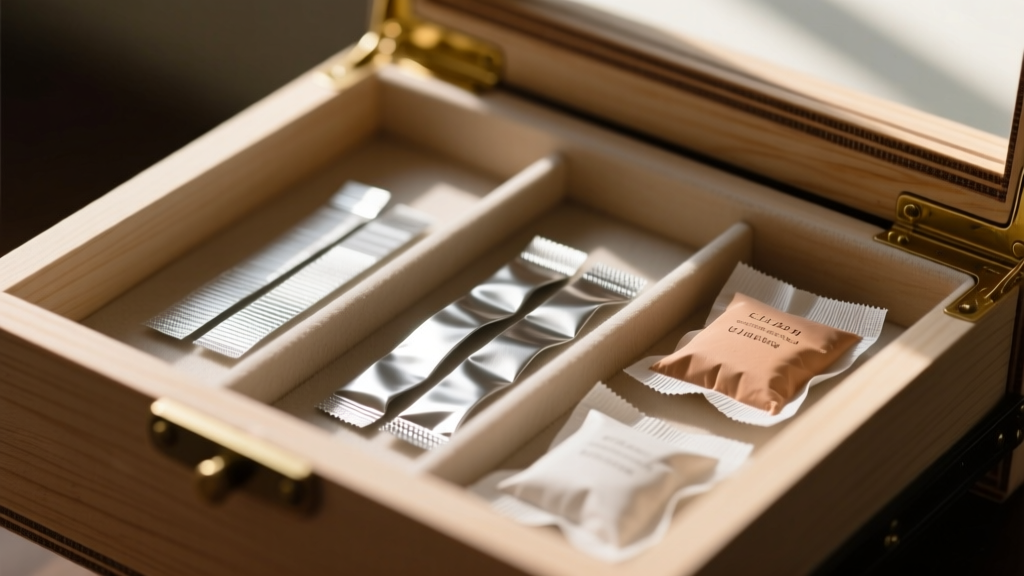
You do not need to abandon your favorite character-themed storage piece. By applying conservation-grade materials, you can isolate the jewelry from the box's harmful substrate. The American Institute for Conservation recommends a layered barrier approach for storing metals in non-archival wooden or composite enclosures.
Step 1: The Vapor Barrier
Before adding any soft lining, you must seal the MDF or ceramic base. The industry standard is Marvelseal 360, an aluminum-nylon laminate film. Cut the Marvelseal to fit the interior dimensions of the box's drawers and main compartment. Adhere it using Jade 403, an acid-free, archival-grade PVA emulsion that dries to a neutral pH. This creates an impermeable vapor barrier that completely halts formaldehyde and VOC migration from the MDF core.
Step 2: The Contact Layer
Never place jewelry directly on the Marvelseal. The top contact layer should be Pacific Silvercloth or unbleached, undyed cotton muslin. Pacific Silvercloth is embedded with microscopic silver particles that act as a sacrificial anode, intercepting hydrogen sulfide and tarnishing gases before they reach your actual jewelry. Secure this top layer using acid-free double-sided linen tape, avoiding any liquid adhesives that might compromise the cloth's anti-tarnish properties.
Environmental Controls and Desiccant Selection
Even with a vapor barrier, the ambient air trapped inside the Winnie the Pooh jewelry box when closed will contain moisture. Controlling Relative Humidity (RH) is critical. Sterling silver requires an RH of 40-45%, while organic gems (like amber or ivory) require 50-55% to prevent cracking. To achieve this, you must select the correct desiccant.
| Desiccant Type | Optimal RH Target | Best Use Case | Reactivation Method |
|---|---|---|---|
| Silica Gel (Indicating) | 30% - 40% | Sterling silver, copper alloys | Bake at 250°F (120°C) |
| Montmorillonite Clay | 45% - 55% | Mixed storage, organic gems, pearls | Bake at 175°F (80°C) |
| Activated Carbon | N/A (Gas Adsorption) | Neutralizing residual VOCs and odors | Replace every 6 months |
For a mixed-jewelry Winnie the Pooh box, Montmorillonite clay packets are the safest choice. Unlike silica gel, which can over-dry the microclimate and crack pearl nacre or opal matrices, clay buffers the humidity gently and will not release its absorbed moisture back into the box unless temperatures exceed 120°F.
Step-by-Step Restoration Protocol for Vintage Finds
If you have acquired a vintage 1980s or 1990s Winnie the Pooh jewelry box from an estate sale or secondary market, the original flocking is likely degrading, shedding fibers, and harboring acidic residue. Restoring the interior requires careful solvent selection to avoid damaging the exterior glaze or painted details.
- Mechanical Removal: Use a dull plastic spudger to gently scrape away the bulk of the deteriorating velvet flocking and cardboard backing.
- Adhesive Dissolution: Avoid acetone or MEK, which will strip the exterior paint and ceramic glazes. Instead, apply D-Limonene (a citrus-based solvent) to a cotton swab to dissolve the residual PVA glue. D-Limonene is highly effective on craft adhesives and leaves no toxic residue.
- Surface Neutralization: Wipe the bare MDF or ceramic interior with a slightly damp cloth containing a 1% solution of calcium hydroxide to neutralize any lingering acidic compounds.
- Re-Lining: Once fully dry (allow 48 hours), apply the Marvelseal 360 and Pacific Silvercloth layers as detailed in the archival upgrades section.
Sourcing and Valuation: Vintage vs. Modern Reproductions
Understanding the provenance of your box aids in determining how aggressively you need to modify it. Vintage ceramic pieces from the Bradford Exchange or 1990s Disney Store commands premium prices ($65 to $150+ on the secondary market as of 2026) due to their heavy, durable construction. However, their heavy hinged lids often feature lead-soldered hinges. Modern reproductions (typically $20 to $45 from retailers like BoxLunch or Primark) are almost entirely MDF and PU-leather. While less valuable as collectibles, their lightweight nature makes them ideal candidates for complete internal gutting and archival retrofitting. Regardless of the era or value, applying these technical storage principles ensures that the magic of the Hundred Acre Wood doesn't come at the expense of your fine jewelry collection.


