Birthstone Jewelry for Men: Technical Guide to Masculine Gemstones
Discover technical specs for birthstone jewelry for men. Learn about Mohs hardness, durable metal alloys, bezel settings, and masculine gem cuts.


The Engineering of Men's Birthstone Rings
As we navigate the 2026 landscape of men's fine jewelry, the demand for birthstone jewelry for men has evolved far beyond simple pendants or delicate bands. Today, selecting a masculine birthstone piece requires a rigorous understanding of structural engineering, metallurgical science, and gemological durability. Men typically subject their rings and bracelets to higher mechanical stress, impact, and environmental exposure than women. Therefore, choosing the right birthstone jewelry for men is not merely an exercise in color matching; it is a critical evaluation of material hardness, tensile strength, and setting mechanics. This technical deep dive explores the precise specifications required to craft men's birthstone jewelry that survives a lifetime of daily wear.
Metallurgical Foundations: Choosing the Right Alloy
The structural integrity of any men's ring begins with its metal alloy. When housing a birthstone, the metal must possess adequate hardness to protect the gem while maintaining enough malleability to be resized or repaired if necessary.
Tungsten Carbide vs. Grade 5 Titanium
Tungsten carbide is frequently marketed for men's rings due to its exceptional scratch resistance, registering between 8 and 9 on the Mohs scale and boasting a Vickers hardness of approximately 1500 HV. However, its high hardness comes at the cost of fracture toughness. Tungsten is inherently brittle; a sharp impact against a hard surface like concrete or steel can cause a tungsten band to shatter. Furthermore, tungsten cannot be resized, making it a risky choice for an heirloom-quality birthstone ring.
Conversely, aerospace-grade Grade 5 Titanium (Ti-6Al-4V) offers an outstanding strength-to-weight ratio. While it is softer than tungsten (around 350 HV), its tensile strength is immense, and it will bend rather than shatter under extreme force. For active men, a Grade 5 titanium band with a bezel-set birthstone provides superior impact resistance, though it requires specialized laser welding equipment for any future resizing.
The Case for 14k Palladium White Gold
For traditionalists, 14k gold remains the gold standard for gemstone settings. Pure 24k gold is far too soft (approx. 25 HV) to securely hold a birthstone. By alloying 58.5% pure gold with copper, zinc, and specifically palladium, jewelers create 14k white gold that achieves a Vickers hardness of roughly 150-170 HV. This specific alloy provides the necessary prong tension to grip a gemstone securely while allowing for traditional bench-jeweler repairs and resizing.
Gemstone Durability: Beyond the Mohs Scale
When evaluating birthstones for men's rings, relying solely on the Mohs scale of mineral hardness is a critical error. The Mohs scale is ordinal and logarithmic, meaning the jump in absolute hardness between a 9 (Sapphire) and a 10 (Diamond) is exponentially larger than the jump between a 2 (Gypsum) and a 3 (Calcite). More importantly, hardness only measures resistance to scratching, not resistance to breaking.
Understanding Cleavage Planes and Toughness
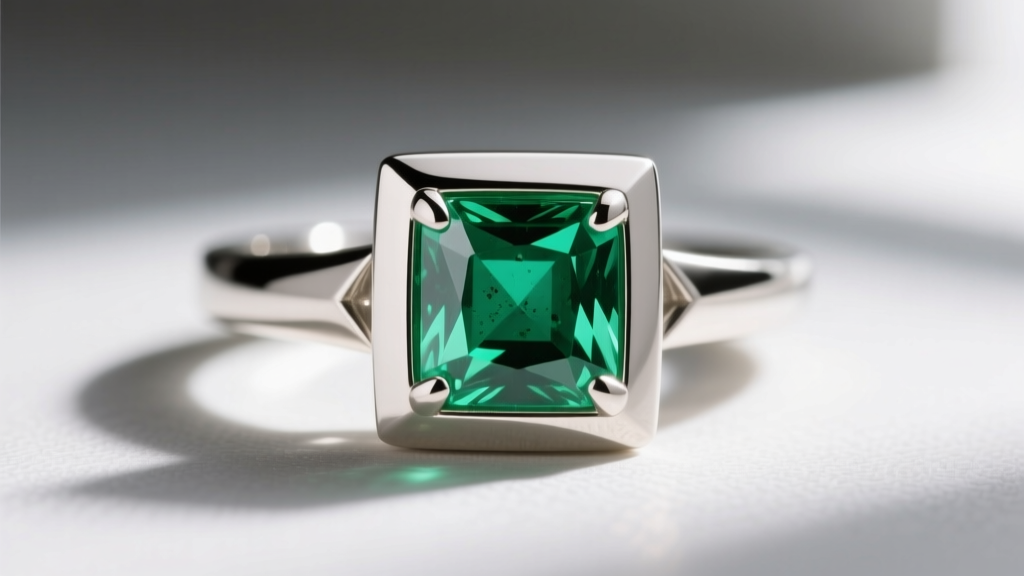
Toughness refers to a gem's ability to resist chipping and fracturing from blunt impact. This is heavily dictated by atomic cleavage planes—directions within the crystal lattice where atomic bonds are weakest. For example, while a Diamond is a 10 on the Mohs scale, it has perfect cleavage in four directions. A hard strike at the wrong angle can split a diamond. Topaz (Mohs 8) has perfect basal cleavage, making it highly susceptible to chipping if struck on its girdle. According to the Gemological Institute of America (GIA), stones like Jadeite and Nephrite possess exceptional toughness due to their interlocking fibrous crystal structures, despite having lower Mohs hardness (6.5 to 7), making them phenomenal choices for men's signet rings.
Technical Data: Birthstone Mechanics for Men
| Month | Primary Birthstone | Mohs Hardness | Cleavage / Fracture | Recommended Men's Setting |
|---|---|---|---|---|
| January | Garnet (Almandine) | 7 - 7.5 | None / Conchoidal | Bezel or Flush |
| April | Diamond | 10 | Perfect (4 directions) | Thick 6-Prong or Bezel |
| May | Emerald | 7.5 - 8 | Distinct Basal | Full Bezel (Chamfered Cut) |
| September | Sapphire | 9 | None / Conchoidal | Tension, Prong, or Flush |
| October | Opal | 5.5 - 6.5 | None / Conchoidal | Bezel with Epoxy Backing |
For months with softer or highly included stones like October's Opal or May's Emerald, men should opt for cabochon cuts or emerald cuts with heavily chamfered corners to eliminate vulnerable sharp points. The American Gem Society emphasizes that protective settings are non-negotiable for stones below an 8 on the Mohs scale when intended for daily male wear.
Optimal Cuts and Setting Mechanics
The way a birthstone is cut and secured dictates its survival in a men's ring. Traditional high-profile prong settings, while excellent for maximizing light return in women's engagement rings, are structural liabilities for men. Prongs easily catch on heavy fabrics, tool handles, and gym equipment, eventually pulling away from the gem's girdle.
The Superiority of Flush and Bezel Settings
- Flush (Gypsy) Setting: The stone is set directly into a drilled cavity within the metal band, leaving the table of the gem perfectly flush with the outer surface of the ring. This eliminates any protruding edges, offering maximum protection against lateral impacts. It requires a gemstone with excellent hardness, ideally 9 or above, as the setting process involves pressing metal directly over the girdle.
- Full Bezel Setting: A continuous rim of metal is burnished over the entire perimeter of the gemstone. This protects the vulnerable girdle and prevents dirt accumulation. For a masculine aesthetic, a brushed or matte-finished bezel provides a striking industrial contrast to a highly polished gemstone.
Alternative Inlay Techniques
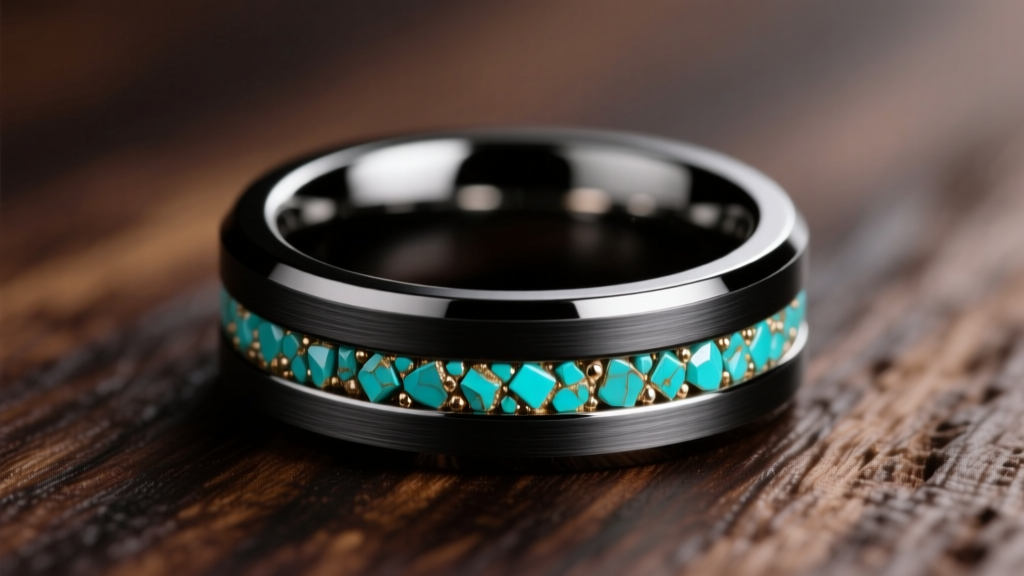
For softer birthstones like Turquoise (Mohs 5-6) or Malachite (Mohs 3.5-4), faceting is rarely viable for men's rings. Instead, jewelers utilize channel inlays or crushed stone composites bound by optical-grade epoxy resins. This technique stabilizes the porous stone, preventing moisture absorption and chemical degradation from sweat or oils, while maintaining a sleek, flush profile.
Ergonomics and Sizing Tolerances
The physical dimensions of men's birthstone jewelry must account for male physiology. Men's fingers typically have larger knuckles relative to the base of the finger, and they are more prone to fluctuation in volume due to temperature changes, sodium intake, and physical exertion.
Expert Sizing Rule: Always size a men's signet or birthstone ring to fit snugly over the knuckle, but utilize a 'comfort fit' interior profile. A comfort fit band features a domed interior (usually a 2mm to 3mm rise) that reduces the surface area contacting the skin, allowing air circulation and preventing the ring from sticking to damp skin.
Furthermore, the width of a men's band directly impacts the perceived size of the birthstone. A standard men's ring width ranges from 6mm to 8mm. If the band is 8mm wide, a 4mm birthstone will appear proportionally balanced. Placing a delicate 2mm stone in an 8mm band will make the gem look like an afterthought and structurally compromise the metal's integrity at the setting point.
Conclusion: Balancing Aesthetics with Structural Integrity
Designing and selecting birthstone jewelry for men is an exercise in applied physics and material science. By prioritizing high-tensile alloys like Grade 5 Titanium or 14k Palladium White Gold, respecting the cleavage planes of the chosen gemstone, and utilizing low-profile bezel or flush settings, you ensure the piece survives the rigors of daily life. True masculine elegance in jewelry is found not just in the visual weight of the piece, but in its engineered resilience.


