Expert Guide to Cleaning Copper Jewelry: Tarnish, Patina & Verdigris
Master the chemistry of cleaning copper jewelry. Learn expert techniques to remove verdigris, restore shine, and preserve intentional patinas safely.

The Metallurgy of Copper Tarnish vs. Patina
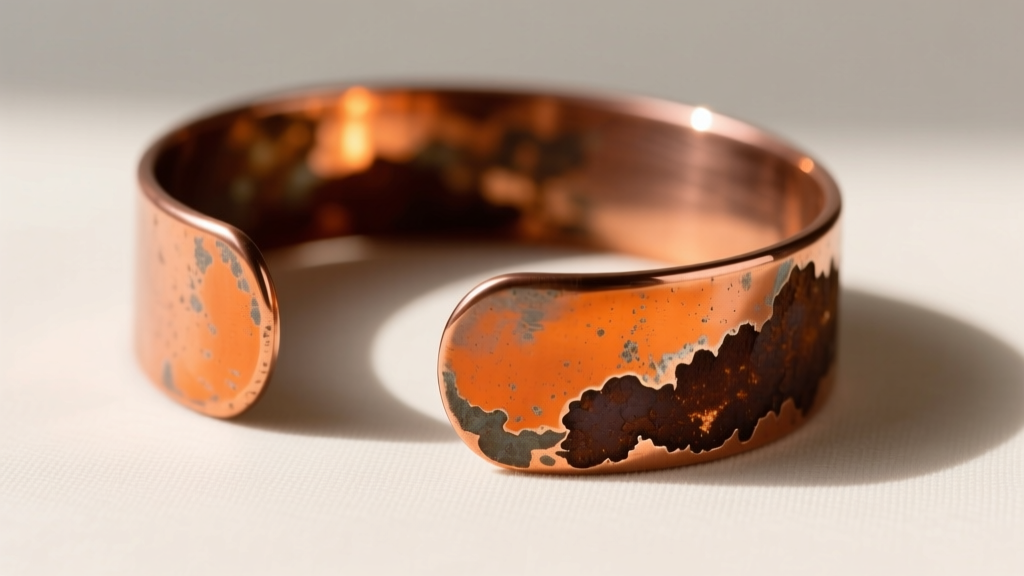
When discussing the maintenance of non-ferrous metals, it is critical to distinguish between destructive corrosion and intentional aesthetic aging. Cleaning copper jewelry requires a foundational understanding of its surface chemistry. Pure copper (Cu) is highly reactive to oxygen, sulfur, and halogens present in the atmosphere and human skin oils. The resulting surface layers dictate your cleaning approach.
The initial oxidation layer is typically cuprite (Cu2O), which presents as a warm, reddish-brown film. Many artisans and collectors prize this layer as a 'natural patina' and will actively avoid stripping it. However, prolonged exposure to moisture, chlorides, and carbon dioxide leads to the formation of tenorite (CuO), a dull black oxide, and eventually malachite or azurite compounds (basic copper carbonates), which manifest as the chalky green or blue crust known as verdigris. According to the Getty Conservation Institute, while cuprite is relatively stable and protective, verdigris is hygroscopic and can cause active, cyclical corrosion known as bronze disease if left untreated on copper alloys.
Diagnostic Framework: Identify Your Copper Condition
Before selecting a chemical or mechanical intervention, diagnose the current state of the metal. Applying an aggressive acid to a piece with a desirable cuprite patina will ruin hours of intentional antiquing. Use the following diagnostic matrix to determine your protocol:
| Visual Indicator | Chemical State | Structural Threat | Recommended Action |
|---|---|---|---|
| Warm reddish-brown hue | Cuprite (Cu2O) | None (Stable) | Gentle wiping with microfiber; apply microcrystalline wax. |
| Dull, matte black film | Tenorite (CuO) / Sulfides | Low (Surface level) | Mild acid-salt matrix or electrochemical reduction. |
| Chalky green/blue crust | Verdigris (Copper Carbonates/Chlorides) | High (Active pitting) | Mechanical removal followed by localized chemical neutralization. |
| Sticky, waxy residue | Oxidized skin oils & sebum | Low (Traps moisture) | Warm water bath with mild non-ionic surfactant (e.g., Orvus WA Paste). |
The Chemistry of Cleaning Copper Jewelry: Proven Methods
The phrase 'cleaning copper jewelry' encompasses a wide array of chemical reactions. As a domain expert, I advise against commercial 'dips' that rely on harsh thiourea compounds, which can leave microscopic crystalline residues that accelerate future tarnishing. Instead, rely on these controlled, chemistry-backed methods.
The Acid-Salt Matrix (Lemon Juice + Sodium Chloride)
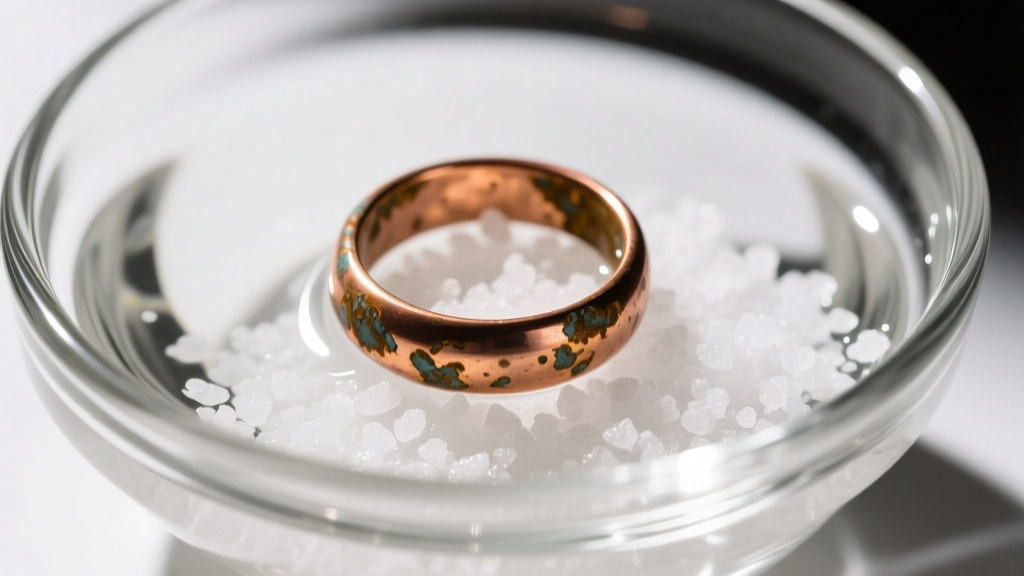
This is the most accessible and highly effective method for stripping tenorite (black tarnish) down to bare, bright metal. The citric or acetic acid alone is too weak to dissolve copper oxide rapidly. However, the introduction of chloride ions (from NaCl / table salt) creates a synergistic effect. The chloride ions complex with the copper ions, pulling them into the solution, while the hydrogen ions from the acid attack the oxygen bonds.
- Ratio: 2 tablespoons of white vinegar or lemon juice to 1 teaspoon of fine non-iodized salt.
- Application: Submerge the piece for no more than 3 to 5 minutes. Agitate gently with a soft-bristled bamboo brush.
- Neutralization: Immediately rinse in distilled water and neutralize any residual acid with a brief bath in water mixed with a pinch of baking soda.
Chelation and Mild Acids (The Ketchup Method)
While it sounds like an old wives tale, ketchup is a highly effective, viscous chelating agent. It contains acetic acid (vinegar), citric acid (tomatoes), and sodium chloride. The viscosity of the tomato paste allows the solution to cling to vertical surfaces and intricate filigree work without dripping off, providing a localized, slow-release chemical cleaning action. Apply a thick layer, let it sit for 10 minutes, and rinse thoroughly. This is ideal for heavily textured cast copper pieces where liquid submersion might pool and cause uneven stripping.
Electrochemical Reduction (Advanced)
For severe sulfide tarnish on solid copper pieces without gemstones, electrochemical reduction is the safest method because it converts the tarnish back into metallic copper rather than dissolving the metal away. Line a glass beaker with aluminum foil (shiny side up). Place the copper jewelry so it touches the foil. Add a tablespoon of sodium bicarbonate (baking soda) and pour in boiling water. The aluminum acts as a sacrificial anode, and the heat accelerates the galvanic cell reaction. You will smell sulfur (rotten eggs) as the silver or copper sulfides are reduced. According to Corrosion Doctors, this electron transfer safely restores the metal lattice without abrasive loss.
What NOT to Do: Ultrasonic and Abrasive Failures
Copper is a remarkably soft metal, ranking at just 2.5 to 3.0 on the Mohs hardness scale. This physical vulnerability dictates strict limitations on mechanical cleaning.
Never use commercial baking soda pastes or toothpaste on polished copper. The angular silica and calcium carbonate abrasives found in these household items will inflict micro-scratches, permanently clouding the mirror finish and creating microscopic grooves that trap future moisture and accelerate tarnishing.
Furthermore, exercise extreme caution with ultrasonic cleaners. While ultrasonic cavitation (operating at 20-40 kHz) is excellent for dislodging dirt from diamond settings, the imploding microscopic bubbles can cause pitting on soft, annealed copper. If you must use an ultrasonic tank to remove polishing compound from the crevices of a newly fabricated copper ring, limit the cycle to under 60 seconds and use a heated, non-ammoniated alkaline solution.
Post-Cleaning Stabilization: Sealing and Waxing
The moment you strip copper down to its bare, bright state, it begins re-oxidizing. The humidity in the air and the oils on your fingers will initiate the cuprite layer within minutes. To halt this, you must apply a barrier coating. The Smithsonian Museum Conservation Institute frequently recommends specific microcrystalline waxes and acrylic resins for long-term metal stabilization.
Renaissance Wax
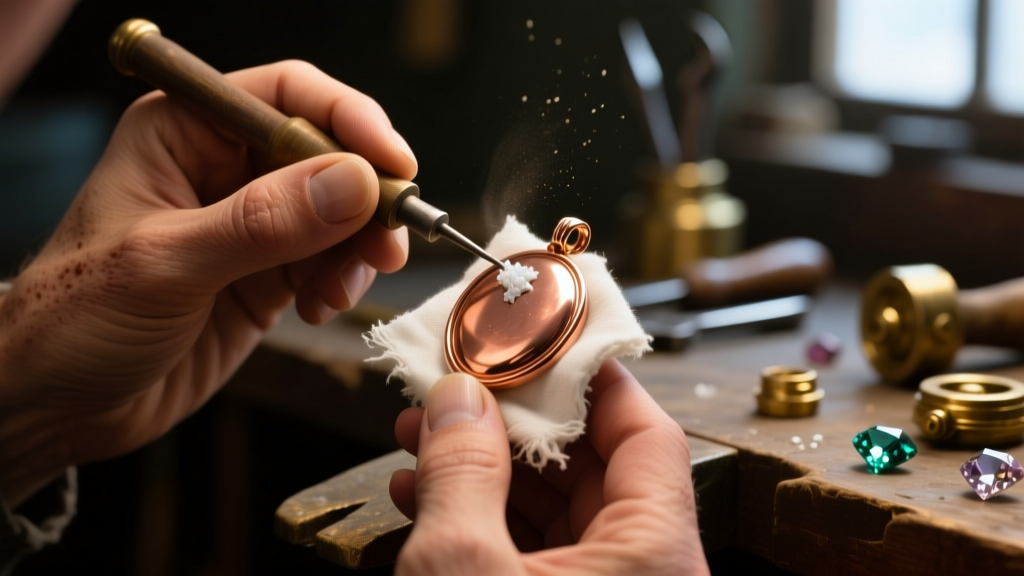
Originally developed by the British Museum, Renaissance Wax is a microcrystalline petroleum-based wax. Unlike beeswax or carnauba, it will not bloom, turn white, or become acidic over time. Apply a microscopic amount with a lint-free cotton cloth, allow it to haze for 15 minutes, and buff vigorously. This provides a 6-to-12-month barrier against skin acids and atmospheric sulfur.
Paraloid B-72 (For Permanent Sealing)
For copper jewelry that will be worn daily in high-humidity environments, wax is insufficient. Conservators use Paraloid B-72, an ethyl methacrylate copolymer. Dissolved in pure acetone at a 5% to 10% weight-to-volume ratio, it can be brushed onto the copper. The acetone flashes off in seconds, leaving a perfectly clear, non-yellowing, reversible acrylic barrier that permanently halts oxidation and prevents the copper from turning the wearer's skin green.
Summary Checklist for the Bench
- Diagnose: Identify if the layer is stable patina (keep) or active verdigris (remove).
- Strip: Use an acid-salt matrix for brightening, or electrochemical reduction for safe sulfide removal.
- Neutralize: Always follow acid baths with a distilled water rinse and a mild alkaline neutralizer.
- Protect: Seal immediately with Renaissance Wax for occasional wear, or Paraloid B-72 for daily-wear pieces.
By respecting the metallurgical properties of copper and utilizing targeted chemical interventions rather than brute-force abrasion, you ensure the longevity, structural integrity, and aesthetic brilliance of your copper jewelry collection.


