How to Authenticate and Buy Genuine Alexandrite Jewelry
Learn how to authenticate genuine alexandrite jewelry with our step-by-step guide. Spot synthetics, check color change, and buy with confidence.

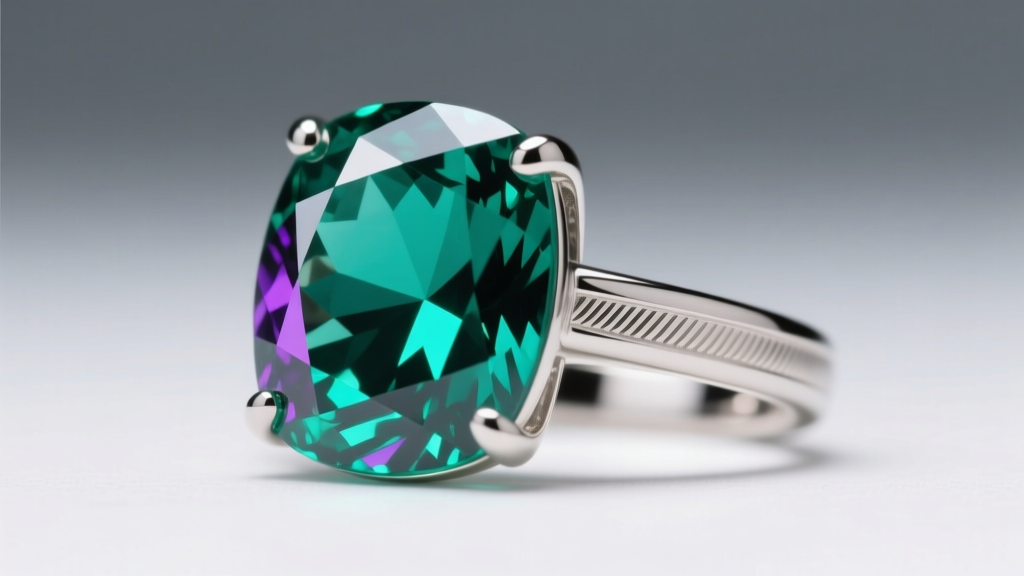
The Ultimate Guide to Authenticating Alexandrite Jewelry
Alexandrite is widely considered the holy grail of colored gemstones. Famous for its dramatic chameleon-like color shift—often described as "emerald by day, ruby by night"—this rare variety of chrysoberyl commands some of the highest per-carat prices in the gemological market. However, its legendary status and steep price tag have made alexandrite jewelry a prime target for synthetics, simulants, and deceptive marketing.
Whether you are hunting for a vintage Russian specimen or a modern Brazilian stone, buying blind is a financial risk you cannot afford. In this comprehensive guide, we break down the exact gemological steps, light-source tests, and inclusion markers you need to confidently authenticate and purchase genuine alexandrite jewelry.
The Science Behind the Color Shift
Before you can authenticate a stone, you must understand why it changes color. Natural alexandrite is a beryllium aluminum oxide (BeAl2O4). Its unique optical property stems from trace amounts of chromium replacing aluminum in its crystal lattice.
This chromium creates a narrow absorption band in the yellow-green region of the visible light spectrum. When exposed to daylight (which is rich in blue and green wavelengths), the stone transmits green light. When exposed to incandescent light (which is rich in red wavelengths), the stone transmits red light. According to the Gemological Institute of America (GIA), a genuine stone must exhibit a noticeable color change; stones with less than a 50% shift are generally not classified as true alexandrite by top-tier labs.
Step 1: Perform the Dual-Light Source Test
The most fundamental step in evaluating alexandrite jewelry is testing the color shift under controlled lighting. Do not rely on standard jewelry store spotlights, as they often use mixed-temperature LEDs that muddy the color transition.
- Daylight Equivalent (D65): Use a 5000K to 6500K LED light source or take the stone outside in diffused, natural sunlight. The stone should display a bluish-green, teal, or grassy green hue.
- Incandescent Equivalent (A-Light): Use a traditional 2700K incandescent bulb or a warm halogen lamp. The stone should shift to a purplish-red, raspberry, or deep crimson hue.
Pro Tip: Beware of stones that shift from a pale, washed-out yellow-green to a muddy brownish-red. While technically exhibiting pleochroism, these low-grade stones lack the vivid saturation required for high-value alexandrite jewelry.
Step 2: Examine Inclusions Under 10x Magnification
Because natural alexandrite forms in complex pegmatite and metamorphic environments, it almost always contains microscopic birthmarks. Using a 10x triplet loupe is non-negotiable when evaluating high-ticket gems.
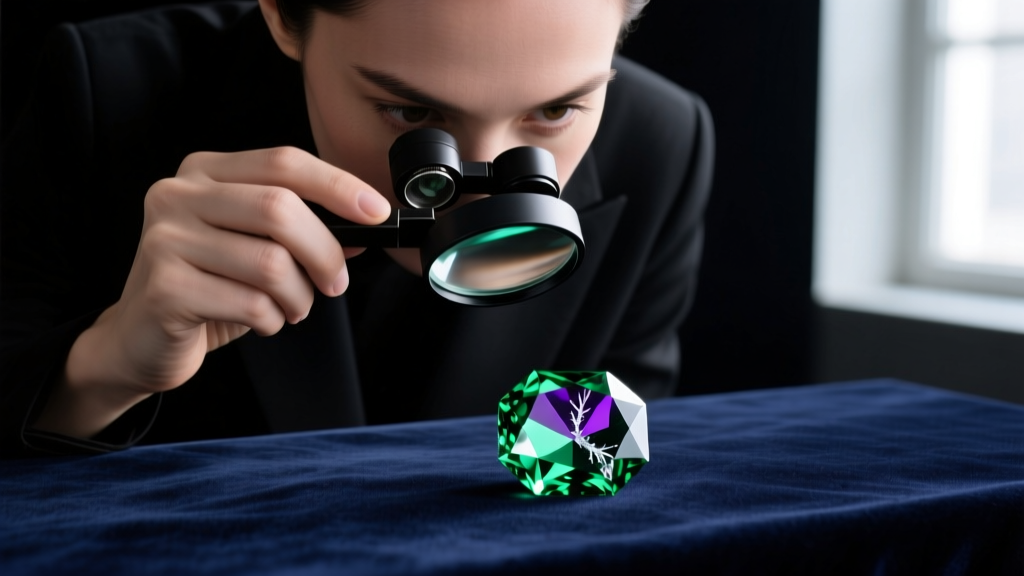
What to Look For in Natural Stones
Natural alexandrite typically features liquid-filled healing fractures, negative crystals, and fine silk (rutile needles). Brazilian stones from the Hematita valley often contain distinctive biotite mica inclusions, while Indian stones may show prominent twinning planes. If the stone is completely flawless under 10x magnification, your suspicion of a synthetic origin should immediately spike.
Identifying Synthetic Tell-Tale Signs
Lab-grown alexandrite is chemically identical to natural stone but forms in sterile environments. If you spot platinum flakes or metallic platelets, you are likely looking at a flux-grown synthetic (where platinum crucibles are used). If you see curved growth striae (curved lines resembling the grooves of a vinyl record), the stone was likely created using the Czochralski pull method.
Step 3: Differentiate Synthetics from Simulants
It is crucial to understand the difference between a synthetic and a simulant. A synthetic alexandrite is lab-created chrysoberyl with the same chemical composition as the natural stone. A simulant is an entirely different material engineered to mimic the color-change effect. The most common simulant is vanadium-doped synthetic corundum (sapphire).
Comparative Matrix: Natural vs. Synthetic vs. Simulant
| Property | Natural Alexandrite | Lab-Grown (Flux/Czochralski) | Simulant (Color-Change Sapphire) |
|---|---|---|---|
| Chemical Composition | BeAl2O4 (Chrysoberyl) | BeAl2O4 (Chrysoberyl) | Al2O3 (Corundum) |
| Refractive Index (RI) | 1.746 - 1.755 | 1.746 - 1.755 | 1.762 - 1.770 |
| Specific Gravity (SG) | 3.73 | 3.73 | 4.00 |
| Typical Inclusions | Silk, liquid feathers, biotite | Platinum flakes, curved striae | Gas bubbles, curved color bands |
| Color Shift Quality | Teal-Green to Purplish-Red | Blue-Green to Violet-Red | Grayish-Blue to Purplish-Red |
For a definitive breakdown of chrysoberyl crystallography and optical properties, gemologists frequently reference the Mindat mineral database, which provides exhaustive data on natural formation environments versus laboratory synthesis markers.
Navigating the Alexandrite Pricing Market
Pricing genuine alexandrite jewelry requires an understanding of the "Four Cs," with color change percentage and origin acting as the ultimate multipliers. As of 2026, the market for top-tier natural stones remains incredibly tight, driven by dwindling supplies from the Ural Mountains and high demand from Asian collectors.
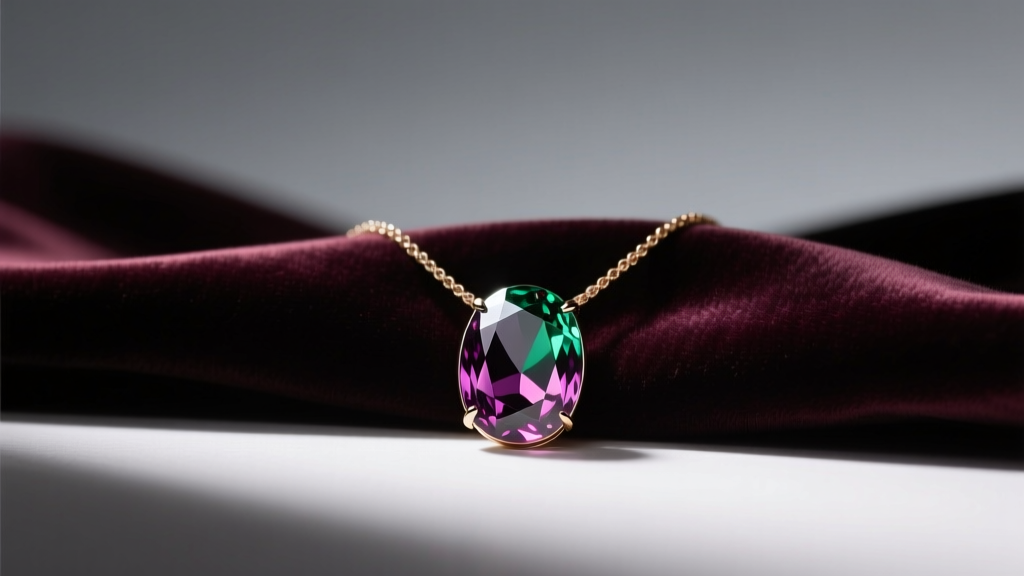
Price Per Carat Estimates (Natural, Untreated)
- Commercial Grade (Under 1 Carat, 50% Shift): $3,000 – $8,000 per carat. Often heavily included or lacking vivid saturation.
- Fine Grade (1 to 2 Carats, 80%+ Shift): $15,000 – $35,000 per carat. Clean to the eye, strong teal-to-raspberry transition.
- Investment Grade (Over 3 Carats, 95%+ Shift, Russian/Brazilian Origin): $50,000 – $100,000+ per carat. Museum-quality pieces that rarely appear on the open market.
Conversely, high-quality flux-grown synthetic alexandrite jewelry typically retails between $300 and $600 per carat, while vanadium-doped corundum simulants are mass-produced for $5 to $25 per carat. If a vendor offers a "natural" 2-carat, eye-clean stone with a 100% color shift for $4,000, you are undoubtedly looking at a simulant or a synthetic.
The Final Verification Checklist
Before wiring funds or signing a receipt for alexandrite jewelry, ensure the seller can provide the following documentation and assurances:
- Independent Lab Report: Demand a report from a top-tier laboratory such as GIA, AGL (American Gemological Laboratories), or Gübelin. The report must explicitly state "Natural Alexandrite" and specify any treatments (though high-quality natural alexandrite is almost never heated or oiled).
- Origin Disclosure: While origin doesn't change the chemical makeup, Russian (Ural) and Brazilian (Hematita) origins carry massive historical and financial premiums. Ensure the lab report corroborates the seller's origin claims via trace element analysis.
- Return Policy: Only purchase with a minimum 14-day, no-questions-asked return window. This allows you to take the piece to an independent local gemologist for a secondary loupe inspection and spectrometer test.
Authenticating alexandrite requires patience, a critical eye, and a refusal to compromise on gemological data. By mastering the light-source tests and understanding inclusion markers, you can safely navigate the market and secure a genuine, heirloom-quality piece of alexandrite jewelry that will hold its value and beauty for generations.


