Malachite Stone Jewelry: 2026 Trend & Style Analysis
Discover 2026 malachite stone jewelry trends. Explore styling tips, pricing tiers, and the shift from boho to architectural luxury settings.

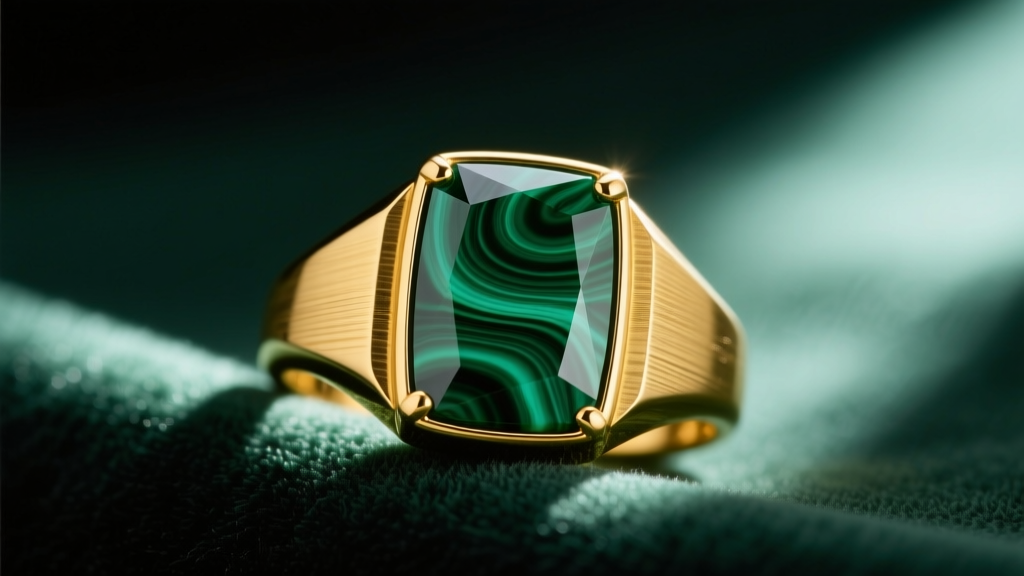
The landscape of colored gemstones is constantly evolving, but few minerals have experienced a cultural and stylistic renaissance quite like malachite. Once relegated to the realm of bohemian festival wear and souvenir shop trinkets, malachite stone jewelry has firmly cemented its place in the upper echelons of contemporary luxury. As we navigate the 2026 jewelry market, the deep, banded green copper carbonate is being reimagined through an architectural, high-fashion lens.
This comprehensive trend analysis breaks down the current lapidary preferences, metal pairings, and authenticity markers that define the modern malachite market, offering actionable insights for collectors, stylists, and everyday enthusiasts.
The 2026 Shift: From Boho Staple to Architectural Luxury
For the better part of the 2010s, malachite was synonymous with organic, free-form slab pendants and wire-wrapped rings. The 2026 aesthetic, however, is defined by structured contrast. High jewelers and indie designers alike are moving away from raw, unpolished edges in favor of precise, Art Deco-inspired geometry.
We are seeing a surge in emerald-cut, hexagonal, and custom-shaped baguette cabochons. The natural, chaotic banding of the stone is now being contained within heavy, brutalist gold bezels. This juxtaposition—the wild, organic interior of the stone trapped within a rigid, mathematical metal framework—is the defining hallmark of this year's malachite stone jewelry trends. It speaks to a broader consumer desire for grounding and structure in an increasingly digital world.
Cut, Polish, and Lapidary Trends
The way a lapidary approaches malachite drastically alters its market value and stylistic application. Because malachite is relatively soft and opaque, faceting is impossible; instead, the art lies in the cabochon cut and surface polishing. Below is a breakdown of the dominant lapidary styles in the current market.
| Lapidary Style | Visual Profile | 2026 Trend Status | Average Price Premium |
|---|---|---|---|
| High-Dome Cabochon | Classic rounded top, deep color saturation, chatoyant-like light play on the polish. | Steady (Traditional Luxury) | Base Market Rate |
| Flat-Table Geometric | Hexagonal or emerald-cut with a completely flat top and sharp, polished bevels. | Surging (Architectural Trend) | +30% to +50% |
| Carved Intaglio/Floral | Three-dimensional carvings, often mimicking vintage Van Cleef & Arpels motifs. | Declining (Oversaturated) | -15% (Unless Vintage) |
| Raw/Geode Edge | Polished center with rough, unpolished, velvety botryoidal crust edges. | Niche (Collector/Indie) | +20% (For high contrast) |
The flat-table geometric cut is currently dominating high-end editorials. By flattening the top of the cabochon, designers allow the concentric banding to read more like abstract topography, making it ideal for minimalist, heavy-gold signet rings and structured cuff bracelets.
The Metal Matrix: Why Heavy Yellow Gold Dominates
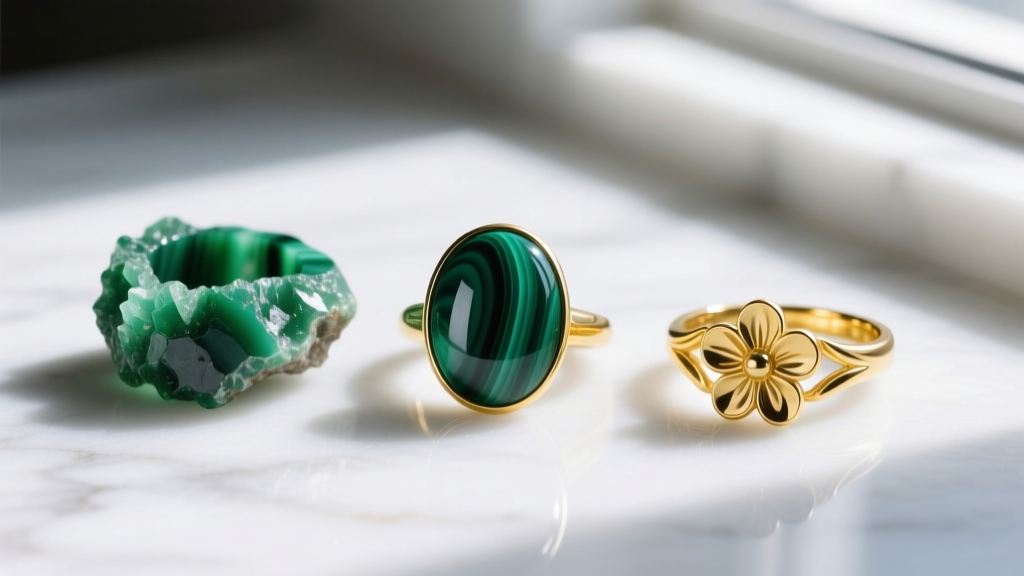
If there is one universal truth in 2026 gemstone styling, it is that malachite demands the warmth of yellow gold. The cool, oxidized tones of sterling silver or the starkness of white gold tend to flatten the stone's vibrant copper-green hues, creating a visually muddy contrast.
Karat Weight and Plating Standards
- 18k Solid Gold: The undisputed king of high-end malachite settings. The rich, buttery yellow of 18k gold perfectly complements the deepest forest-green bands of top-tier Congolese malachite.
- 14k Solid Gold: Offers a slightly paler yellow, which pairs beautifully with lighter, mint-green banded malachite, often sourced from the Ural Mountains.
- Gold Vermeil: For accessible luxury, vermeil is acceptable, but consumers must demand a minimum of 2.5 microns of 18k gold plating over a sterling silver base. Anything less will wear through to the silver within months, ruining the aesthetic harmony with the green stone.
Rose gold remains a controversial pairing. While some avant-garde designers use it to highlight the subtle red/copper undertones in certain malachite specimens, it is generally avoided in mainstream luxury due to its tendency to clash with the stone's primary green spectrum.
Navigating Authenticity: Natural vs. Reconstituted
As the demand for premium malachite stone jewelry has skyrocketed, so has the proliferation of synthetic and reconstituted alternatives. Understanding the difference is critical for any serious buyer.
The 'Block Malachite' Deception
According to the Gemological Institute of America (GIA), true malachite is a copper carbonate hydroxide mineral. However, the market is flooded with 'block malachite'—a composite material made from pulverized, low-grade malachite dust mixed with epoxy resins and synthetic dyes, then pressed into blocks.
How to identify reconstituted malachite:
- The Banding Test: Natural malachite features sharp, erratic, and highly contrasting concentric bands. Block malachite often has blurry, uniform, or 'swirly' bands that look artificially painted.
- The Weight Factor: Natural malachite is exceptionally dense, with a specific gravity of 3.6 to 4.0. Resin-bound block malachite feels noticeably lighter and 'plasticky' in the hand.
- The Hot Needle Test (Destructive): A red-hot needle touched to an inconspicuous area of natural malachite will do nothing. If it melts, smells of burning plastic, or leaves a mark, it is resin-bound.
For investment-grade jewelry, always request a certificate of origin or purchase from lapidaries who guarantee untreated, natural cabochons.
Durability and the Mohs 3.5 Reality Check
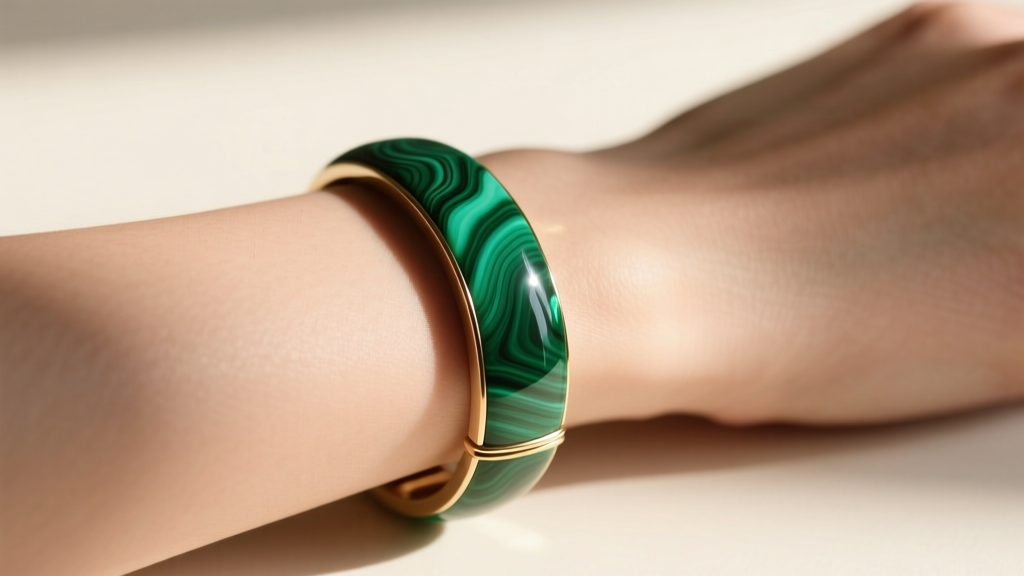
Styling malachite requires an understanding of its physical limitations. Registering at a mere 3.5 to 4.0 on the Mohs hardness scale, malachite is significantly softer than quartz (7.0) or topaz (8.0). It is easily scratched by everyday dust, which contains microscopic quartz particles.
Non-Negotiable Care Protocols
- No Ultrasonic Cleaners: The high-frequency vibrations can cause internal fractures, especially in stones with natural micro-fissures along the banding lines.
- No Steam or Heat: Malachite contains water within its crystalline structure. Excessive heat can cause it to dehydrate, turning the vibrant green stone into a dull, earthy brown.
- Chemical Avoidance: As a copper-based mineral, it is highly reactive to acids, ammonia, and even the natural pH of human sweat. Always put your malachite jewelry on after applying perfumes, lotions, and cosmetics.
- The Toxicity Factor: According to the Mindat.org mineral database, raw or unpolished malachite dust is toxic due to its high copper content. While polished jewelry is perfectly safe to wear, never wear raw, unsealed malachite in the shower or while swimming, as water can leach microscopic copper compounds.
2026 Styling Framework: The Rule of Contrast
When integrating malachite stone jewelry into a modern wardrobe, the 2026 styling ethos relies heavily on deliberate contrast. The era of matching green stones to green clothing is over.
Color-Blocking Strategy: Malachite pops most vibrantly against stark, neutral backdrops. Think crisp white poplin shirts, charcoal grey cashmere, or deep navy silk. The dark green bands act as a visual anchor, while the lighter mint bands provide a luminous pop against dark fabrics.
The Single-Statement Rule: Because of its intense visual weight and complex banding, malachite should be treated as the focal point of an outfit. If you are wearing a heavy, geometric malachite cocktail ring, opt for simple, unadorned gold hoops or a delicate chain rather than competing statement earrings. Let the stone command the space.
Conclusion
The elevation of malachite stone jewelry from a counter-culture staple to a pillar of architectural luxury is one of the most exciting gemological shifts of the decade. By prioritizing precision lapidary cuts, demanding high-karat gold pairings, and strictly vetting for natural authenticity, collectors can invest in pieces that are not only visually arresting but culturally resonant. As 2026 unfolds, the bold, unapologetic geometry of malachite will continue to define the vanguard of colored gemstone styling.


