Black Jade Jewelry vs Onyx & Obsidian: Properties Guide
Discover how black jade jewelry compares to onyx, obsidian, and tourmaline. Explore Mohs hardness, pricing, and identification tips for buyers.

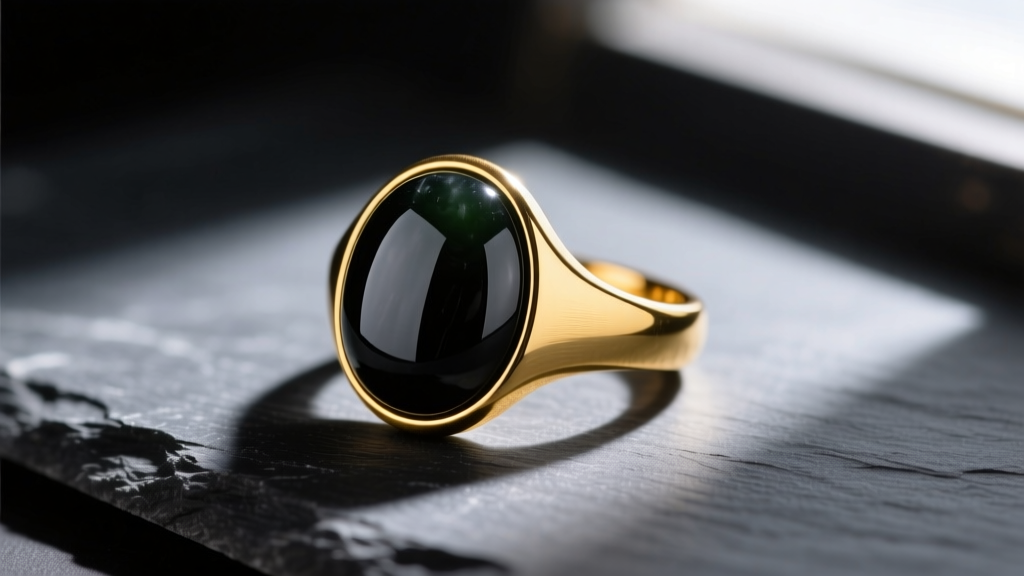
The market for dark, opaque gemstones has surged, with collectors and designers increasingly seeking out black jade jewelry for its understated elegance and rich cultural history. However, the commercial jewelry market is notoriously opaque when it comes to labeling black stones. Pieces marketed as 'black jade' are frequently misidentified black onyx, dyed chalcedony, or volcanic obsidian. Understanding the exact mineralogical properties, structural toughness, and market value of true black jade is essential for making informed purchasing decisions in 2026.
The Mineralogy of Black Jade: Nephrite vs. Jadeite
True jade is not a single mineral, but rather a term encompassing two distinct silicate minerals: nephrite and jadeite. Both can manifest in deep, opaque black hues, but their chemical compositions and visual characteristics differ significantly.
Black Nephrite
Black nephrite is a calcium magnesium-iron silicate. Its dark coloration is typically caused by microscopic inclusions of graphite or magnetite dispersed throughout its fibrous crystal matrix. According to the Mindat mineralogy database, nephrite's interlocking fibrous structure gives it unparalleled toughness, making it highly resistant to chipping. Major sources for high-quality black nephrite include Western Australia (often marketed as 'Australian Black Jade'), British Columbia, and Russia.
Black Jadeite
Black jadeite is a sodium aluminum silicate. True pitch-black jadeite is exceptionally rare; most 'black' jadeite is actually a very dark, saturated green (often omphacite-rich jadeite) that appears black to the naked eye but reveals a deep forest green edge when backlit with a strong fiber-optic pen. Guatemalan and Myanmar deposits are the primary sources. Jadeite commands a significantly higher premium due to its vitreous luster and rarity.
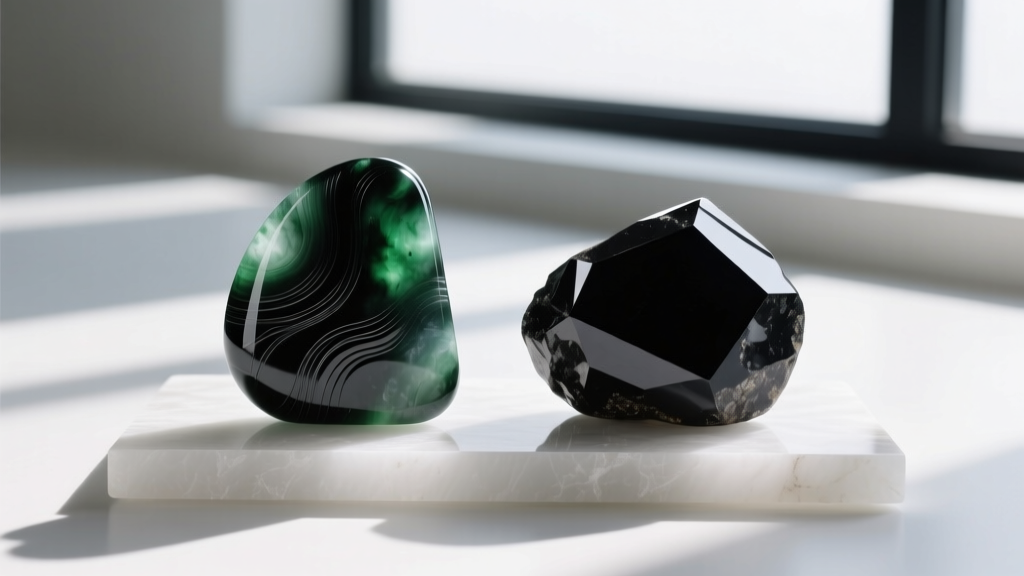
Material Comparison Matrix: Black Jade vs. Common Alternatives
To understand where black jade jewelry stands in the broader gemological landscape, we must compare its physical properties against the stones most frequently used as substitutes. The table below outlines the critical data points gemologists use for identification.
| Material | Mineral Family | Mohs Hardness | Toughness (Impact) | Specific Gravity | Refractive Index |
|---|---|---|---|---|---|
| Black Nephrite | Amphibole | 6.0 - 6.5 | Exceptional | 2.90 - 3.03 | 1.60 - 1.63 |
| Black Jadeite | Pyroxene | 6.5 - 7.0 | Very High | 3.30 - 3.38 | 1.66 - 1.68 |
| Black Onyx | Quartz (Chalcedony) | 7.0 | Moderate (Brittle) | 2.60 - 2.65 | 1.53 - 1.54 |
| Obsidian | Volcanic Glass | 5.0 - 5.5 | Low (Very Brittle) | 2.35 - 2.60 | 1.48 - 1.51 |
| Black Tourmaline | Cyclosilicate | 7.0 - 7.5 | Low (Brittle) | 3.00 - 3.25 | 1.62 - 1.64 |
Note: As highlighted by the Gemological Institute of America (GIA), nearly all commercial black onyx is actually gray chalcedony that has been artificially dyed and heated. True, naturally black onyx is incredibly rare.
Durability & Wearability: Cleavage, Fracture, and Daily Impact
When evaluating black jade jewelry for daily wear, it is crucial to distinguish between hardness (resistance to scratching) and toughness (resistance to breaking, chipping, or shattering upon impact).
While black onyx and black tourmaline possess a higher Mohs hardness (7.0+) than nephrite jade (6.0-6.5), they are far more brittle. Onyx and tourmaline exhibit distinct cleavage planes or conchoidal fracturing, meaning a sharp knock against a granite countertop can easily cleave the stone in half. Obsidian, being a natural glass, will shatter similarly to a dropped wine glass.
Black nephrite, conversely, lacks cleavage. Its internal structure consists of densely packed, interlocking microscopic fibers. This felt-like matrix absorbs kinetic energy, making nephrite one of the toughest natural gemstones on earth—surpassing even diamonds and rubies in sheer impact resistance. This makes black nephrite the superior choice for high-impact jewelry pieces like signet rings, bangles, and men's wedding bands.
Setting Recommendations for Black Jade Jewelry
Because jade is tough but relatively soft compared to quartz, it is prone to surface scratching from environmental dust (which contains quartz particles). Settings must protect the stone's polish:
- Bezel Settings: The gold standard for black jade cabochons. Use a minimum 1.5mm to 2.0mm bezel wall thickness in 14k or 18k gold to protect the girdle edge from abrasion.
- Prong Settings: Generally discouraged for jade. If required for a faceted or carved piece, use V-prongs at the corners and ensure the prong wire is at least 18-gauge (1.0mm) to prevent the metal from bending and releasing the stone.
- Drilling: For bead necklaces, ensure drill holes are chamfered (countersunk) at the edges. Sharp 90-degree drill hole edges will cause the bead to chip internally when strung on rigid wire.
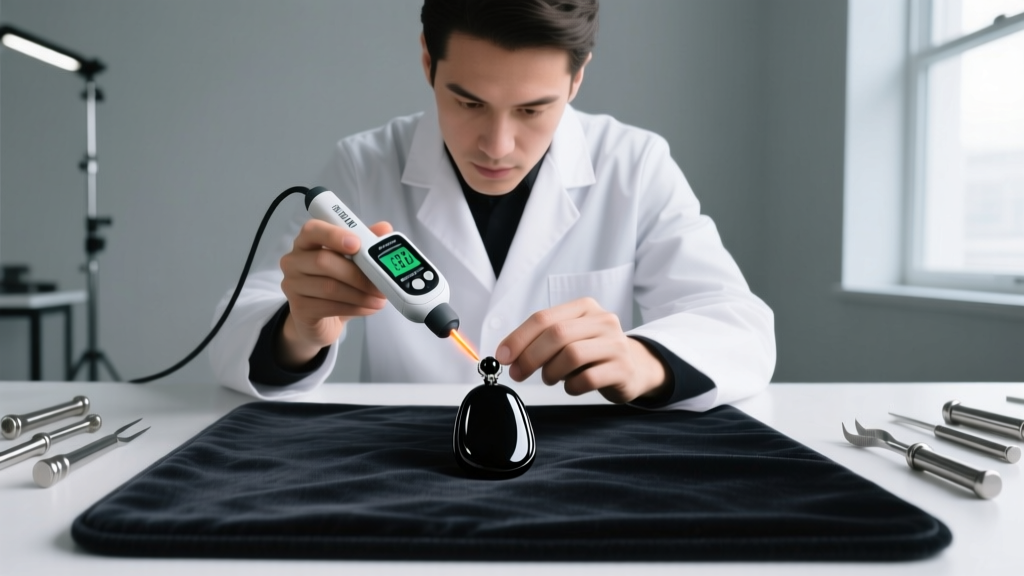
Identification & Authenticity: Spotting Fakes in the Market
With the rising popularity of dark gemstones, misrepresentation is rampant. Here is how gemologists definitively separate black jade jewelry from its imposters without relying on destructive testing.
- Specific Gravity (SG) Testing: This is the most reliable non-destructive test. Using a hydrostatic scale, black nephrite will yield an SG of ~2.95, while jadeite will sit around ~3.34. If the stone reads ~2.60, you are holding dyed onyx or agate. If it reads ~2.40, it is likely obsidian or black glass.
- Thermal Conductivity: Jade feels distinctly cold to the touch and takes longer to warm up against the skin compared to glass or plastic imitations. However, synthetic resins and certain glasses can mimic this, so thermal probes should only be used as a preliminary screening tool.
- Translucency and Fiber-Optic Testing: Shine a high-lumen fiber-optic penlight directly against the thinnest edge of the cabochon. True black jadeite will often bleed a rich, dark emerald green. Black nephrite may show a murky, opaque edge or faint brownish-green hues. Dyed black onyx will remain completely dead and opaque, or show unnatural red/purple dye concentration lines under magnification.
- Magnification: Under a 10x triplet loupe, obsidian will reveal spherical gas bubbles and flow lines. Black nephrite will show a pitted, granular surface texture if the polish is examined closely, while dyed onyx may reveal dye concentrations in microscopic surface-reaching fractures.
Pricing Realities & Market Value
The pricing of black jade jewelry varies wildly based on the mineral type, origin, and craftsmanship. In the current 2026 market, buyers should expect the following baseline ranges for standard, untreated stones:
- Black Nephrite Cabochons (Standard 15x20mm): $25 to $80. Australian black nephrite with a flawless, mirror-like polish and zero surface pitting commands the top end of this bracket.
- Black Jadeite (Dark Omphacite) Cabochons: $150 to $600+. High-clarity pieces that exhibit a strong green transmission under backlighting are highly prized by Asian markets and luxury collectors.
- Carved Black Jade (Nephrite): $100 to $500+ depending on the intricacy of the lapidary work. Because nephrite is so tough, it can be carved with incredibly fine, sharp details without chipping, making it a favorite for intricate cameos and dragon motifs.
- Black Onyx / Obsidian Alternatives: $5 to $20. These are abundant, mass-market stones. If a retailer is charging premium 'jade' prices for a stone that lacks a gemological certificate verifying nephrite or jadeite, walk away.
Gemologist's Care Note: Never clean black jade jewelry in an ultrasonic cleaner or using harsh chemical dips. The vibrations can exacerbate internal stress fractures, and chemicals can strip the natural oils or waxes often used in the final polishing stages of nephrite. Clean exclusively with warm water, a drop of mild dish soap, and a microfiber cloth.
By understanding the distinct mineralogical profile of black jade, collectors can confidently navigate the market, ensuring their investments are backed by genuine geological rarity and unmatched structural durability.


