How Do You Know If Jewelry Is Real Gold? A Stylist's Guide
Learn how do you know if jewelry is real gold with our stylist's guide to vintage hallmarks, wear patterns, and advanced testing methods.

The Archival Gold Rush: Why Authentication is the Ultimate Style Skill
In the contemporary fashion landscape, the pursuit of archival and vintage gold jewelry has shifted from a niche hobby to a mainstream style imperative. As consumers pivot away from disposable fast-fashion accessories, the secondary market for estate gold has exploded. But this surge in demand has birthed a parallel industry of highly sophisticated counterfeits. For the modern collector, curator, or trend-conscious buyer, the question is no longer just about aesthetic appeal; it is fundamentally about material integrity. So, how do you know if jewelry is real gold when the fakes can perfectly mimic the visual warmth of a vintage 18k piece?
Answering this requires moving beyond the outdated, unreliable "bite test" or simple magnet tricks. True authentication in 2026 blends an understanding of historical jewelry manufacturing, stylistic wear patterns, and modern metallurgical testing. Whether you are sourcing mid-century signet rings or heavy Italian chain links, mastering these authentication frameworks is essential to building a genuine, investment-grade collection.
Visual & Stylistic Tells: Reading the Aesthetics of Authentic Gold
Before applying any chemical or electronic tests, a trained stylist reads the jewelry itself. Authentic gold ages, wears, and stamps in ways that counterfeiters consistently fail to replicate. The first step in your authentication journey is a meticulous visual inspection using a 10x jeweler's loupe.
Hallmark Typography and Era-Specific Stamps
Hallmarks are the fingerprints of gold jewelry. However, because counterfeiters now use laser engraving to fake stamps, you must analyze the typography, depth, and historical accuracy of the mark, not just its presence. According to the London Assay Office, a true hallmark consists of multiple distinct punches indicating the maker, the purity, and the assay office. In the US market, where hallmarks are less strictly regulated by the Federal Trade Commission, you must look for specific historical anomalies.
| Stamp / Marking | Meaning & Era | Authentication Red Flags |
|---|---|---|
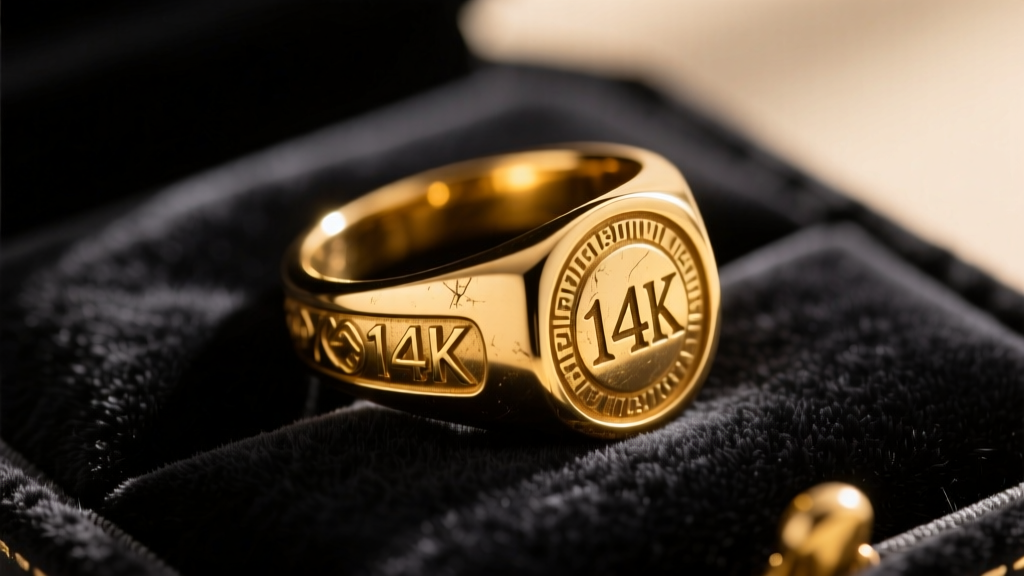
| 14KP | "Plumb" Gold (exactly 14k). Pre-1981 US standard. | If a piece looks brand new but has a 14KP stamp, it is likely a modern fake. The "P" was phased out after the 1981 US Gold Stamping Act. |
| 585 / 750 | European 14k / 18k standard. | Should be accompanied by a maker's mark or country-specific assay symbol (e.g., the French eagle head for 18k). |
| 1/20 14k GF | Gold Filled (not solid). | Often worn off on vintage pieces. If the stamp is crisp but the clasp shows heavy brass wear, the piece is heavily used gold-filled. |
| GE / HGE | Gold Electroplate / Heavy Gold Electroplate. | These are base metals. Often found on chunky 1980s-style statement rings that feel suspiciously light. |
Patina, Micro-Scratches, and Wear Patterns
Real gold is a relatively soft metal, particularly in higher karats like 18k and 22k. Over decades, authentic vintage gold develops a soft, lustrous patina—a network of microscopic, multidirectional scratches that give the metal a "warm" glow. Counterfeit gold-plated brass or steel often retains a harsh, mirror-like polish, or conversely, shows localized, aggressive flaking.
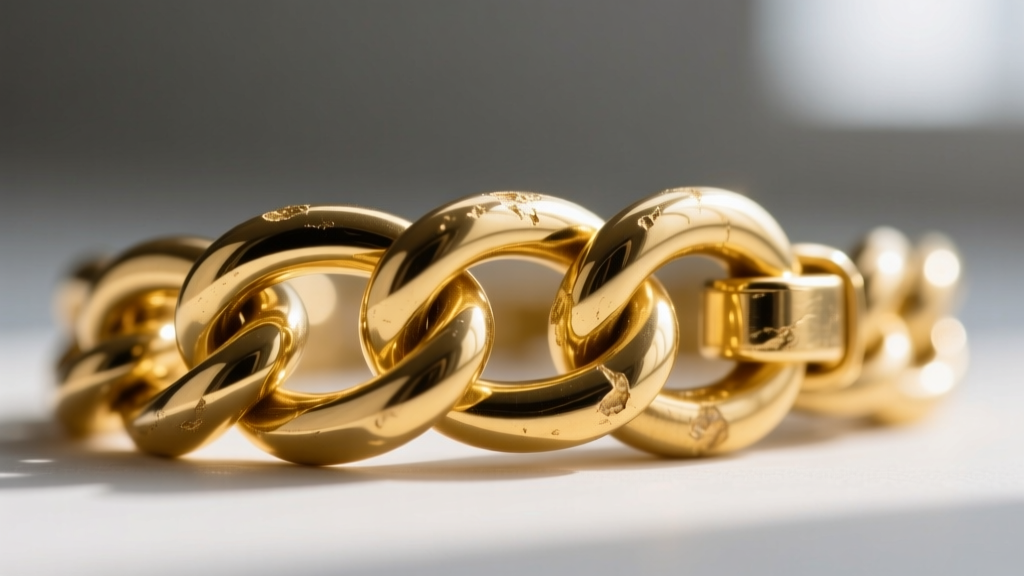
Pay close attention to high-friction areas: the inside of ring bands, the threads of screw-back earrings, and the jump rings on chain clasps. On gold-plated or gold-filled items, these areas will wear through to reveal a silvery (nickel/silver) or reddish-brown (brass/copper) base metal. Solid gold wears evenly; the color remains consistent no matter how deep the scratch.
The Physical Testing Framework: Beyond the Magnet Test
While a neodymium magnet is a useful first-line defense (gold is diamagnetic and will not stick to a magnet), it is entirely useless against paramagnetic base metals like copper, brass, and aluminum, which are frequently used in high-end fakes. To truly determine authenticity, you must rely on density and chemical reactivity.
The Ceramic Streak Test (and Its Limitations)
Dragging a piece of gold across an unglazed ceramic plate is a classic test. Real gold leaves a golden-yellow streak, while pyrite (fool's gold) or brass leaves a dark, blackish-green streak. However, as a stylist, I caution against this method for archival pieces: it is destructive. Scratching a pristine mid-century Cartier piece on ceramic will permanently mar its value. Reserve this for unbranded, heavily damaged scrap gold.
Specific Gravity and the Density Test
Gold is exceptionally dense. This physical property is the ultimate enemy of the counterfeiter. Pure 24k gold has a specific gravity (SG) of 19.32 g/cm³. By comparison, brass sits around 8.5 g/cm³, and stainless steel around 8.0 g/cm³. Even 14k gold maintains an SG of roughly 13.0 to 14.0 g/cm³.
- The Water Displacement Method: Weigh the dry piece on a precise digital scale. Then, suspend the piece in water using a fine thread and weigh it again. Divide the dry weight by the difference between the dry and wet weights. If your 18k chain yields an SG of 8.5, you are holding brass, regardless of what the hallmark says.
- The Tungsten Threat: Tungsten has an SG of 19.25, nearly identical to 24k gold. Counterfeiters use tungsten cores plated in thick 24k gold for heavy chains and bars. Density tests alone cannot catch tungsten-core jewelry, which is why acoustic testing and XRF are required for heavy investment pieces.

Trend Alert: The "Super Fake" Market and Italian Chains
In the current vintage market, heavy Italian gold chains—specifically Miami Cuban links, Figaros, and rope chains—are the most counterfeited items. The "super fakes" of 2026 are manufactured using advanced electroforming, creating hollow but incredibly thick gold-plated shells over resin or base-metal cores.
How do you spot an electroformed fake? Weight-to-volume ratio. A genuine solid 14k gold 10mm Cuban link chain weighing 100 grams will have a specific, dense heft. An electroformed fake of the exact same dimensions might weigh only 45 grams. Always carry a portable digital pocket scale when sourcing at estate sales or vintage pop-ups. If the chain feels "floaty" or unnaturally light for its massive visual footprint, walk away.
Acid Testing vs. XRF: When to Call the Professionals
For decades, the nitric acid scratch test has been the industry standard. By scratching the gold on a testing stone and applying drops of 14k, 18k, and 22k acid solutions, you can observe the chemical reaction.
- 14k Acid: Dissolves anything below 14k. If the streak disappears, it's plated or brass.
- 18k Acid: Will turn a 14k streak milky or brown, but an 18k streak will remain bright and clear.
However, acid testing only reads the surface of the metal. It will easily be fooled by a thick layer of 18k gold plated over a tungsten or brass core. According to the Gemological Institute of America (GIA), non-destructive elemental analysis is the only foolproof method for high-value items.
The XRF Scanner Advantage
X-Ray Fluorescence (XRF) scanners shoot X-rays into the metal and measure the fluorescent energy that bounces back, providing an exact elemental breakdown (e.g., 75.1% Gold, 15% Silver, 9.9% Copper). Most reputable local jewelers or pawn shops will perform an XRF scan for $20 to $50. If you are investing thousands in an archival gold piece, this small fee is non-negotiable. It protects your capital and ensures your vintage collection is built on a foundation of genuine, enduring luxury.


